Pengene tilbage-garanti · 100 dage Gratis levering i hele verden
449.587kunstværker 30.613kunstnere 4.660museer 32sprog
Valuta
    Sprog
      Atelier · Est. 2015 · Paris, Frankrig
      AllPaintingsStore
      allpaintingsstore.com
      Catalogue entry

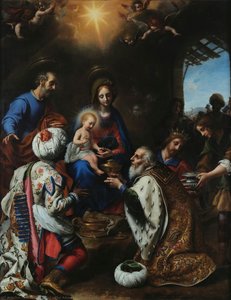
      Circumcision

      1580. Olie, 95.0 x 73.0 cm. Hermitage Museum.

      Fig. 1. Luis De Carbajal, Circumcision, 1580. Shown as the reproduction you are specifying: , .

      § 1Catalogue data

      § 2Abstract

      Beskrivelse af samlerobjektet

      Luis de Carbajal maler fra Toledo - Et imponerende religiøst værk præget af El Greco's stil og den spanske Renæssance. Besøg Prado museet!

      Kunstnerbiografi

      Explore the masterful works of Luis de Carbajal, a Spanish painter renowned for religious scenes & cathedral art. Discover his legacy in Toledo & beyond!

      § 3Commentary

      Luis de Carbajal: En Toledo’s Spirit – A Masterpiece of Gothic Revival

      Luis de Carbajal (c. 1531 – after 1618) represents one af the most prolific and influential painters of the Spanish Renaissance, particularly renowned for his monumental cathedral altarpieces that embody the grandeur and spiritual fervor of the era. While overshadowed by contemporaries like El Greco—with whom he shared a formative artistic connection—Carvajal’s distinctive style cemented his place in art history as a pivotal figure in Toledo’s artistic revival and a masterful interpreter of Gothic sensibilities adapted to the burgeoning humanist spirit. His output spanned decades, leaving behind an impressive legacy that continues to inspire admiration for its meticulous detail and emotive power – a testament to his unwavering dedication to capturing the sublime. ### The Crucible of Influence: Early Training & El Greco's Legacy Carvajal’s artistic journey began in Toledo, where he absorbed the profound influence of Juan Bautista Monegro, his father—a sculptor equally committed to religious expression—and crucially, under the tutelage of Juan de Villoldo. This formative environment instilled in him a deep appreciation for classical proportions and compositional balance alongside an instinctive understanding of how to convey spiritual depth through carefully crafted imagery. But it was El Greco’s arrival in Toledo that truly ignited Carbajal's artistic imagination. The celebrated Mannerist painter established himself as a teacher, introducing Carbajal to the dramatic use of chiaroscuro—the interplay of light and shadow—a technique central to El Greco’s expressive style. This mentorship profoundly shaped Carbajal’s approach to painting, fostering a fascination for theatrical lighting and encouraging him to prioritize emotional impact over mere visual accuracy. ### Cathedral Altarpieces: Monumental Expressions of Faith – A Synthesis of Tradition & Innovation Carvajal's fame rests primarily on his monumental cathedral altarpieces—a genre that flourished during the Habsburg reign and served as a powerful vehicle for disseminating theological narratives. He undertook several ambitious commissions, most notably seven canvases depicting saints for the Escorial Cathedral, commissioned by Philip II to commemorate the Holy Spirit. These works exemplify Carbajal’s mastery of technique: he employed oil paint on canvas with painstaking precision, layering translucent glazes to achieve luminous effects and capturing subtle nuances of expression in his figures. The composition—characterized by pyramidal structures and dramatic diagonals—mirrors the architectural grandeur of the cathedral itself, reinforcing its symbolic significance as a locus of divine presence. Each saint is portrayed with palpable emotion, conveying not merely doctrinal correctness but also spiritual contemplation – reflecting the humanist values championed by thinkers like Erasmus and Pico della Mirandola. Carbajal skillfully blended Gothic stylistic elements—such as elongated figures and stylized drapery—with Renaissance principles of perspective and anatomical accuracy, creating a visual language that resonated deeply with audiences of his time. ### Symbolism & Emotion: Capturing the Divine Essence Beyond mere technical prowess, Carbajal’s paintings are imbued with profound symbolic meaning. He deliberately chose subjects that conveyed moral virtues – compassion, humility, courage – mirroring the ethical ideals prevalent in humanist circles. The saints depicted aren't simply representations of biblical figures; they embody spiritual aspirations and serve as reminders of God’s grace. Carbajal’s meticulous attention to detail—from the folds of robes to the expressions on faces—demonstrates a remarkable understanding of human psychology, elevating his canvases beyond mere decorative art into emotionally resonant experiences. The artist's aim was not merely to depict saints but to inspire viewers with contemplation and reverence – capturing the essence of faith itself. ### Legacy & Rediscovery: Toledo’s Artistic Soul Preserved Today, Carbajal’s masterpieces reside primarily in the Museo del Prado in Madrid, where they continue to captivate audiences with their breathtaking beauty and spiritual depth. Recent scholarship has illuminated the significance of his work within the broader context of Toledo’s artistic revival—a period marked by a renewed interest in classical ideals alongside an enduring devotion to Christian faith. His paintings stand as testament to Carbajal's skill, creativity, and unwavering commitment to conveying the sublime – securing his place among Spain’s greatest artists and ensuring that his legacy endures for centuries to come.

      Spørgsmål og svar

      Hvordan passer "Circumcision" ind i Luis De Carbajals temaer og stil?

      "Circumcision" deler med Luis De Carbajals øvrige værker sin Baroque Revival-stil og de gennemgående temaer: religious symbolism, gothic revival, patron saint imagery, cathedral decoration, baroque tradition.

      Hvilken stemning formidler Baroque Revival-værket "Circumcision"?

      Den Melankolsk stemning i "Circumcision" ledsager dens Baroque Revival stil.

      Hvordan finder jeg kunstværker, der minder om "Circumcision" af Luis De Carbajal?

      Se lignende værker til "Circumcision" på siden Lignende værker.

      § 4The artist

      Luis De Carbajal

      Luis De Carbajal

      1531 - 1618, Spain

      Quick facts about Luis De Carbajal

      • Full Name: Luis de Carbajal y de la Cueva
      • Nationality: Spanish
      • Date Of Birth: 1531
      • Date Of Death: 1618
      • Place Of Birth: Toledo, Spain
      • Notable Artworks: ['Circumcision']
      • Artistic Movement Or Style: Religious Painting; Gothic Art Style
      • Artists Who Influenced This Artist: ['Alonso Berruguete']
      • Artists Or Movements Influenced By This Artist: ['El Greco']

      Kunstnerbiografi

      The Radiant Legacy of Luis de Carbajal

      In the heart of Toledo, a city where the echoes of medieval devotion meet the burgeoning light of the Renaissance, the life of Luis de Carbajal unfolded as a profound testament to spiritual and artistic endurance. Born around 1531, Carbajal emerged from the vibrant, intellectually charged atmosphere of Spain’s most storied religious center. While history often casts a long shadow through the ethereal mysticism of El Greco, Carbajal stands as a monumental figure in his own right—a master who bridged the gap between the soaring, structural grandeur of the Gothic tradition and the nuanced, humanistic spirit of the Spanish Renaissance. His journey was one of deep connection to the sacred, moving through the halls of cathedrals and royal monasteries, leaving behind a visual legacy that captured the very soul of an era defined by faith.

      The foundations of Carbajal’s artistry were laid within the prestigious workshops of Toledo, under the guidance of masters like Juan de Villoldo. This early training provided him with a rigorous understanding of classical proportions and compositional balance, yet it was his encounter with the transformative energy of El Greco that truly ignited his creative vision. From this connection, Carbajal embraced the dramatic power of chiaroscuro, learning to manipulate light and shadow to evoke deep emotional resonance. Unlike the more otherworldly, elongated figures of his contemporary, Carbajal’s work maintained a grounded, architectural dignity. He drew inspiration from the very bones of Toledo—its ribbed arches, vaulted ceilings, and stained glass—incorporating these Gothic elements into his canvases to create spaces that felt both physically immense and spiritually intimate.

      A Master of the Altarpiece and Royal Commission

      Carbajal’s career was marked by an extraordinary level of productivity, with estimates suggesting he produced over 300 works during his long life. His talent earned him the prestigious distinction of being named a painter for King Philip II of Spain, a role that placed him at the epicenter of the Spanish Golden Age. His brush traveled through the most sacred corridors of the empire, from the intimate oratories of the Pardo Palace to the imposing halls of the monastery in El Escorial. One of his most significant achievements was the creation of seven large-scale canvases for the church of the Escorial in 1570, where he masterfully paired saints such as Cosme and Damián, and Cecilia and Barbara, weaving complex theological narratives into single, cohesive compositions.

      His ability to command large-scale religious subjects allowed him to become a primary architect of visual devotion. His works were not merely decorations but were essential tools for the dissemination of Catholic doctrine during a period of intense religious fervor. Through his meticulous attention to detail and his ability to render the divine within a tangible, earthly framework, he achieved several notable milestones:

      • Monumental Altarpieces: He specialized in massive cathedral commissions that served as the focal points for liturgical worship, embodying the grandeur of the Habsburg reign.
      • Narrative Depth: His paintings, such as the Circumcision, utilized dramatic lighting to guide the viewer's eye through complex biblical stories.
      • Ecclesiastical Influence: By decorating the Archbishop's chapel in Toledo and various convent cloisters, he shaped the visual identity of the Spanish Church.

      Historical Significance and Enduring Spirit

      The historical importance of Luis de Carbajal lies in his role as a stabilizer of tradition during a time of radical artistic change. While the art world moved toward the more distorted and emotive Mannerism, Carbajal provided a sense of continuity, anchoring the new humanist ideas within the familiar, comforting language of Gothic architecture and classical balance. He was a painter who understood that to move the heart, one must first respect the structure of the faith. His work remains a vital link in the evolution of Spanish art, representing a moment when the medieval past and the Renaissance future existed in perfect, painted harmony.

      Today, the traces of his genius can still be found in the great repositories of Spanish heritage, including the Museo del Prado in Madrid. To study Carbajal is to witness the pulse of Toledo itself—a master who took the stone and light of his homeland and transformed them into an eternal dialogue between the human and the divine. His life, stretching well into the 17th century, serves as a bridge across eras, ensuring that the spiritual gravity of the Spanish Renaissance would never be forgotten.

      § 5Comparanda

      § 6Questions

      Hurtige fakta

      • Influences: El Greco
      • Location: Museo del Prado
      • Year: 1580
      • Title: Circumcision
      • Movement: Mannerism
      • Subject or theme: Religiøs ceremonie

      Kunstquiz

      Der er kun ét korrekt svar på hvert spørgsmål.

      Spørgsmål 1:
      Hvad er titel på dette maleri?
      Spørgsmål 2:
      I hvilken by blev Luis de Carbajal født?
      Spørgsmål 3:
      Omkring hvornår blev dette maleri skabt?
      Spørgsmål 4:
      Hvilken kunststil dominerer primært denne kunstværk?
      Spørgsmål 5:
      Hvor kan du finde en reproduktion af dette maleri?

      § 7Cite this entry

      AllPaintingsStore.com, “Luis De Carbajal, Circumcision (1580)”, https://allpaintingsstore.com/da/art/luis-de-carbajal-circumcision-8Y35H8-da/ArtistReproduction/ (accessed 2 oktober 2026).

      § 8The reproduction

      Håndlavet oliereproduktion

      Håndmalet olie på lærred i din valgte størrelse og ramme, udført efter bestilling af vores kunstnere. ( Skift til printsalg Skift til digitalt billede)

      It is specified on the order sheet in the margin; the present state of that sheet reads as follows.

      Circumcision

      Reproduktionsmetode

      Størrelse på reproduktion

      -

      Eksklusivt udvalgte senior-kunstnere

      Mere detaljerigdom, finesse og ekstra produktionstid

      -

      Indramning af reproduktion

      -

      -

      For kunstværker eller reproduktioner, der er større end 105 cm (ca. 41 tommer) på en hvilken som helst side, vil rammen blive leveret som et adskilt sæt. Denne metode sikrer sikker levering og forhindrer skader under transport.

      Professionel montering er påkrævet – dette er ikke et gør-det-selv produkt.
      Sættet skal samles, og lærredet skal opspændes af en erfaren professionel indrammer ved brug af trælim (ikke medfølger), en lærredsspænder og klemmer til at holde blindrammen vinkelret, mens limen tørrer. Forkert samling eller ujævn spænding af lærredet kan beskadige kunstværket permanent og er ikke dækket af vores garanti.

      • Alle massive trælister er inkluderet, præcist tilpasset i størrelsen.

      • Samles med de medfølgende skruer samt trælim til hjørneforbindelserne, som ikke medfølger og skal anskaffes af din indrammer.

      • Professionelt værktøj er påkrævet og medfølger ikke: en lærredsstrækker (spændetang) og klemmer til at holde blindrammen vinkelret, mens limen tørrer.

      Vigtigt:
      Hjørneforbindelserne kræver trælim, listerne skal holdes fast med skruetvinger, indtil limen er helt tør, og opspænding af lærredet på den samlede ramme kræver en lærredsspænder. Ingen af disse dele er inkluderet i sættet. Vi anbefaler, at du kontakter en erfaren professionel indrammer, før du bestiller denne størrelse.

      Navneskilt

      -

      -

      Beskyttende fernis

      Blank lak (fremhæver farverne og beskytter mod lys og fugt)

      -

      Tilpas mit kunstværk

      Eksempler på tilpasningsmuligheder: Udskift ansigt med kunde-foto; Tilføj kæledyr (f.eks. udskift kat med hund); Inkluder skjult besked i baggrunden; Ændr baggrundslandskab eller elementer.

      -

      Hurtig levering

      Verdensomspændende levering () på 3-4 uger i stedet for de standard 5 uger. (30 oktober). Ingen kompromiser med kvaliteten.

      -

      Ekspreslevering

      Verdensomspændende levering til inden for 5 uger. (6 november).

      Inkluderet

      Samlet pris

      Dkr 1709

      Included with every order

      • Gratis ekspresforsendelse til hele verden
      • Lærred af linned i høj kvalitet
      • Fuld transportforsikring
      • Garanti for refusion af told og importafgifter
      • Garanti for præcis farvegengivelse
      • 100 dages returret ved fabrikationsfejl
      • 100% fuld returret
      • Mængderabat ved flere køb
      Udforsk kunstværker organiseret efter temaer, stilarter og karakteristika.
      Order sheet