


 Se i rummet
 Del som kort
 Del
Del
 Detaljer
 Guide
Guide

 Download
 Lignende værker
 Røntgenundersøgelse
 Diasshow
 Q&A
Q&A Statistikker
Abraham and Sarah
 Acrylic
- WallArt
- Fantastic Surrealism
 1956
1956 37.0 x 27.0 cm
 Vis mere
Kunstværket vist på denne side er beskyttet af ophavsretsloven, hvilket betyder, at vi ikke lovligt kan skabe eller sælge en identisk reproduktion. Denne beskyttelse håndhæves i henhold til internationale aftaler som f.eks. den Bernerkonventionen og af nationale love, herunder de bestemmelser, der er fastlagt i Amerikansk ophavsretslov - Titel 17.
Denne metode overholder fuldt ud ophavsretsreglerne, da den ikke indebærer kopiering eller duplikering af det beskyttede kunstværk. I stedet er der tale om en kreativ nytolkning – et nyt maleri, som er inspireret af det oprindelige, men ikke identisk med det.
Giclée / Kunsttryk
Giclée- eller lærredstryk i museumskvalitet med hurtig produktion og fleksible muligheder for finish. ( Køb håndmalet maleri Skift til digitalt billede)




P118B Dkr10

P118H Dkr10

P118W Dkr10

P438Z Dkr10

P508JH Dkr12

P508YH Dkr12

P805H Dkr10

P805Z Dkr10

P919BZ Dkr10

P919G Dkr10

P919XJ Dkr10

P959ZH Dkr10

P968JZ Dkr12

W106C Dkr8

W218G Dkr10

W218JH Dkr8

W218Y Dkr10

W307PJ Dkr10

W316G Dkr10

W316PJ Dkr8

W316Y Dkr10

W398PJ Dkr8

W4111J Dkr10

W500HY Dkr15

W500JH Dkr15

W692G Dkr12

W849H Dkr8

W940BG Dkr15

W953PJ Dkr8




Vælg mellem vores forudindstillede størrelser, der matcher kunstværkets originale proportioner.

Indtast den bredde og højde, du har brug for, så det passer til din ramme eller din væg. Et print kan kun beskæres, aldrig gøres større end selve billedet, så en størrelse med et andet format vil medføre, at dele af motivet går tabt. Vi sender dig en digital mockup til godkendelse, før vi printer noget. Billedet vist på denne side viser ikke den faktiske beskæring — det er kun mockuppen, der gør.
Verdensomspændende levering () på 2 uger i stedet for de sædvanlige 4/5 uger. (30 oktober)

Gratis ekspresforsendelse til hele verden

Lærred af linned i høj kvalitet

Fuld transportforsikring

Garanti for refusion af told og importafgifter

Garanti for præcis farvegengivelse

100 dages returret ved fabrikationsfejl

100% fuld returret

Mængderabat ved flere køb
 Glasmulighed er kun tilgængelig i størrelser under 110 cm

Abraham and Sarah
Giclée / Kunsttryk
Størrelse på reproduktion
-


Samlet pris
Dkr 431
A Window Into Memory: Exploring Marc Chagall’s “Abraham and Sarah”
The painting "Abraham and Sarah" by Marc Chagall, completed in 1956, isn't simply a depiction of biblical figures; it’s an embodiment of Chagall’s distinctive artistic language—a language born from dreams, folklore, and the profound influence of his Vitebsk upbringing. Measuring 37 x 27 cm, this artwork transcends mere representation, inviting viewers into a realm where reality blends seamlessly with fantasy.- Subject Matter: Chagall’s interpretation of Abraham and Sarah—the patriarch and matriarch of Judaism—is central to the composition. However, he abandons traditional iconography, presenting them not as solemn figures in prayer but as individuals engaged in a quiet intimacy, gazing intently at each other.
- Style: Chagall’s style is instantly recognizable for its lyrical abstraction and vibrant color palette. He employs flattened perspectives and stylized forms reminiscent of Russian folk art, creating an atmosphere that feels both timeless and deeply rooted in personal experience.
Historical Context: Vitebsk and Jewish Identity
Chagall's artistic journey began in Vitebsk, Belarus, where he experienced firsthand the complexities of Jewish life under Soviet rule. The town’s cultural landscape—marked by Orthodox churches alongside Jewish marketplaces—served as a constant source of inspiration for his work. Chagall’s early paintings reflected this duality, exploring themes of faith, tradition, and exile with sensitivity and imagination. The painting "Abraham and Sarah" speaks to this broader context, embodying the enduring spirit of Jewish heritage amidst shifting political realities.Symbolism: Flight and Fertility
Beyond its biblical narrative, “Abraham and Sarah” is laden with symbolic imagery. The figures are depicted in flight—a motif recurrent throughout Chagall’s oeuvre—representing aspiration, liberation, and the yearning for transcendence. This upward movement contrasts sharply with the grounded presence of the clock on the wall, symbolizing time's relentless passage and perhaps hinting at the fragility of earthly existence. Furthermore, the depiction of Sarah—often interpreted as representing fertility—suggests a celebration of life’s renewal and continuity.Emotional Impact: A Portrait of Inner Harmony
Ultimately, “Abraham and Sarah” succeeds in conveying a profound sense of emotional resonance. Chagall captures not just the visual likeness of his subjects but also their inner state—a quiet communion characterized by tenderness and understanding. The painting’s luminous colors and expressive brushstrokes evoke feelings of serenity and contemplation, inviting viewers to contemplate themes of love, faith, and remembrance. It's a testament to Chagall’s ability to transform biblical stories into deeply personal meditations on the human condition.Spørgsmål og svar
Er farverne i "Abraham and Sarah" af Marc Chagall mættede eller dæmpede?
Farverne i "Abraham and Sarah" af Marc Chagall har en Muted mætning. Mætning beskriver, hvor livlige eller dæmpede farverne er.
Er billedet af "Abraham and Sarah" af Marc Chagall frit tilgængeligt i det offentlige domæne?
"Abraham and Sarah" af Marc Chagall er stadig beskyttet af ophavsret. Denne status bestemmer, hvordan billedet af værket må reproduceres.
I hvilket år blev "Abraham and Sarah" af Marc Chagall skabt?
"Abraham and Sarah" af Marc Chagall er dateret til 1956.
Lignende kunstværker


Kunstnerbiografi
A Life Painted in Dreams: The World of Marc Chagall
Marc Chagall, born Moishe Shagal in 1887 in the small Belarussian town of Liozna near Vitebsk, wasn’t merely a painter; he was a poet of color, a weaver of dreams, and a chronicler of memory. His life, spanning nearly a century, mirrored the tumultuous currents of the 20th century, yet his art remained steadfastly rooted in a deeply personal vision—one infused with the folklore of his Hasidic Jewish upbringing and an unwavering belief in the power of imagination. Vitebsk itself was more than just a birthplace; it became the emotional core of his artistic universe, a recurring motif populated by flying figures, whimsical animals, and the vibrant hues of remembered landscapes. The town’s unique blend of cultures—Russian Orthodox churches alongside bustling Jewish marketplaces—forged an aesthetic sensibility that would defy easy categorization throughout his long career. Though he sought formal training first with a local sign painter and later in St. Petersburg under Léon Bakst, and then in Paris at the Académie de la Grande Chaumière, Chagall never fully embraced any single artistic movement. He absorbed elements of Cubism, Symbolism, and Fauvism, but always filtered them through his own intensely personal lens, creating a style that was uniquely, unmistakably Chagall.Early Years and Artistic Beginnings
Chagall’s formative years were marked by hardship and displacement. Born into a family of impoverished Jewish artisans, he experienced the trauma of pogroms—violent attacks against Jews—which instilled in him a profound awareness of persecution and loss. Despite these challenges, Chagall pursued his artistic ambitions with unwavering determination. He initially studied sign painting in Vitebsk, honing his technical skills while simultaneously nurturing his imaginative spirit. His early works already hinted at the distinctive language he would develop – paintings like I and the Village (1911) are not simply depictions of place; they are explorations of identity, memory, and the relationship between the individual and community. The village isn’t rendered realistically but as a fragmented collection of recollections, imbued with symbolic meaning. This ability to transmute personal experience into universal themes became a hallmark of his art. His palette was bold and expressive, often employing vibrant, non-naturalistic colors to convey emotion rather than literal representation. Figures float and dance across the canvas, defying gravity and logic, creating a dreamlike atmosphere that invites viewers into his inner world. This stylistic approach wasn’t accidental; it stemmed from a desire to move beyond mere imitation of reality and capture the essence of feeling, the weight of memory, and the power of folklore.The Symbolist Influence and Vitebsk's Landscape
Chagall’s artistic development was significantly shaped by the Symbolist movement, which championed emotion and imagination over objective representation. Artists like Gustave Moreau and Edvard Munch profoundly influenced his visual vocabulary, encouraging him to prioritize expressive color and evocative imagery. Vitebsk itself became an enduring source of inspiration for Chagall—a recurring motif populated by flying figures, whimsical animals, and the vibrant hues of remembered landscapes. The town’s unique blend of cultures—Russian Orthodox churches alongside bustling Jewish marketplaces—forged an aesthetic sensibility that would defy easy categorization throughout his long career. He captured these scenes with a lyrical sensitivity, conveying not just what he saw but also what he felt – the nostalgia for his childhood home and the complexities of cultural identity.The Revolution and Artistic Transformation
The Russian Revolution of 1917 irrevocably altered Chagall’s life trajectory. Returning to Vitebsk after years abroad, he became involved in cultural initiatives, establishing an art school that briefly flourished before succumbing to the restrictions imposed by the new regime. This period was marked by both creative energy and political disillusionment – a tension that would continue to shape his artistic trajectory. He experimented with Surrealist techniques, incorporating dreamlike imagery and illogical juxtapositions into his paintings. Works like Over Vitebsk (1920-1922) demonstrate his continued engagement with his childhood memories, while simultaneously reflecting the anxieties of a rapidly changing world.International Recognition and Legacy
Chagall’s artistic reputation soared internationally in the 1930s and 40s. He gained acclaim for his monumental stained glass windows commissioned for the Jerusalem synagogue, which embody his profound spiritual convictions and masterful craftsmanship. His paintings—such as White Crucifixion (1938)—became powerful statements about suffering and resilience during World War II. Following the war, Chagall settled in New York City, where he continued to produce innovative works that explored themes of exile and displacement. He received numerous prestigious commissions, including the ceiling of the Paris Opera (1964), a breathtaking explosion of color and form that celebrated musical masterpieces. Marc Chagall’s legacy extends beyond his paintings; it resides in the enduring power of his vision—a vision that celebrates love, memory, and the boundless possibilities of the human imagination. He left behind a body of work that is both deeply personal and universally accessible, inviting viewers to lose themselves in a world painted with dreams and illuminated by hope. His art continues to inspire, challenge, and move us, ensuring that his vibrant and imaginative spirit will live on for generations to come.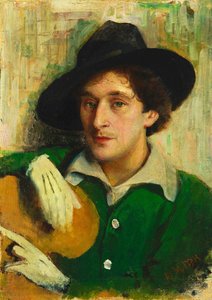
Marc Chagall
1887 - 1985 , Hviderusland
Kort om kunstneren
- Artistic Movement Or Style: Modernisme, Kubisme
- Artists Or Movements Influenced By This Artist:
- Surrealisme
- Moderne kunst
- Artists Who Influenced This Artist:
- Bakst
- Delaunay
- Borovikovsky
- Date Of Birth: 7. juli 1887
- Date Of Death: 28. marts 1985
- Full Name: Marc Chagall
- Nationality: Russisk-Fransk
- Notable Artworks:
- I og byen
- Over Vitebsk
- Hvid korsfæstelse
- Place Of Birth: Liozna, Belarus
Relaterede artikler

Acrylic Paint Guide: Leveraging Fast-Drying Versatility for Professional Art Reproductions and Large-Scale Hospitality Projects
Master the use of acrylic paint for professional art reproductions. Discover how fast-drying versatility, impasto textures, and large-scale scalability provide efficient, durable, and high-quality solutions for hotel designers and large-scale hospitality procurement projects.


