

Wedding
1918. Oil On Canvas, 100.0 x 119.0 cm.

§ 1Catalogue data
 Oil On Canvas
- WallArt
- Symbolic Expressionism
 1918
1918- Modern
 100.0 x 119.0 cm
Dette kunstværk er ophavsretsbeskyttet
Kunstværket vist på denne side er beskyttet af ophavsretsloven, hvilket betyder, at vi ikke lovligt kan skabe eller sælge en identisk reproduktion. Denne beskyttelse håndhæves i henhold til internationale aftaler som f.eks. den Bernerkonventionen og af nationale love, herunder de bestemmelser, der er fastlagt i Amerikansk ophavsretslov - Titel 17.
Som et respektfuldt og lovligt alternativ tilbyder vi skræddersyede, håndmalede kunstværker inspireret af originalen. Vores dygtige og professionelle kunstnere studerer omhyggeligt originalens stil, stemning og kunstneriske essens for at skabe et nyt, unikt værk, der fremkalder den samme følelse – samtidig med at det forbliver en original skabelse i egen ret.
Denne metode overholder fuldt ud ophavsretsreglerne, da den ikke indebærer kopiering eller duplikering af det beskyttede kunstværk. I stedet er der tale om en kreativ nytolkning – et nyt maleri, som er inspireret af det oprindelige, men ikke identisk med det.
 Læs mere
§ 2Abstract
Beskrivelse af samlerobjektet
Marc Chagall’s ethereal Wedding captures a poignant moment of familial love amidst angelic figures and symbolic elements—a dreamlike depiction from 1918 reflecting Vitebsk's cultural heritage, inviting you to explore this timeless masterpiece.
Kunstnerbiografi
Udforsk Marc Chagall (1887-1985)'s fantastiske verden af drømmebilleder og jiddisk folklore! Oplev hans ikoniske værker og den unikke kunstners præstation inden for moderne kunst.
§ 3Commentary
A Symphony of Memory and Dream: Exploring Marc Chagall’s “Wedding”
In the quiet, monochrome depths of Marc Chagall’s 1918 masterpiece, “Wedding,” we find ourselves transported into a realm where the boundaries between reality and folklore dissolve. This is not merely a depiction of a matrimonial union; it is a profound exploration of emotion and symbolism, serving as a testament to the artist's enduring fascination with his Jewish heritage and the ethereal landscapes of his youth. Measuring 10 and 119 cm, the painting immediately draws the viewer into a scene brimming with fantastical figures set against a backdrop that whispers of Chagall’s beloved Vitebsk. Through a delicate interplay of light and shadow, the work captures a sense of timelessness, inviting us to witness a moment that feels simultaneously like a cherished personal memory and a universal myth.
The visual narrative is masterfully constructed through a style that blends elements of realism with the burgeoning surrealism of the early 20th century. Chagall employs a distinctive technique characterized by flattened perspectives and distorted proportions, prioritizing expressive gesture over meticulous anatomical detail. At the heart of the composition, a man embraces his wife while gazing tenderly upon their child, creating an intimate nucleus of affection amidst a swirling expanse of sky and earth. This central trio is flanked by celestial observers—angels that drift into the frame, lending a divine benediction to the earthly union. The artist’s skillful use of hatching and cross-hatching builds tonal variations that provide texture and depth, proving that even in the absence of his signature vibrant palette, Chagall can command an immense emotional range through grayscale alone.
Symbolism and the Anchors of Time
Beyond the central figures, the painting is peppered with recurring motifs that serve as anchors to memory and tradition. A violin rests near the top right corner, a poignant symbol of the music and soul of Jewish life, while a clock hangs suspended, reminding us of the inexorable passage of time and the fleeting nature of joy. These elements are not merely decorative; they are the threads that weave Chagall’s personal recollections into the broader tapestry of cultural identity. For collectors and enthusiasts, these symbols offer a rich layer of contemplation, making the piece an intellectually stimulating addition to any curated collection. The way these objects float within the composition mirrors the weightlessness of a dream, encouraging the viewer to abandon the constraints of gravity and enter a world where the soul takes flight.
For interior designers and lovers of fine art, "Wedding" offers a unique opportunity to introduce a sense of narrative depth and historical gravity into a space. The monochrome palette provides a sophisticated, understated elegance that complements both modern minimalist settings and more traditional, classical interiors. It acts as a window into the tumultuous era of 1918—a period of significant upheaval in Europe following World War I. By bringing a high-quality reproduction of this work into a home or gallery, one does not just display a painting; one invites the spirit of Vitebsk and the poetic resilience of Chagall’s vision to reside within the walls, creating an atmosphere of profound peace, love, and enduring togetherness.
Spørgsmål og svar
Hvad forestiller "Wedding" af Marc Chagall, og hvilken stemning formidler det?
"Wedding" viser marriage, family, angel, love, faith, dreams, biblical, og den indfangede stemning er Mystical.
Hvilke proportioner har "Wedding" af Marc Chagall, og hvor stor er den?
"Wedding" af Marc Chagall har proportionerne af et Landscape værk på 100 x 119 cm.
Hvilken kunstner tilskrives "Wedding"?
Kunstneren bag "Wedding" er Marc Chagall. Værket er katalogiseret under Marc Chagalls navn.
§ 4The artist
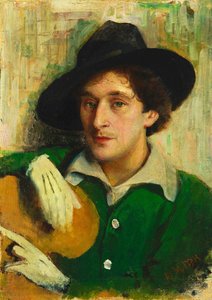
Marc Chagall
1887 - 1985, Hviderusland
Kort om kunstneren
- Artistic Movement Or Style: Modernisme, Kubisme
- Artists Or Movements Influenced By This Artist:
- Surrealisme
- Moderne kunst
- Artists Who Influenced This Artist:
- Bakst
- Delaunay
- Borovikovsky
- Date Of Birth: 7. juli 1887
- Date Of Death: 28. marts 1985
- Full Name: Marc Chagall
- Nationality: Russisk-Fransk
- Notable Artworks:
- I og byen
- Over Vitebsk
- Hvid korsfæstelse
- Place Of Birth: Liozna, Belarus
Kunstnerbiografi
A Life Painted in Dreams: The World of Marc Chagall
Marc Chagall, born Moishe Shagal in 1887 in the small Belarussian town of Liozna near Vitebsk, wasn’t merely a painter; he was a poet of color, a weaver of dreams, and a chronicler of memory. His life, spanning nearly a century, mirrored the tumultuous currents of the 20th century, yet his art remained steadfastly rooted in a deeply personal vision—one infused with the folklore of his Hasidic Jewish upbringing and an unwavering belief in the power of imagination. Vitebsk itself was more than just a birthplace; it became the emotional core of his artistic universe, a recurring motif populated by flying figures, whimsical animals, and the vibrant hues of remembered landscapes. The town’s unique blend of cultures—Russian Orthodox churches alongside bustling Jewish marketplaces—forged an aesthetic sensibility that would defy easy categorization throughout his long career. Though he sought formal training first with a local sign painter and later in St. Petersburg under Léon Bakst, and then in Paris at the Académie de la Grande Chaumière, Chagall never fully embraced any single artistic movement. He absorbed elements of Cubism, Symbolism, and Fauvism, but always filtered them through his own intensely personal lens, creating a style that was uniquely, unmistakably Chagall.Early Years and Artistic Beginnings
Chagall’s formative years were marked by hardship and displacement. Born into a family of impoverished Jewish artisans, he experienced the trauma of pogroms—violent attacks against Jews—which instilled in him a profound awareness of persecution and loss. Despite these challenges, Chagall pursued his artistic ambitions with unwavering determination. He initially studied sign painting in Vitebsk, honing his technical skills while simultaneously nurturing his imaginative spirit. His early works already hinted at the distinctive language he would develop – paintings like I and the Village (1911) are not simply depictions of place; they are explorations of identity, memory, and the relationship between the individual and community. The village isn’t rendered realistically but as a fragmented collection of recollections, imbued with symbolic meaning. This ability to transmute personal experience into universal themes became a hallmark of his art. His palette was bold and expressive, often employing vibrant, non-naturalistic colors to convey emotion rather than literal representation. Figures float and dance across the canvas, defying gravity and logic, creating a dreamlike atmosphere that invites viewers into his inner world. This stylistic approach wasn’t accidental; it stemmed from a desire to move beyond mere imitation of reality and capture the essence of feeling, the weight of memory, and the power of folklore.The Symbolist Influence and Vitebsk's Landscape
Chagall’s artistic development was significantly shaped by the Symbolist movement, which championed emotion and imagination over objective representation. Artists like Gustave Moreau and Edvard Munch profoundly influenced his visual vocabulary, encouraging him to prioritize expressive color and evocative imagery. Vitebsk itself became an enduring source of inspiration for Chagall—a recurring motif populated by flying figures, whimsical animals, and the vibrant hues of remembered landscapes. The town’s unique blend of cultures—Russian Orthodox churches alongside bustling Jewish marketplaces—forged an aesthetic sensibility that would defy easy categorization throughout his long career. He captured these scenes with a lyrical sensitivity, conveying not just what he saw but also what he felt – the nostalgia for his childhood home and the complexities of cultural identity.The Revolution and Artistic Transformation
The Russian Revolution of 1917 irrevocably altered Chagall’s life trajectory. Returning to Vitebsk after years abroad, he became involved in cultural initiatives, establishing an art school that briefly flourished before succumbing to the restrictions imposed by the new regime. This period was marked by both creative energy and political disillusionment – a tension that would continue to shape his artistic trajectory. He experimented with Surrealist techniques, incorporating dreamlike imagery and illogical juxtapositions into his paintings. Works like Over Vitebsk (1920-1922) demonstrate his continued engagement with his childhood memories, while simultaneously reflecting the anxieties of a rapidly changing world.International Recognition and Legacy
Chagall’s artistic reputation soared internationally in the 1930s and 40s. He gained acclaim for his monumental stained glass windows commissioned for the Jerusalem synagogue, which embody his profound spiritual convictions and masterful craftsmanship. His paintings—such as White Crucifixion (1938)—became powerful statements about suffering and resilience during World War II. Following the war, Chagall settled in New York City, where he continued to produce innovative works that explored themes of exile and displacement. He received numerous prestigious commissions, including the ceiling of the Paris Opera (1964), a breathtaking explosion of color and form that celebrated musical masterpieces. Marc Chagall’s legacy extends beyond his paintings; it resides in the enduring power of his vision—a vision that celebrates love, memory, and the boundless possibilities of the human imagination. He left behind a body of work that is both deeply personal and universally accessible, inviting viewers to lose themselves in a world painted with dreams and illuminated by hope. His art continues to inspire, challenge, and move us, ensuring that his vibrant and imaginative spirit will live on for generations to come.§ 5Comparanda
Lignende kunstværker


§ 6Questions
§ 7Further reading
Relaterede artikler

Bryllupsminder der Ikke Er Kedelige: Opgrader Din Indretning Med Brugerdefineret Kunst
Skab varige bryllupsminder med personlig kunst! Find inspiration til live painting, håndmalet portrætter & unik indretning. Ekspert rådgivning hos .

Giclée Prints: Archival Quality & Aesthetic Nuances for the Discerning Collector
Explore the world of giclée prints with AllPaintingsStore. Learn about archival quality, aesthetic nuances & investment potential. Expert guidance for discerning art collectors seeking museum-quality reproductions and lasting value.

Sort i Kunsten: Top 10 Berømte Malerier & Deres Mystik | AllPaintingsStore.dk
Oplev 10 berømte malerier domineret af sort – fra Rembrandts drama til Goyas mystik. Lær historierne bag disse ikoniske kunstværker og find inspiration til dit hjem. Køb museumskvalitets reproduktioner på AllPaintingsStore.com

Hvide Mesterværker: Top 10 Maler der Fascinerer – Kunst til Dit Hjem | AllPaintingsStore.dk
Oplev skønheden i hvide malerier! Fra Monet til Van Gogh – udforsk 10 ikoniske kunstværker og deres historie. Find inspiration til dit hjem & køb museumskvalitets reproduktioner på AllPaintingsStore.com.

Kærlighed på Lærred: 7 Romantiske Stilarter til Dit Bryllupsportræt
Find inspiration til dit perfekte bryllupsportræt! Udforsk 7 romantiske stilarter og få professionel vejledning til at forevige jeres kærlighedshistorie på lærred. Bestil i dag!
Cite this entry
AllPaintingsStore.com, “Marc Chagall, Wedding (1918)”, https://allpaintingsstore.com/da/art/marc-chagall-wedding-8XYGNM-en/ArtistReproduction/ (accessed 1 oktober 2026).
§ 8The reproduction
Håndlavet oliereproduktion
Håndmalet olie på lærred i din valgte størrelse og ramme, udført efter bestilling af vores kunstnere. ( Skift til printsalg Skift til digitalt billede)
It is specified on the order sheet in the margin; the present state of that sheet reads as follows.

Wedding
Reproduktionsmetode
Størrelse på reproduktion
-

Eksklusivt udvalgte senior-kunstnere
Mere detaljerigdom, finesse og ekstra produktionstid
-

Indramning af reproduktion
-
-
For kunstværker eller reproduktioner, der er større end 105 cm (ca. 41 tommer) på en hvilken som helst side, vil rammen blive leveret som et adskilt sæt. Denne metode sikrer sikker levering og forhindrer skader under transport.
Professionel montering er påkrævet – dette er ikke et gør-det-selv produkt.
Sættet skal samles, og lærredet skal opspændes af en erfaren professionel indrammer ved brug af trælim (ikke medfølger), en lærredsspænder og klemmer til at holde blindrammen vinkelret, mens limen tørrer. Forkert samling eller ujævn spænding af lærredet kan beskadige kunstværket permanent og er ikke dækket af vores garanti.
 For kunstværker eller reproduktioner, der er større end 105 cm (ca. 41 tommer) på en hvilken som helst side, vil rammen blive leveret som et adskilt sæt. Denne metode sikrer sikker levering og forhindrer skader under transport.
Alle massive trælister er inkluderet, præcist tilpasset i størrelsen.
Samles med de medfølgende skruer samt trælim til hjørneforbindelserne, som ikke medfølger og skal anskaffes af din indrammer.
Professionelt værktøj er påkrævet og medfølger ikke: en lærredsstrækker (spændetang) og klemmer til at holde blindrammen vinkelret, mens limen tørrer.
Vigtigt:
Hjørneforbindelserne kræver trælim, listerne skal holdes fast med skruetvinger, indtil limen er helt tør, og opspænding af lærredet på den samlede ramme kræver en lærredsspænder. Ingen af disse dele er inkluderet i sættet. Vi anbefaler, at du kontakter en erfaren professionel indrammer, før du bestiller denne størrelse.

Navneskilt
-
-

Beskyttende fernis
Blank lak (fremhæver farverne og beskytter mod lys og fugt)
-

Tilpas mit kunstværk
Eksempler på tilpasningsmuligheder: Udskift ansigt med kunde-foto; Tilføj kæledyr (f.eks. udskift kat med hund); Inkluder skjult besked i baggrunden; Ændr baggrundslandskab eller elementer.
-

Hurtig levering
Verdensomspændende levering () på 3-4 uger i stedet for de standard 5 uger. (29 oktober). Ingen kompromiser med kvaliteten.
-
Ekspreslevering
Verdensomspændende levering til inden for 5 uger. (5 november).
Inkluderet
Samlet pris
Dkr 1700
Included with every order
- Gratis ekspresforsendelse til hele verden
- Lærred af linned i høj kvalitet
- Fuld transportforsikring
- Garanti for refusion af told og importafgifter
- Garanti for præcis farvegengivelse
- 100 dages returret ved fabrikationsfejl
- 100% fuld returret
- Mængderabat ved flere køb


