Olie.

§ 1Catalogue data


§ 2Abstract
Beskrivelse af samlerobjektet
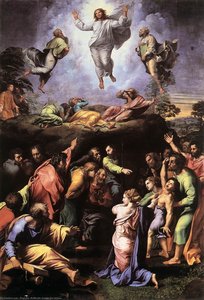
A serene vision of divine harmony unfolds in Raphael's High Renaissance masterpiece St. Cecilia with Saints, where celestial music meets earthly grace, inviting you to explore this timeless emblem of spiritual beauty.
 Vis mere
Kunstnerbiografi
Raphael (1483-1520): En af Renæssancens mest berømte kunstnere, kendt for sine elegante Madonner og mesterværker som 'Skolen i Athen'. Udforsk hans Urbino-baggrund og kunstneriske arv.
§ 3Commentary
A Symphony of Divine Grace
In the hallowed halls of the Pinacoteca Nazionale di Bologna, there exists a masterpiece that does not merely depict a scene, but orchestrates a celestial melody. Raphael’s “St. Cecilia with Saints,” completed between 1516 and 1517, is far more than an altarpiece; it is a profound meditation on the intersection of human artistry and divine inspiration. As one gazes upon this High Renaissance triumph, the eyes are immediately drawn to the serene presence of Saint Cecilia, the patron saint of musicians. She sits at the heart of a spiritual sacra conversazione, her expression one of rapturous devotion, caught in a moment of profound listening to an angelic choir that seems to vibrate with the very essence of heaven.
The composition is a masterclass in Renaissance equilibrium and grace. Raphael skillfully arranges a gathering of venerable figures—St. John the Evangelist, St. Paul, St. Augustine, and Mary Magdalene—creating a sense of eternal companionship. Each saint contributes to the painting's narrative richness, yet they are unified by a shared atmosphere of contemplative peace. The artist’s ability to balance these individual personalities within a single, harmonious movement is what defines his genius, offering a visual stability that has captivated collectors and admirers for centuries.
The Language of Music and Symbolism
Beyond the faces of the saints, the painting breathes through its symbolic objects, which serve as a bridge between the earthly and the divine. Scattered throughout the lower register are musical instruments that act as silent protagonists in this sacred drama. A violin rests near the bottom, representing the tangible beauty of human expression, while the harp—Cecilia’s signature instrument—stands as a symbol of heavenly harmony. The presence of multiple harps punctuates the scene, reinforcing the theme of a cosmic, unending song.
Interestingly, art historians often note that while Raphael directed the grand vision, the intricate details of the musical instruments may have been the delicate touch of his talented student, Giovanni da Udine. This collaboration adds another layer of depth to the work, showcasing the vibrant energy of the Renaissance workshop. For the discerning decorator or collector, these elements offer a wealth of symbolic meaning, making the piece an ideal focal point for spaces dedicated to reflection, creativity, or the celebration of classical beauty.
A Timeless Legacy for the Modern Collector
To bring a reproduction of this masterpiece into a contemporary interior is to invite a sense of profound tranquility and intellectual depth. Raphael’s mastery of perspective, anatomical accuracy, and soft, luminous color palettes provides an aesthetic that transcends time. Whether placed in a grand library, a sophisticated living space, or a curated gallery, the painting serves as a window into the humanist ideals of the 16th century—a period where the pursuit of beauty was seen as a path to understanding the divine.
For interior designers seeking to evoke emotion and prestige, “St. Cecilia with Saints” offers an unparalleled opportunity. It is a work that commands attention through its subtlety rather than through noise. The painting’s ability to harmonize complex figures and symbolic objects makes it a versatile cornerstone for any high-end collection, providing a timeless elegance that continues to inspire the soul of every viewer who encounters its celestial melody.
Spørgsmål og svar
Hvor kan jeg finde kunstværker, der ligner "St. Cecilia with Saints" af Rafael?
Se lignende værker til "St. Cecilia with Saints" af Rafael på denne side: Lignende værker
Hvilken kunstretning tilhører "St. Cecilia with Saints" af Rafael?
"St. Cecilia with Saints" af Rafael tilhører Renaissance-bevægelsen. Denne bevægelse giver den stilistiske kontekst for værket.
Hvad er lysstyrken i "St. Cecilia with Saints" af Rafael?
Luminansen registreret for "St. Cecilia with Saints" af Rafael er Blød skygge.

 Skift til printsalg


 For kunstværker eller reproduktioner, der er større end 105 cm (ca. 41 tommer) på en hvilken som helst side, vil rammen blive leveret som et adskilt sæt. Denne metode sikrer sikker levering og forhindrer skader under transport.