


 Se i rummet
 Send
Send Del
Del
 Detaljer
 Guide
Guide

 Download
 Lignende værker
 Røntgenundersøgelse
 Se diasshow
 Statistik
King Richard I of England and Soldan Saladin
 Oil On Canvas
- WallArt
- Historical Painting
 1835
1835- 19th Century
 173.0 x 206.0 cm
 Walker Art Gallery
 Læs mere
Håndlavet oliereproduktion
Håndmalet olie på lærred i din valgte størrelse og ramme, udført efter bestilling af vores kunstnere. ( Skift til printversion Skift til digitalt billede)




P118B $10

P118H $10

P118W $10

P438Z $10

P508JH $12

P508YH $12

P805H $10

P805Z $10

P919BZ $10

P919G $10

P919XJ $10

P959ZH $10

P968JZ $12

W106C $8

W218G $10

W218JH $8

W218Y $10

W307PJ $10

W316G $10

W316PJ $8

W316Y $10

W398PJ $8

W4111J $10

W500HY $15

W500JH $15

W692G $12

W849H $8

W940BG $15

W953PJ $8




Vælg mellem vores forudindstillede størrelser, der matcher kunstværkets originale proportioner.

Du kan indtaste dine egne mål for at passe til en bestemt ramme eller plads. Hvis den valgte størrelse ikke stemmer overens med det originale billedes proportioner, vil vi enten beskære kunstværket eller udvide maleriet med yderligere håndmalede elementer. En digital skitse sendes til din godkendelse, før produktionen påbegyndes.
Bemærk venligst, at forhåndsvisningen på skærmen ikke afspejler den faktiske beskæring eller udvidelse. Kun skitsen vil nøjagtigt vise den endelige komposition.
Selvom specialmål er mulige, anbefaler vi at vælge en dimension fra den foruddefinerede liste for at bevare de originale proportioner.
Efter bestilling vil AllPaintingsStore.com team sende en e-mail til kunden for at indhente instruktioner og fremsende et udkast til gennemgang.
Levering i hele verden () på 3-4 uger i stedet for de standard 5 uger. (21 september). Ingen kompromiser med kvaliteten.

Gratis ekspresforsendelse til hele verden

Lærred af linned i høj kvalitet

Komplet transportforsikring

Garanti for refusion af told og importafgifter

Garanti for autentisk farvegengivelse

100 dages returret ved fabrikationsfejl

100% fuld returret

Mængderabat ved flere køb
 Glasmulighed er kun tilgængelig i størrelser under 110 cm

King Richard I of England and Soldan Saladin
Reproduktionsmateriale
Reproduktionsstørrelse
-


Samlet pris
$ 258
A Dialogue of Steel and Spirit
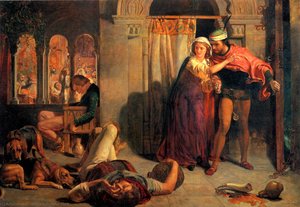
In the grand tapestry of nineteenth-century historical painting, few moments capture the intersection of martial prowess and diplomatic gravity as poignantly as Solomon Alexander Hart’s 1835 masterpiece, “King Richard I of England and Soldan Saladin.” This oil on canvas does not merely depict a meeting; it orchestrates a profound encounter between two of history's most legendary adversaries. As the viewer approaches this expansive work, they are immediately drawn into the tension of the Third Crusade, witnessing a pivotal negotiation over the fate of Jerusalem. Hart, a pioneer who broke societal barriers as the first Jewish member of the Royal Academy, utilizes his mastery of the historical genre to breathe life into a moment where the clash of civilizations meets the possibility of peace.
The composition is a masterclass in visual storytelling, utilizing chiaroscural techniques to define the characters' internal landscapes. On the left, King Richard I—the Lionheart himself—commands the space with a regal and formidable presence. Clad in the shimmering textures of chainmail, his long hair flowing with a wild, heroic energy, he holds aloft both a sword and a diplomatic scroll. This duality is central to the painting's soul: the sword represents the unyielding strength of the Crusader, while the scroll signifies the heavy burden of negotiation. In stark, beautiful contrast, Saladin sits upon an intricately patterned carpet, his posture one of deep, contemplative stillness. Enveloped in softer shadows, his lowered gaze and thoughtful repose suggest a wisdom that transcends the battlefield, creating a breathtaking balance between the kinetic energy of the West and the introspective dignity of the East.
The Artistry of Victorian Grandeur
For the discerning collector or interior designer, this painting offers an unparalleled opportunity to introduce a sense of narrative depth and classical prestige into a space. Hart’s technique is characterized by a meticulous, academic precision that celebrates the tactile beauty of his subject matter. One can almost feel the cold weight of the King's armor and the luxurious softness of the Sultan's silken robes. The artist’s deliberate brushstrokes capture the interplay of light upon metal and fabric with such accuracy that the scene transcends mere illustration to become a living, breathing historical window.
Beyond its technical brilliance, the work serves as an evocative piece of decor that invites conversation. It is a painting of contrasts—light and shadow, power and humility, conflict and diplomacy. When placed in a curated setting, such as a formal study, a library, or a grand hallway, it acts as an anchor of historical significance. The rich, warm tones and the dramatic interplay of light provide a sophisticated focal point that can elevate the atmosphere of any room, offering a timeless connection to the era of romanticism and the enduring human struggle for understanding across cultural divides.
Lignende kunstværker



Om kunstneren
A Pioneer Forging New Paths: The Life and Art of Solomon Alexander Hart
Solomon Alexander Hart, born in Plymouth, England, in 1806, occupies a unique and pivotal position within the landscape of 19th-century British art. He wasn’t merely a painter of historical scenes and compelling portraits; he was a trailblazer, becoming the first Jewish member of the prestigious Royal Academy – a breakthrough that resonated far beyond the artistic community. His journey, beginning with early training from his father, Samuel Hart, a respected engraver and teacher of Hebrew, was one of persistent dedication and remarkable talent. While initially apprenticed to a local engraver after completing his basic education, young Solomon’s ambition led him to seek entry into the Royal Academy itself, an institution previously closed off to artists of Jewish faith. This acceptance marked not only a personal triumph but also signaled a gradual shift in societal barriers within the British art world.From Genre Scenes to Renaissance Echoes: Artistic Development and Style
Hart’s artistic explorations at the Royal Academy were characterized by a willingness to experiment, ranging from intimate genre scenes depicting everyday life to grand historical compositions demanding meticulous research and skillful execution. He quickly distinguished himself as a master of miniature painting, demonstrating an extraordinary capacity for detail and precision – qualities highly valued during that era. However, it was his early works imbued with Jewish themes that first revealed his cultural heritage and personal connection to his roots. A turning point in Hart’s artistic trajectory arrived with a formative study trip to Italy in 1841. Immersing himself in the art of the Italian Renaissance, particularly captivated by the frescoes of Domenico Ghirlandaio, he began incorporating motifs and compositional elements from church and monastery paintings into his own work. This fusion of styles – blending British academic tradition with Italian Renaissance influences and Jewish iconography – became a hallmark of his unique artistic voice. He wasn’t simply imitating; he was synthesizing diverse traditions to create something distinctly his own.Achievements and Recognition: A Rising Star in the Royal Academy
Hart's debut at the Royal Academy exhibitions in 1826, with a portrait of his father, immediately established him as an artist to watch. His talent was undeniable, and his dedication unwavering. By 1840, he had achieved full membership within the Academy, solidifying his reputation and securing his place among Britain’s leading artists. Notable works from this period include “The Submission of the Emperor Barbarossa to Pope Alexander III,” a dramatic historical narrative showcasing his skill in large-scale composition, and "The Writing on the Wall," a powerful depiction of biblical prophecy. Beyond his easel paintings, Hart broadened his reach by creating illustrations for prominent periodicals such as the Athenaeum and the Jewish Chronicle, demonstrating his versatility and engaging with a wider audience. The pinnacle of his academic career arrived in 1854 when he was appointed a professor at the Royal Academy, further cementing his position as a leading figure in British art education and mentorship.Legacy and Historical Significance: Breaking Barriers and Bridging Cultures
Solomon Alexander Hart’s influence extends far beyond his impressive body of work. He remains a significant figure for several reasons. Firstly, he was a key influencer who blended genre painting with historical narratives and religious themes, creating a unique visual language that resonated with Victorian audiences. Secondly, as the first Jewish member of the Royal Academy, he shattered long-standing barriers and paved the way for future generations of Jewish artists in Britain. His life story serves as an inspiring example of perseverance and artistic achievement in the face of societal prejudice. Even as his eyesight gradually diminished in later years, Hart continued to paint with unwavering passion until his death in 1881. He left behind a legacy not only of artistic innovation but also of cultural representation – a testament to his enduring impact on British art history. His work continues to be studied and admired for its technical brilliance, historical insight, and the powerful message of inclusivity it embodies. He stands as a reminder that art has the power to transcend boundaries and connect us across cultures and time.
Solomon Alexander Hart
1806 - 1881 , United Kingdom
Hurtige fakta
- Artistic Movement Or Style: Historical, portraiture
- Artists Or Movements Influenced By This Artist: Future Jewish artists
- Artists Who Influenced This Artist: ['Domenico Ghirlandaio']
- Date Of Birth: 1806
- Date Of Death: 1881
- Full Name: Solomon Alexander Hart
- Nationality: British
- Notable Artworks:
- Milton Visiting Galileo
- Procession of the Law
- Self Portrait
- The Writing on the Wall
- Place Of Birth: Plymouth, UK
Relaterede artikler

The Enduring Power of Painting: A Historical & Contemporary Exploration of Form and Emotion
Explore the rich history & enduring techniques of oil painting with AllPaintingsStore. Discover masterpieces, learn about art collecting, and find authentic handmade reproductions crafted by skilled artists.

The Enduring Legacy of Oil on Canvas: Technique, History & Aesthetic Impact
Explore the rich history & techniques of oil painting – from Renaissance masters to Impressionism. Discover pigments, layering methods, and why this timeless medium endures. Expert insights for artists & art enthusiasts.

Oil on Canvas: A Historical & Technical Exploration of a Timeless Artistic Medium
Explore the rich history & enduring techniques of oil painting on canvas. Discover the science behind its longevity, conservation practices, and contemporary relevance. Expert insights for art enthusiasts.

Oliemaleriets Arv: Teknik, Historie og Nutidig Praksis
Dyk ned i oliemaleriets fascinerende verden! Lær om teknikker, historie og nutidige kunstnere. Få ekspertviden og inspiration til dit eget maleprojekt.

The Timeless Charm of Oil on Board: Reimagining Texture and Light through the Impressionist Lens
Discover the profound intimacy of oil on panel. Explore how Impressionist masters used rigid supports to capture light, texture, and impasto depth through exquisite, handmade oil reproductions for discerning collectors.

