

Acrylic On Canvas. Bechtler Museum of Modern Art.

§ 1Katalogdata


Dette kunstværk er ophavsretsbeskyttet
Kunstværket vist på denne side er beskyttet af ophavsretsloven, hvilket betyder, at vi ikke lovligt kan skabe eller sælge en identisk reproduktion. Denne beskyttelse håndhæves i henhold til internationale aftaler som f.eks. den Bernerkonventionen og af nationale love, herunder de bestemmelser, der er fastlagt i Amerikansk ophavsretslov - Titel 17.
Som et respektfuldt og lovligt alternativ tilbyder vi skræddersyede, håndmalede kunstværker inspireret af originalen. Vores dygtige og professionelle kunstnere studerer omhyggeligt originalens stil, stemning og kunstneriske essens for at skabe et nyt, unikt værk, der fremkalder den samme følelse – samtidig med at det forbliver en original skabelse i egen ret.
Denne metode overholder fuldt ud ophavsretsreglerne, da den ikke indebærer kopiering eller duplikering af det beskyttede kunstværk. I stedet er der tale om en kreativ nytolkning – et nyt maleri, som er inspireret af det oprindelige, men ikke identisk med det.
 Læs mere
§ 2Abstrakt
Beskrivelse af samlerobjektet
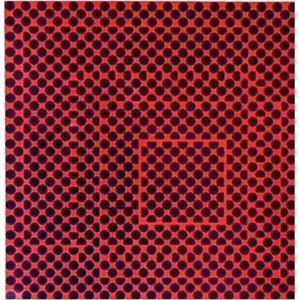
Explore Victor Vasarely’s mesmerizing NB 22 Caope – a masterful Op Art piece featuring interlocking circles that generate an illusion of movement and depth. Witness the birth of kinetic art, celebrating geometric precision and challenging our visual reality.
Kunstnerbiografi
Op Art pioneren Victor Vasarely (1906-1997) skabte geometriske illusioner og dynamiske mønstre, der udfordrede vores synsopfattelse. Udforsk hans banebrydende kunst!
§ 3Kommentarer
NB 22 Caope: A Geometric Symphony by Victor Vasarely
Victor Vasarely’s “NB 22 Caope” is more than just an abstract painting; it's a meticulously crafted portal into the heart of Op Art, a movement that sought to redefine our perception of reality. This striking work, dominated by a precisely arranged grid of black and white circles, exemplifies Vasarely’s pioneering approach to visual illusion – a technique he developed with mathematical rigor and an almost obsessive attention to detail. The image itself captures a key moment in the artist's career, showcasing his mastery of creating dynamic movement and depth through seemingly static geometric forms.
At first glance, “NB 22 Caope” presents a stark simplicity: a tightly controlled composition of circles. However, closer observation reveals a sophisticated interplay of overlapping shapes and subtle variations in size. This creates an illusion of three-dimensionality, drawing the viewer’s eye across the canvas and generating a captivating sense of movement – a hallmark of Op Art. The deliberate restriction to black and white amplifies this effect, maximizing contrast and intensifying the optical stimulation.
The Genesis of Optical Illusion
Born in Pécs, Croatia (then part of Austria-Hungary) in 1906, Victor Vasarely’s artistic journey began far from the world of abstract art. Initially pursuing medical studies, he was drawn to visual expression and ultimately embraced a path shaped by geometric abstraction. His formative years were profoundly influenced by the Bauhaus movement, particularly through his association with Sándor Bortnyik's “Műhely” workshop in Budapest – a space where functional design principles and rigorous mathematical calculations converged. This background is crucial to understanding Vasarely’s approach; he didn’t simply paint circles; he engineered visual experiences.
Vasarely’s work, like that of many Op Artists, was driven by a desire to challenge traditional notions of representation. Rather than depicting recognizable objects, he sought to manipulate the viewer's perception directly, creating an illusion of movement and depth through carefully arranged geometric patterns. The ‘NB 22 Caope’ series, created between 1962 and 1968, represents a peak in this exploration, demonstrating his refined control over optical effects.
Symbolism and the Pursuit of “Art for All”
While strictly abstract, "NB 22 Caope" resonates with potential symbolic interpretations. The repetitive pattern of circles can be seen as representing growth, cycles, or even interconnectedness – themes frequently explored by Vasarely. He famously stated his goal was to create ‘art for all,’ accessible and engaging regardless of prior artistic knowledge. This accessibility is achieved through the immediate, visceral impact of the work’s optical effects.
The Fondation Vasarely, established in Aix-en-Provence, continues to champion Vasarely's legacy, showcasing his innovative approach to art and design. Reproductions like this one allow us to experience firsthand the power of his geometric vision – a testament to the enduring appeal of Op Art’s exploration of perception.
Spørgsmål og svar
Hvor kan man i dag se "NB 22 Caope" af Victor Vasarely udstillet?
Du kan se det originale værk "NB 22 Caope" på Bechtler Museum of Modern Art, Charlotte, USA.
Hvilken størrelse anbefales det at printe "NB 22 Caope" i?
"NB 22 Caope" anbefales i en trykstørrelse på Large. Andre størrelser er tilgængelige med de samme proportioner.
Hvor høj er kontrasten i "NB 22 Caope" af Victor Vasarely?
Lys-mørke-kontrasten i "NB 22 Caope" er registreret som Statement. Kontrast beskriver, hvor kraftigt lyse og mørke områder adskiller sig fra hinanden.




 Skift til printsalg


 For kunstværker eller reproduktioner, der er større end 105 cm (ca. 41 tommer) på en hvilken som helst side, vil rammen blive leveret som et adskilt sæt. Denne metode sikrer sikker levering og forhindrer skader under transport.


