

Oil On Canvas.

§ 1Catalogue data


§ 2Abstract
Beskrivelse af samlerobjektet
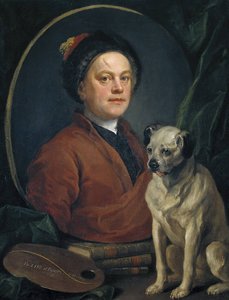
William Hogarth's 1757 Self Portrait showcases the artist at work, blending realism & Classicism. A glimpse into his creative process & artistic legacy.
 Vis mere
Kunstnerbiografi
Udforsk William Hogarths satiriske verden (1697-1764)! Pioner indenfor engelsk kunst med billedserier som 'En skørdoms fremmarch'. Se hans skarpe sociale kommentarer og unikke stil.
§ 3Commentary
An Encounter with the Artist's Soul
In the quiet intimacy of his studio, William Hogarth presents us with more than just a likeness; he offers a profound window into the very essence of Enlightenment observation. His Self-Portrait is a masterclass in capturing the intersection of personal identity and professional dedication. As we gaze upon this oil on canvas, we find ourselves seated alongside the artist, witnessing a moment of focused creation. Hogarth depicts himself not as a distant figure of myth, but as a man deeply engaged with his craft, his hands holding the tools of his trade—the brush and palette—while his eyes remain fixed upon the unseen canvas before him. This directness creates an immediate emotional bond between the viewer and the subject, inviting us to participate in the silent, sacred ritual of artistic production.
The composition is a delicate balance of grandeur and domesticity, structured with the deliberate grace of Baroque principles. While the central positioning of Hogarth establishes a sense of importance and stability, the inclusion of his small pug dog introduces a tender, humanizing element. This canine companion, sitting attentively by his side, serves as a poignant symbol of loyalty and companionship, grounding the formal portrait in a relatable, lived reality. The arrangement suggests a world where high intellectual pursuit and simple, everyday affection coexist harmoniously, making the piece deeply resonant for anyone who finds beauty in the quiet moments of life.
The Mastery of Light and Line
Technically, this portrait is a testament to Hogarth’s extraordinary command over Classicism. Eschewing the flamboyant and opulent colors that often characterized his contemporaries, Hogarth employs a restrained and sophisticated palette dominated by muted browns, creams, and subtle tonal gradations. This choice of color serves to emphasize clarity and precision, allowing the viewer to focus on the meticulous textures of the scene. His brushwork is smooth and expertly blended, a skill likely refined during his early years as an engraver. Through careful layering of paint, he achieves a sense of volume and form that breathes life into the fabric of his clothing and the soft fur of his companion.
The interplay of light and shadow within the work is subtle yet transformative. Rather than relying on dramatic, theatrical lighting, Hogarth uses a more diffused approach to define the contours of his face and the physical space around him. This technique creates a sense of realism that aligns perfectly with the Enlightenment's fascination with empirical truth. For the collector or interior designer, this understated elegance makes the piece incredibly versatile; it possesses a timeless quality that can anchor a room with its intellectual depth and quiet strength, providing a sophisticated focal point that rewards prolonged contemplation.
A Legacy of Observation
To understand this self-portrait is to understand the spirit of mid-18th-century London. Created during a period when reason and scientific inquiry were reshaping the world, Hogarth’s work embodies the era's commitment to portraying reality without embellishment. He stands as a visual historian, using his art to document not just faces, but the very character of an age. The portrait reflects a man who is both a creator and a critic, someone whose gaze is trained to see the truth beneath the surface of social convention.
Owning a reproduction of this masterpiece is an opportunity to bring a piece of art history's most observant minds into one's personal space. It is an invitation to value precision, to celebrate the beauty of the real, and to surround oneself with the enduring spirit of human curiosity. Whether displayed in a library, a study, or a contemporary living space, this Self-Portrait serves as a constant reminder of the power of the observant eye and the profound dignity found in dedicated labor.
Spørgsmål og svar
Hvilken størrelse anbefales det at printe "Self Portrait" i?
"Self Portrait" anbefales i en trykstørrelse på Small. Andre størrelser er tilgængelige med de samme proportioner.
Hvilke farver dominerer i "Self Portrait" af William Hogarth?
"Self Portrait" af William Hogarth benytter en Earthy farvepalet, hvor Gray (#6d6c6b) er den dominerende farve.
Hvor placerer "Self Portrait" sig blandt William Hogarths gennemgående motiver?
"Self Portrait" skildrer portraiture, self-representation, domesticity, satirical art, british art, animal companion, 18th century, mens William Hogarths registrerede temaer er social critique, classical tradition, british society, artist identity, visual narrative. En sammenligning af de to viser, hvordan værket relaterer sig til kunstnerens sædvanlige motiver.


 Skift til printsalg


 For kunstværker eller reproduktioner, der er større end 105 cm (ca. 41 tommer) på en hvilken som helst side, vil rammen blive leveret som et adskilt sæt. Denne metode sikrer sikker levering og forhindrer skader under transport.


