Alexandre Defaux: A Painter of French Pastoral Life
Born in Cergy, France, in 1826, Alexandre Defaux emerged as a significant figure within the Barbizon School of landscape painting – a movement that profoundly shifted the course of French art. While often associated with the legacy of Jean-Baptiste Corot, his artistic journey was one of independent exploration and a deeply personal response to the rural landscapes of France. Defaux’s work offers a serene glimpse into the daily rhythms of farming communities and the quiet beauty of the countryside, capturing an era before rapid industrialization fundamentally altered the French landscape.
Defaux's early artistic development was undeniably shaped by his apprenticeship under Jean-Baptiste Corot, a master known for his atmospheric landscapes and subtle use of light. Like Corot, Defaux initially produced panoramic cityscapes and depictions of Neapolitan peasants – scenes reflecting the influence of his teacher’s travels to Italy. However, he quickly established his own distinct style, gravitating towards the forests and villages of the Fontainebleau region and later, the Normandy countryside. This shift marked a crucial turning point, demonstrating an increasing independence from Corot's direct guidance.
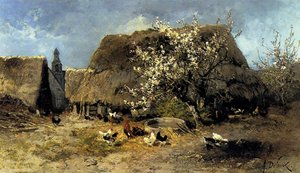
The Barbizon School, in which Defaux played a vital role, distinguished itself by prioritizing *en plein air* painting – working directly outdoors to capture the immediate effects of light and atmosphere. This commitment to observation is evident throughout his oeuvre. His paintings are characterized by a remarkable sensitivity to detail, particularly in rendering foliage, water, and the textures of rural life. Unlike the idealized landscapes prevalent in earlier academic traditions, Defaux’s scenes often present a realistic portrayal of weathered farmhouses, humble dwellings, and the hardworking individuals who shaped them. His palette is typically muted – dominated by earthy greens, browns, and blues – creating a sense of tranquility and timelessness.
Key Works and Recurring Themes
Several of Defaux’s paintings stand out as particularly compelling examples of his artistic vision. “Flock of Geese at Montigny-sur-Loing” (1862) exemplifies his ability to capture the fleeting effects of light and atmosphere, depicting a serene rural scene with remarkable precision. The composition is balanced and harmonious, drawing the viewer’s eye across the canvas to the distant horizon. “Rural River Scene” similarly showcases his talent for portraying the beauty of the French countryside, capturing the reflections of sunlight on the water's surface and the lush greenery along the riverbanks. “Time of grain,” painted in 1876, offers a poignant glimpse into the rhythms of agricultural life, depicting farmers harvesting their crops under a vast expanse of sky.
A recurring theme throughout Defaux’s work is the depiction of daily rural life – the simple routines of farming, the gathering of firewood, and the quiet moments of contemplation. He avoids grand narratives or dramatic events, instead focusing on the subtle beauty of ordinary scenes. This focus on the everyday contributed significantly to the Barbizon School's rejection of historical and mythological subjects in favor of contemporary landscapes.
Influence and Legacy
Alexandre Defaux’s artistic trajectory is inextricably linked to that of Jean-Baptiste Corot, yet he forged his own distinct path within the Barbizon School. While initially a student, Defaux developed a unique approach to landscape painting, characterized by an intimate understanding of light, atmosphere, and the textures of rural France. His work helped to establish the Barbizon School as a major force in 19th-century French art, influencing generations of artists who followed.
Interestingly, Defaux’s family history reveals connections beyond the artistic realm. The surname “Defaux” has roots tracing back to a place name in Belgium, potentially linked to beech trees – a detail that subtly reflects his deep connection to the natural world and his artistic inspiration. His work continues to be appreciated for its quiet beauty, offering a timeless vision of French pastoral life.
Further Exploration
For deeper insights into Alexandre Defaux’s life and work, consider exploring these resources:
- Wikipedia Entry: Provides a comprehensive overview of his biography and artistic career.
- “Flock of Geese at Montigny-sur-Loing”: A detailed examination of this iconic painting.
- “Rural River Scene”: Another significant work showcasing his mastery of landscape depiction.
- Corot Experts - Alexandre DeFaux: Provides a deeper look into the connection between Defaux and Corot.
His work is a testament to the power of observation, capturing not just the visual beauty of the French countryside but also its enduring spirit.
Spørgsmål og svar
Hvordan finder jeg værker af Alexandre Defaux inden for et specifikt tema?
For at finde værker af Alexandre Defaux inden for et specifikt tema kan du bruge kunstnerens Efter nøgleord-side, som grupperer værkerne efter nøgleord.
Hvor kan man finde Alexandre Defauxs kunstværker organiseret efter farve?
Siden Farveindeks organiserer Alexandre Defauxs værker efter farve.
Hvor mange kunstværker af Alexandre Defaux er tilgængelige at gennemse?
Du kan gennemse 17 kunstværker værker af Alexandre Defaux på siden Alle kunstværker.