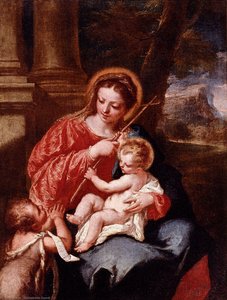
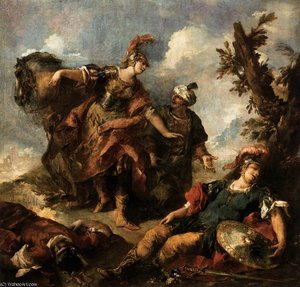
The Dramatic Visionary of the Venetian Baroque
Gianantonio Guardi, a name synonymous with the theatrical splendor of the 18th century, stands as a pivotal figure in the evolution of the Venetian Baroque. Born in Vienna in 1699 into a noble family deeply rooted in artistic tradition, his life was shaped by the vibrant cultural currents that flowed between the imperial grandeur of Austria and the shimmering canals of Venice. As the son of the respected painter Domenico Guardi, Giovanni Antonio did not merely learn a craft; he inherited a legacy of meticulous observation and technical mastery. His formative years were spent immersed in an environment where art was both a familial duty and a profound way of interpreting the world, leading him to develop a style that would eventually capture the very soul of Venice.
The development of Guardi’s artistry was deeply intertwined with his family's collaborative spirit. Alongside his brothers, Francesco and Niccolò, he helped establish a studio that became a cornerstone of mid-18th-century Venetian painting. This period of his life was marked by a rigorous pursuit of excellence, further solidified by his involvement in the founding of the Accademia Veneziana. Through this institution, Guardi championed a unique synthesis of scientific accuracy and aesthetic beauty, pushing the boundaries of what Venetian art could achieve. His work moved away from the purely idealized forms of the past, seeking instead to document the pulse of the city with an almost journalistic precision, yet elevated by the dramatic flair characteristic of the Baroque era.
Mastery of Light and the Pulse of Daily Life
To gaze upon a Guardi masterpiece is to witness a masterclass in chiaroscuro. He possessed an unparalleled ability to manipulate the interplay between light and shadow, creating compositions that feel as though they are breathing with life. This dramatic lighting was never used merely for effect; rather, it served to direct the viewer's eye through complex, dynamic landscapes and bustling urban scenes. His brushwork captured the fleeting nature of light reflecting off canal waters or the soft glow of a religious procession moving through a crowded campo.
What truly distinguishes Guardi from his contemporaries was his profound commitment to realism and the celebration of the mundane. While other artists sought the divine in distant, mythological realms, Guardi found it in the streets of Venice. His canvases are populated by the true inhabitants of the Venetian Republic:
- Market vendors engaged in the spirited haggling of daily commerce.
- Gondoliers navigating the intricate labyrinth of the city's waterways.
- Ordinary citizens participating in the grand religious and civic rituals that defined the era.
By focusing on these commonplace activities, Guardi achieved a level of palpable realism that allowed his work to resonate with both spiritual fervor and human connection. He did not just paint scenes; he captured the atmosphere, the noise, and the very texture of 18th-century life.
Legacy and Historical Significance
The historical significance of Gianantonio Guardi lies in his ability to bridge the gap between the grandiosity of the Baroque and a burgeoning interest in the observational realism that would define later centuries. He transformed the cityscape from a mere backdrop into a living, breathing protagonist. His meticulous attention to detail—capturing everything from the weathered stone of the Colleoni Statue to the lively energy of Campo Santi Paolo—ensured that his work serves as a vital historical record of a vanished era.
Today, Guardi is remembered not just as a painter of views, but as a storyteller of the human condition. His legacy persists in the way we perceive the intersection of architecture and life, reminding us that there is profound beauty to be found in the shadows of the everyday. Through his dynamic compositions and emotive use of light, he remains a definitive voice of the Venetian Baroque, leaving behind a visual testament to the enduring spirit of Venice.
Spørgsmål og svar
Hvor og hvornår er Gianantonio Guardi født?
Gianantonio Guardi blev født i Vienna i 1699.
Hvilke kunstværker af Gianantonio Guardi har flest visninger?
Se statistik over Gianantonio Guardis værker på kunstnerens Statistik side.
Hvor kan jeg se Gianantonio Guardis værker i kronologisk rækkefølge?
Se kunstnerens Tidslinje for kunstværker for en kronologisk gennemgang af Gianantonio Guardis værker, år for år.