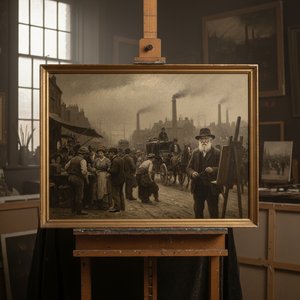
The Chronicler of Empire: The Life and Legacy of Harry Payne
In the golden twilight of the Victorian era, few artists captured the rhythmic pulse of British military life with as much precision and patriotic fervor as Harry Payne. Born in Newington, London, on May 8, 1858, Payne emerged from a family rooted in the professional middle class—the son of a solicitor’s clerk—to become one of the most prolific illustrators of his generation. His journey into the heart of military iconography was not born of the battlefield, but rather through a meticulous eye for detail developed during his early career working as a designer for military contractors. This unique vantage point allowed him to blend the technical accuracy required by the armed forces with a romanticized aesthetic that resonated deeply with the British public, transforming mere documentation into enduring art.
Payne’s artistic evolution was marked by a sophisticated mastery of light and atmosphere. While his foundations were rooted in a rigorous realism, he was not immune to the sweeping influences of luminism and Impressionism that were reshaping the European landscape. By weaving these styles together, he achieved a remarkable feat: he could render the heavy brass of a cannon or the intricate embroidery of a regimental tunic with absolute clarity, while simultaneously bathing the scene in a soft, atmospheric haze that evoked the solemnity of duty and the grandeur of the British Empire. This delicate balance between the tangible and the ethereal gave his work a lifelike quality that felt both historically grounded and emotionally resonant.
A Collaborative Vision and the Oilette Revolution
The narrative of Harry Payne is inseparable from that of his brother, Arthur C. Payne. Together, they formed the Payne & Payne Studios, a creative partnership that would leave an indelible mark on the visual culture of the early 20th century. Their collaboration was particularly transformative in the realm of mass-produced art. Working alongside the renowned publisher Raphael Tuck & Sons, the brothers became instrumental in the creation of the iconic oilette postcards. These small but exquisite works of art brought high-quality military imagery into the homes of the masses, allowing the public to collect miniature masterpieces that celebrated the bravery and splendor of various regiments.
Their professional reach extended far beyond simple illustrations, as they undertook significant commissions for prestigious publishers such as Gale and Polden. This period of intense productivity saw Payne collaborating with other notable military artists, including Edgar Alfred Holloway, John McNeill, and Ernest Ibbetson. Through these shared endeavors, Payne helped cultivate a cohesive visual language for British military pride. His work was not merely admired by the public but also garnered the respect of the highest echelons of society; his illustrations were sought after by the Prince of Wales and other members of the Royal Family, particularly during the momentous celebrations of Queen Victoria’s Golden and Diamond Jubilees.
The Spirit of the Regiment: Themes and Historical Significance
To look upon a painting by Harry Payne is to witness a meticulously curated history of the British Army. His oeuvre serves as a vibrant archive of various units, from the dashing Queen's Lancers to the disciplined 6th Dragoon Guards Carabiniars. Each piece was a study in identity, where the specific arrangement of weaponry, the exact shade of a uniform, and the particular posture of a mounted officer served to honor the unique heritage of each regiment. His depictions of the Royal Horse Artillery, for instance, are celebrated for their dynamic energy, capturing the movement and tension inherent in cavalry life.
Beyond the technical brilliance, Payne’s work holds profound historical significance as an expression of Victorian ideals. His canvases functioned as powerful vessels for notions of courage, duty, and imperial stability. In an era of rapid global change, his art provided a sense of continuity and heroic permanence. Through his dedication to portraying his subjects with unwavering dignity, Harry Payne did more than just paint soldiers; he immortalized the very spirit of an age, ensuring that the splendor of the Victorian military tradition would remain etched in the collective memory of the world.
Spørgsmål og svar
Hvordan er Harry Paynes karriere opdelt i perioder?
En kronologisk gennemgang af Harry Paynes værker er tilgængelig på kunstnerens Kronologi-side, hvor værkerne præsenteres i rækkefølge efter deres skabelse, kapitel for kapitel.
Hvor kan man finde Harry Paynes kunstværker organiseret efter farve?
Harry Paynes værker kan udforskes efter farve på kunstnerens Farveindeks side.
Hvilke farver brugte Harry Payne oftest?
Farveprofilen for Harry Paynes værker kan ses på kunstnerens Farvepalettens DNA-side.