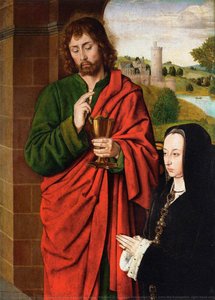
The Enigmatic Shadow of the Bourbon Court
In the twilight of the fifteenth century, amidst the opulent courts of France and Burgundy, there emerged a painter whose name would become synonymous with a profound, quiet mastery. Jean Hey, often whispered in art historical circles as the Master of Moulins, remains one of the most captivating enigmas of the Early Netherlandish period. While the biographical details of his life are shrouded in the mists of time—with only scant records suggesting he may have been active around 1475 and perhaps spent his final years in Paris—his brushwork speaks with an unmistakable and enduring voice. His identity, once a puzzle of fragmented documentation, now stands as a testament to a period where artistic brilliance often transcended the need for personal fame.
The origins of Hey’s talent are steeped in scholarly speculation, fueling a narrative of cross-cultural influence that defines his very essence. Many historians believe his stylistic foundations were laid under the tutelage of Hugo van der Goes, the titan of Flemish Primitivism. This connection is evident in the way Hey breathes life into his subjects through a meticulous attention to detail and a sophisticated use of light. His work represents a sublime intersection of Northern Renaissance realism and a burgeoning French elegance, creating a visual language that is both structurally rigorous and emotionally tender.
A Masterpiece of Devotion: The Moulins Triptych
The pinnacle of Jean Hey’s career, and perhaps the most significant achievement of his entire oeuvre, is the monumental Moulins Triptych housed in the Moulins Cathedral. Completed around 1494-1495, this work serves as a breathtaking window into the spiritual and political heart of the Bourbon court. The central panel, depicting the Madonna and Child adored by celestial angels, radiates a serene divinity that anchors the entire composition. However, it is the flanking wings that truly ground the divine in the earthly realm, presenting poignant portraits of the era's nobility.
Through these panels, Hey captures the essence of Burgundian prestige with unparalleled skill:
- Peter II, Duke of Bourbon: Presented by Saint Peter, this portrait showcases the artist's ability to render heavy fabrics and the solemn dignity of high office.
- Anne de Beaujeu, Duchess of Bourbon: A masterpiece of Early Renaissance elegance, where subtle sfumato shading captures the delicate features and aristocratic grace of one of France's most powerful women.
- The Presence of Suzanne: The inclusion of the Duke’s daughter adds a layer of familial intimacy to the grand religious narrative, showcasing Hey's talent for humanizing the divine.
Legacy of Light and Detail
Beyond the grand scale of his triptychs, Jean Hey’s smaller works—ranging from intimate portraits to profound biblical scenes—reveal a painter obsessed with the interplay of light and texture. In works such as The Annunciation and Meeting at the Golden Gate, one observes a dramatic use of lighting that predates many later Renaissance developments, lending a sense of theatricality to sacred moments. His ability to render the tactile quality of velvet, the cold sheen of armor, and the soft glow of skin remains a hallmark of his technical prowess.
The historical significance of Jean Hey lies not just in the beauty of his surviving panels, but in his role as a bridge between traditions. He took the meticulous, almost scientific realism of the Netherlandish masters and infused it with a lyrical, French sensibility. Though his life was brief and much of his biography remains lost to history, his legacy is preserved in every meticulously painted fold of drapery and every soulful gaze captured on panel. He remains a pivotal figure whose work continues to illuminate the transition from the medieval spirit to the dawn of the modern era.
Spørgsmål og svar
Hvor kan man finde Jean Heys kunstværker grupperet efter nøgleord?
Siden Efter nøgleord for Jean Hey grupperer kunstnerens værker efter nøgleord.
Hvor kan man finde Jean Heys kunstværker organiseret efter farve?
Jean Heys værker kan udforskes efter farve på kunstnerens Farveindeks side.
Kan jeg gennemse Jean Heys værker efter medie?
For at finde alle værker af Jean Hey inden for et bestemt medie, kan du bruge kunstnerens Alle medier side.