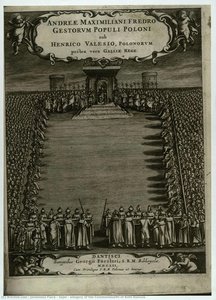
A Master of the Burin: The Life of Jeremiasz Falck
In the vibrant tapestry of the seventeenth-century Baroque, few names resonate with the intricate precision of Jeremiasz Falck. A virtuoso engraver and printmaker, Falck’s life was a journey across the great cultural hubs of Europe, reflecting the interconnectedness of the era's artistic spirit. Born in the historic city of Danzig, Poland, he emerged from a world where the Polish–Lithuanian Commonwealth served as a vital crossroads of intellect and art. His early training, likely under the guidance of Willem Hondius, laid the foundation for a career defined by technical mastery and an extraordinary ability to translate the grandeur of painting into the delicate language of copper and ink.
Falck’s professional odyssey was as expansive as his artistic vision. From the bustling streets of Paris, where he worked in the 1630s and 1640s, to the royal courts of Northern Europe, his presence was felt wherever fine craftsmanship was revered. A significant chapter of his life unfolded in Sweden, where he served as the Royal Swedish engraver for Queen Christina. This prestigious appointment allowed him to capture the likenesses of the era's most influential figures, often signing his works with evocative titles such as Falck Polonus or Falck Gedanensis, proudly asserting both his Polish roots and his connection to the city of Gdańsk.
The Art of the Line and the Legacy of Print
The true essence of Falck’s genius lay in his command over various printmaking techniques, including engraving, etching, and aquafort. His oeuvre, comprising hundreds of works, serves as a window into the Baroque soul. He was not merely a creator of images but a reproductive printmaker of immense skill, often translating the masterpieces of contemporary painters—such as Daniel Schultz, Erasmus Quellinus, and David Beck—into widely distributable engravings. This role made him an essential figure in the dissemination of visual culture, allowing the portraits of bishops, royals, and scholars to travel far beyond the confines of private galleries.
Beyond the solemnity of portraiture, Falck’s versatility allowed him to explore diverse subject matters that captured the curiosity of his age. His work included:
- Botanical Elegance: Exquisite engravings of flowers and plants, such as those published in Hamburg, which showcased his ability to render organic delicacy with scientific precision.
- Scientific Illustration: Illustrative contributions to monumental scientific works, including the celebrated Selenography by Johannes Hevelius.
- Allegorical Narratives: Complex compositions that utilized mythological and allegorical themes to convey deeper philosophical or political meanings.
Through his meticulous use of the burin, Falck achieved a level of tonal depth and textural richness that commanded respect across the continent. Whether he was documenting the anatomy of man or the intricate petals of a tulip, his work remained anchored in a profound respect for detail. As he moved through cities like Amsterdam, Copenhagen, and Hamburg, he continued to weave his legacy into the fabric of European printmaking, leaving behind a body of work that remains a testament to the enduring power of the engraved line.
Spørgsmål og svar
Findes der en kronologisk gennemgang af Jeremiasz Falck?
En kronologisk gennemgang af Jeremiasz Falcks værker er tilgængelig på kunstnerens Kronologi-side, hvor værkerne præsenteres i rækkefølge efter deres skabelse, kapitel for kapitel.
Hvor kan jeg se Jeremiasz Falcks værker i kronologisk rækkefølge?
Se kunstnerens Tidslinje for kunstværker for en kronologisk gennemgang af Jeremiasz Falcks værker, år for år.
Hvor mange kunstværker af Jeremiasz Falck er tilgængelige at gennemse?
Du kan gennemse 1 kunstværker værker af Jeremiasz Falck på siden Alle kunstværker.