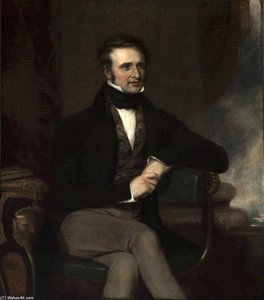
The Luminescent Legacy of Thomas Clement Thompson
In the grand tapestry of nineteenth-century art, few threads are as delicately woven as those left by Thomas Clement Thompson. A master of both the intimate and the expansive, Thompson’s career serves as a bridge between the meticulous precision of Georgian portraiture and the atmospheric, emotive depths of the Luminist movement. Born in Belfast in 1780, his life was shaped by the intellectual and artistic currents of an era defined by transition. His early training at the Dublin Society Schools, which began in 1796, provided him with a rigorous academic foundation, instilling a profound command over draughtsmanship and tonal manipulation that would remain the hallmark of his artistry throughout his long and distinguished life.
Thompson first rose to prominence through the delicate medium of portrait miniatures. These small-scale works, characterized by their remarkable sensitivity, allowed him to capture the very essence of his subjects with a precision that enchanted the high society of Belfast and Dublin. There is an inherent intimacy in the miniature, a quiet dialogue between the artist and the sitter, which Thompson navigated with unparalleled grace. His ability to render nuanced expressions and the subtle textures of skin and fabric made him a sought-after chronicler of the era's most notable figures, including royalty such as George IV.
A Transition Toward the Sublime
As the nineteenth century progressed, Thompson underwent a profound artistic metamorphosis. Between 1803 and 1809, he made the deliberate and daring decision to pivot from the miniature format toward large-scale portraiture and landscape painting. This shift was not merely a change in scale, but a fundamental evolution in his aesthetic philosophy. Influenced by the monumental styles of Joshua Reynolds and Benjamin West, Thompson began to explore the concept of the sublime—the idea that art should evoke awe through the depiction of nature's grandeur and the play of light.
This period saw him embracing the principles of Luminism, a style that prioritizes the effects of light and atmosphere. In his landscapes, such as the evocative Early Snow, Algonquin Park or the dynamic Thunder Cloud, one can witness his mastery of atmospheric perspective. He utilized soft, diffused light and muted color palettes to create immersive vistas where the boundaries between earth and sky seem to dissolve. Through these works, Thompson did not merely paint scenery; he captured the ephemeral, fleeting moments of weather and light that define the human experience of the natural world.
Legacy and Historical Significance
Thompson’s influence extended far beyond the borders of Ireland. By 1817, his burgeoning success led him to establish a new studio in London, where he became a regular fixture at the prestigious Royal Academy exhibitions. His presence in the London art scene solidified his reputation as an international figure of significant merit. His commitment to the institutionalization of art was equally profound; as a founding member of the Royal Hibernian Academy, he played a crucial role in shaping the artistic landscape of Ireland for generations to come.
The later years of his life saw him settling in Cheltenham, where he continued to refine his craft until his passing in 1857. When reflecting on his body of work, several key achievements emerge:
- Mastery of Scale: His seamless transition from the microscopic detail of miniatures to the sweeping vistas of landscape painting.
- Luminist Innovation: His ability to use light as a primary subject, creating atmospheric depth and emotional resonance.
- Institutional Impact: His foundational role in the Royal Hibernian Academy, fostering a structured environment for Irish artists.
- Societal Connection: His skill in capturing the likenesses of the political and social elite, preserving the visual history of the Georgian and Victorian eras.
Today, the works of Thomas Clement Thompson remain vital touchstones for students of art history. They stand as a testament to an artist who could move effortlessly between the quietest whisper of a portrait and the thunderous roar of a storm-swept sky, leaving behind a legacy of light, shadow, and enduring beauty.
Spørgsmål og svar
Hvor populære er Thomas Clement Thompsons kunstværker?
Se statistik over Thomas Clement Thompsons værker på kunstnerens Statistik side.
Kan jeg besøge et virtuelt museum med Thomas Clement Thompsons værker?
Thomas Clement Thompsons værker kan opleves i et 3D-galleri på kunstnerens 3D-galleri-side.
I hvilken historisk periode arbejdede Thomas Clement Thompson?
Thomas Clement Thompson var aktiv i 19th Century-perioden. Denne periode placerer kunstnerens virke i en historisk kontekst.