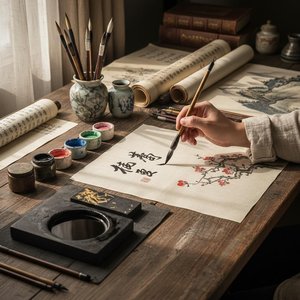
Unkoku Tōgan: A Life Dedicated to Landscape and Spirituality
- Born: Nagasaki, Japan (1547)
- Died: 1618
Unkoku Tōgan, born in 1547, stands as a significant figure in Japanese art history, renowned for his realistic landscapes and the profound spirituality interwoven within his works. Born into privilege as the second son of Hara Naoie, lord of Nokomi Castle in Hizen province, Nagasaki provided the backdrop to his early life and artistic development.
Early Training and Artistic Development
Tōgan’s initial training occurred within the esteemed Kanō school, a dominant force in Japanese art during that era. However, he soon transcended this foundation, drawing significant inspiration from the celebrated painter Sesshū Tōsai. This influence is evident in his signature style – paintings primarily executed using ink on paper, depicting strikingly realistic landscapes. He initially worked under Lord Mori of Yamaguchi Prefecture.
Artistic Style and Notable Works
Unkoku Tōgan’s artistic hallmark lies in his bold brushstrokes and the vibrant colors he employed, a departure from traditional Japanese art styles. His landscapes weren't merely depictions of scenery; they conveyed a sense of depth and realism rarely seen at the time. Some of his most recognized works include:
- Screen Depicting Landscape, People, Flowers, and Birds: Currently housed at the Iwami Art Museum, this piece exemplifies his ability to integrate various elements into a cohesive and captivating scene.
- Bodhidharma: A masterful 1601 ink wash painting embodying Zen philosophy, showcasing minimalist composition and profound spirituality.
- Priest Xianzi: Demonstrates his skill in portraiture alongside landscape artistry.
Beyond Painting: Buddhist Life and Spiritual Influence
Tōgan’s life extended beyond the realm of painting. He embraced a spiritual path, becoming a Buddhist priest and abbot of Unkoku-an Temple. This experience profoundly shaped his artistic vision, imbuing his works with themes of nature and spirituality. His paintings often reflect a deep connection to the natural world and an understanding of Zen principles.
Legacy and Influence
Unkoku Tōgan’s influence resonated throughout Japanese art history. While rooted in the Kanō school, he forged his own distinct style that inspired subsequent generations of artists. Notable figures who drew inspiration from his work include:
- Kano Sansetsu
- Kanō Eitoku
His paintings are housed in prestigious institutions such as the Museum Menard Art Museum, highlighting his enduring importance within Japanese cultural heritage. His artistic style and legacy continue to be studied by art historians and scholars today.
Spørgsmål og svar
Hvor og hvornår er Unkoku Togan født?
Unkoku Togan blev født i Nagasaki i 1547.
Hvor kan jeg opleve Unkoku Togans kunstværker i et 3D-galleri?
3D-galleri for Unkoku Togan er en side, der fremviser kunstnerens værker i et virtuelt tredimensionelt galleri.
Kan jeg gennemse Unkoku Togans værker efter medie?
For at finde alle værker af Unkoku Togan inden for et bestemt medie, kan du bruge kunstnerens Alle medier side.