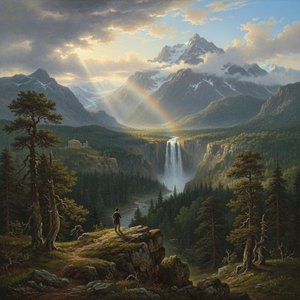
1833. Oil On Canvas, 78.0 x 105.0 cm. Neue Pinakothek.

§ 1Catalogue data

- 78.0 x 105.0 cm


§ 2Abstract
Beschreibung des Sammlerstücks
Blechen pioneered Romantic industrialization, portraying scenes of technological advancement alongside sublime landscapes. Explore his Italian sketches and lasting influence.
 Weiterlesen
Künstlerbiografie
Carl Blechen (1798-1840) war ein deutscher Romantiker, berühmt für seine ausdrucksstarken Landschaften und wegweisenden Darstellungen der frühen Industrialisierung. Entdecken Sie seine Italien-Skizzen und sein bleibendes Erbe.
§ 3Commentary
A Symphony of Ambition and Nature
In his 1833 masterpiece, Building the Devil's Bridge, Carl Blechen invites the viewer into a profound dialogue between human ingenuity and the indomitable spirit of the natural world. This oil on canvas work is far more than a mere documentation of construction; it is a poignant exploration of the Romantic era’s complex relationship with progress. As a bridge begins to span a dramatic, yawning gorge, we witness a moment frozen in time where the burgeoning industrial revolution meets the ancient, silent majesty of the earth. The scene captures a sense of monumental effort, as workers navigate the rugged terrain, their small figures serving as a testament to human resilience amidst the towering, intimidating cliffs that frame the composition.
The painting breathes with a palpable tension, a duality that Blechen masterfully orchestrates through his use of light and shadow. The atmosphere is thick with a certain melancholic grandeur, achieved through a muted palette of earthy browns, somber greys, and subdued greens. This choice of color grounds the work in a raw, naturalistic reality, yet it is the dramatic lighting that truly stirs the soul. Soft, diffused daylight casts long, sweeping shadows across the gorge, highlighting the precariousness of the construction. These shadows do more than provide depth; they act as a metaphor for the inescapable shadow of mortality and the inherent vulnerability of human endeavors when pitted against the immense scale of geological time.
Symbolism and the Industrial Sublime
To gaze upon this work is to encounter the "Industrial Sublime." Blechen, a pioneer who dared to look beyond idealized landscapes, utilizes the bridge itself as a powerful symbol of human ambition and the desire to dominate formidable natural forces. The jagged edges of the rocks and the verticality of the cliffs represent the resistance of nature, while the presence of the crane—reminiscent of an instrument of execution—hints at the potential cost of such rapid advancement. There is a haunting beauty in this struggle, a sense that every step toward progress carries a weight of consequence.
For the discerning collector or interior designer, Building the Devil's Bridge offers a sophisticated focal point that commands attention through its narrative depth and structural complexity. The strong diagonal perspective draws the eye deep into the heart of the landscape, leading from the immediate human presence toward the hazy, distant mountains. This use of atmospheric perspective creates an expansive sense of space, making the artwork feel like a window into another era. Whether placed in a contemporary gallery or a classic study, this reproduction brings with it an aura of intellectual curiosity and emotional resonance, perfect for those who appreciate art that challenges the mind while captivating the eye.
Fragen & Antworten
Welcher Strömung und welcher Epoche ist "Building the Devil's Bridge" von Carl Blechen zuzuordnen?
"Building the Devil's Bridge" von Carl Blechen lässt sich der Strömung des Romantic Industrialization innerhalb der – 19. Jahrhundert-Ära seines Schöpfers zuordnen.
In welchem Museum befindet sich das Original von „Building the Devil's Bridge“?
"Building the Devil's Bridge" von Carl Blechen wird im Neue Pinakothek, München, Deutschland ausgestellt. Die Museumsangabe bezieht sich auf das Originalwerk, nicht auf Reproduktionen.
Welche Farbpalette und welche Leitfarbe prägen "Building the Devil's Bridge"?
Die Farbidentität von "Building the Devil's Bridge" von Carl Blechen: eine Earthy-Palette, dominiert von Espresso (#4f4b4b).




 Zum Druck wechseln


 Bei Kunstwerken oder Reproduktionen, die an einer Seite größer als 105 cm (ca. 41 Zoll) sind, wird der Rahmen zerlegt als Bausatz geliefert. Diese Methode gewährleistet eine sichere Zustellung und verhindert Schäden während des Transports.