


 Vorschau anzeigen
 Versenden
 Teilen
 Details anzeigen
 Leitfaden

 Herunterladen
 Ähnliche Objekte
 Röntgenaufnahme
 Diashow
 Q&A
Q&A Statistiken
St John the Baptist


 Weiterlesen
Giclée / Kunstdruck
Giclée- oder Leinwanddruck in Museumsqualität mit schneller Produktion und flexiblen Veredelungsoptionen. ( Handgemalte Reproduktion bestellen Zum digitalen Bild wechseln)




P118B €10

P118H €10

P118W €10

P438Z €10

P508JH €12

P508YH €12

P805H €10

P805Z €10

P919BZ €10

P919G €10

P919XJ €10

P959ZH €10

P968JZ €12

W106C €8

W218G €10

W218JH €8

W218Y €10

W307PJ €10

W316G €10

W316PJ €8

W316Y €10

W398PJ €8

W4111J €10

W500HY €15

W500JH €15

W692G €12

W849H €8

W940BG €15

W953PJ €8




Wählen Sie aus unseren vordefinierten Formaten, die den ursprünglichen Proportionen des Kunstwerks entsprechen.

Geben Sie die benötigte Breite und Höhe an, damit der Druck perfekt in Ihren Rahmen oder an Ihre Wand passt. Ein Druck kann nur beschnitten, aber niemals größer als das Originalbild angefertigt werden; daher verliert ein Format mit anderen Proportionen einen Teil des Bildes. Wir senden Ihnen ein digitales Mockup zur Freigabe, bevor wir den Druck ausführen. Das auf dieser Seite gezeigte Bild zeigt nicht den tatsächlichen Beschnitt – dies ist nur im Mockup ersichtlich.
Weltweiter Versand () innerhalb von 2 Wochen statt der üblichen 4/5 Wochen. (30 Oktober)

Kostenloser weltweiter Expressversand

Hochwertige Leinenleinwand

Umfassender Versicherungsschutz beim Versand

Zollgebühren-Rückerstattungsgarantie

Garantie für exakte Farbtreue

100 Tage Rückgaberecht (nur bei Mängeln)

100% Geld-zurück-Garantie

Mengenrabatt verfügbar
 Die Glasoption ist nur für Größen unter 110 cm verfügbar.

St John the Baptist
Giclée / Kunstdruck
Format der Reproduktion
-


Endpreis
€ 56
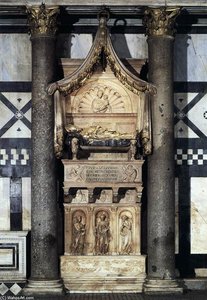
The Silent Majesty of St. John the Baptist
Donatello’s “St. John the Baptist,” sculpted around 1438 in Carrara marble and now residing within the serene Chapel of St. John the Baptist at Santa Maria Gloriosa dei Frari in Venice, is more than just a portrait; it's an embodiment of Florentine Renaissance ideals – a masterful synthesis of classical restraint and deeply human emotion. This isn’t the triumphant, idealized figure often depicted in later High Renaissance art; instead, Donatello presents us with a young man wrestling with profound spiritual awareness, a figure both vulnerable and powerfully resolute.
The sculpture immediately draws the eye with its stark simplicity. The pose is deliberately unassuming: John stands on a simple, unadorned pedestal, his body slightly turned away from the viewer, creating an intimate sense of connection. His garments are rough, almost shaggy, crafted from animal hide – a deliberate choice that speaks to his ascetic lifestyle and rejection of worldly comforts. This isn’t a king or a warrior; it's a prophet stripped bare, preparing for his calling. The muted palette of the marble further enhances this sense of austerity, emphasizing the figure’s inner intensity rather than external grandeur.
Donatello’s genius lies in his ability to imbue this seemingly straightforward form with an extraordinary depth of feeling. His face is a study in concentration and quiet contemplation. The furrowed brow, the intense gaze fixed on some distant point, and the slightly parted lips suggest a man wrestling with weighty truths – the impending judgment, the need for repentance, and the promise of salvation. The hand raised to his chest isn’t a gesture of piety; it's an expression of profound inner turmoil, as if he is grappling with the burden of his prophetic role.
A Renaissance Synthesis: Classical Influence & Florentine Innovation
To fully appreciate “St. John the Baptist,” one must understand the artistic currents swirling around Florence in the early 15th century. Donatello was deeply influenced by the rediscovery and reinterpretation of classical sculpture, particularly the works of Greek and Roman masters. However, he didn’t simply copy these ancient forms; instead, he adapted them to his own unique vision, imbuing them with a distinctly Florentine sensibility.
Notice the subtle contrapposto – the shift in weight that creates a dynamic sense of movement within the static form. This technique, borrowed from classical sculpture, gives John’s body a naturalism and vitality rarely seen in earlier Gothic art. Furthermore, Donatello's use of marble is remarkably expressive; he skillfully manipulates the texture and surface to create subtle gradations of light and shadow, highlighting the contours of the face and torso and adding depth and volume to the figure.
Crucially, Donatello was pushing beyond the conventions of his predecessors. While earlier Florentine sculptors often depicted religious figures in elaborate, richly ornamented robes, Donatello favored a more restrained approach, focusing on capturing the essence of the subject’s character rather than merely illustrating their status or piety. This emphasis on psychological realism – conveying inner thoughts and emotions through outward form – was a hallmark of the Early Renaissance.
Symbolism & Spiritual Significance
The sculpture is rich in symbolic meaning, reflecting John's role as a precursor to Christ. The rough animal hide garments represent his rejection of worldly possessions and his dedication to a life of simplicity and asceticism. His bare feet symbolize humility and connection with the earth.
The raised hand, as mentioned earlier, is particularly significant. It’s not an act of blessing or benediction; it's a gesture of warning – a call to repentance and preparation for the coming of the Messiah. The book held in his hand isn’t a scriptural text but a scroll containing John’s prophecies, further emphasizing his role as a messenger of God.
The overall effect is one of profound spiritual intensity. “St. John the Baptist” is not merely a depiction of a biblical figure; it's an invitation to contemplate our own relationship with faith, morality, and the mysteries of existence. It’s a testament to Donatello’s ability to capture the complexities of the human spirit within the confines of sculpted stone.
A Legacy Enduring: Reproduction & Artistic Inspiration
Reproductions of “St. John the Baptist” offer art enthusiasts and interior designers alike an opportunity to bring this iconic masterpiece into their homes or spaces. When selecting a reproduction, consider the level of detail and accuracy – a high-quality print on canvas or a meticulously crafted three-dimensional sculpture will best capture the essence of Donatello’s original work.
Beyond its aesthetic appeal, “St. John the Baptist” serves as a powerful reminder of the enduring legacy of the Early Renaissance. Donatello's innovative techniques and profound psychological insights continue to inspire artists and designers today, demonstrating the timeless relevance of his vision. This sculpture is not just a work of art; it’s a window into the soul of Florence – a city that forever changed the course of Western civilization.
Fragen & Antworten
Wer ist der Urheber von "St John the Baptist" und aus welchem Jahr stammt das Werk?
Donatello schuf „St John the Baptist“ im Jahr 1438.
Welche Farbe prägt die Komposition von "St John the Baptist" von Donatello?
Die Farbe, die in „St John the Baptist“ am stärksten hervorsticht, ist Putty (#d1cec9). Die dominante Farbe ist hilfreich, um ein Kunstwerk auf eine Inneneinrichtung abzustimmen.
Wer hat "St John the Baptist" geschaffen und in welchem Stil ist es gehalten?
Donatello schuf „St John the Baptist“ im Rahmen der Early Renaissance-Bewegung.
Ähnliche Kunstwerke




Künstlerbiografie
Frühes Leben und Karriere
Donato di Niccolò di Betto Bardi, bekannt als Donatello, wurde um 1386 in Florenz, Italien geboren. Er studierte klassische Bildhauerei, was seine Entwicklung eines frühen Renaissance-Stils stark beeinflusste. Dieser neue Ansatz für Kunst und Kultur sollte schließlich zum Kennzeichen der florentinischen Renaissance werden.Schlüsselwerke und Innovationen
Donatellos berühmtestes Werk, David, war seit der Antike die erste freistehende nackte männliche Skulptur. Sie wurde von der Familie Medici in Auftrag gegeben und zeigte seinen innovativen Stil und seine technische Expertise. Zu den anderen bemerkenswerten Werken gehören:- St. Louis von Toulouse (jetzt im Museum der Basilika di Santa Croce), das einen klassischen Rahmen aufwies, der von Donatello entworfen wurde.
- Das Opfer des Isaak, geschaffen für den Campanile von Santa Maria del Fiore in Florenz, zeichnete sich durch starke Porträtdetails aus.
- Kreuzifix (1425) für Santa Croce, das Christus in einem Moment der Agonie darstellte.
Künstlerischer Stil und Vermächtnis
Donatellos Stil lässt sich in breite Phasen einteilen, beginnend mit der Entwicklung von Ausdruckskraft und klassischer Monumentalität. Seine Arbeit wurde nicht sofort von der Gemeinschaft akzeptiert, entwickelte sich aber schließlich zum beliebtesten und beeinflusste andere italienische Höfe und europäische Künstler. Wichtige Kunstbewegungen:Persönliches Leben und Arbeitsweise
Donatello war bekannt dafür, liebenswert und gutmütig zu sein, aber schlecht in der geschäftlichen Seite seiner Karriere. Er nahm oft mehr Aufträge an, als er bewältigen konnte, und vollendete Werke häufig verspätet oder übergab sie anderen Bildhauern. Bemerkenswerte Kunstwerke und Künstler:- Leonardo da Vinci: Ankündigung (Detail)
- Amico Aspertini: Statua di Pan/Leone che azzanna un cavallo
- Michelangelo Buonarroti: Tondo Pitt
Museen und Kunstsammlungen:
- Museo della Collegiata (Empoli, Italien): Ein verstecktes Juwel der Renaissance mit Werken von Francesco Botticini und Raffaello Botticini.
- Die frühe italienische Kunstbewegung der Renaissance

Donatello
1386 - 1466 , Italien
Kurzinfos
- Beeinflusste Künstler:
- Leonardo da Vinci
- Michelangelo Buonarroti
- Bemerkenswerte Werke:
- David
- St. Louis von Toulouse
- Das Opfer des Isaak
- Kreuzifix (1425)
- Geburtsdatum: ca. 1386
- Geburtsort: Florenz, Italien
- Künstlerische Bewegung:
- Frührenaissance
- Florentiner Renaissance
- Künstlerische Einflüsse: ['Antike Skulptur']
- Nationalität: Italiener
- Sterbedatum: 1466
- Vollständiger Name: Donatello (Donato di Niccolò)
Ähnliche Artikel

John Constable: Die 25 Meisterwerke des englischen Landschaftsgenies – AllPaintingsStore
Entdecken Sie die 25 Meisterwerke von John Constable! Erleben Sie englische Landschaftsmalerei vom Hay Wain bis zur Stour Valley. Hochwertige Reproduktionen & Kunst für Ihr Zuhause auf AllPaintingsStore.com.

Die 10 legendärsten Bronzestatuen: Meisterwerke, die Kunstgeschichte schrieben | AllPaintingsStore
Entdecken Sie die 10 legendärsten Bronzestatuen der Kunstgeschichte! Von Rodin bis Michelangelo – erfahren Sie die Geschichten hinter ikonischen Skulpturen und finden Sie hochwertige Reproduktionen für Ihr Zuhause. Jetzt bei AllPaintingsStore entdecken!
John Singer Sargent: Die 25 Meisterwerke des Porträts – Kunst für Ihr Zuhause | AllPaintingsStore
Entdecken Sie die 25 Meisterwerke von John Singer Sargent! Tauchen Sie ein in die Welt der Porträtmalerei, des Impressionismus & der Belle Époque. Hochwertige Kunstdrucke & Reproduktionen für Ihr Zuhause – jetzt auf AllPaintingsStore.com!

Bronze-Meisterwerke: Die 10 Skulpturen, die Kunstgeschichte schrieben | AllPaintingsStore
Entdecken Sie die 10 legendärsten Bronze Skulpturen der Kunstgeschichte! Von Michelangelo bis Rodin – erfahren Sie die Geschichten hinter den Meisterwerken und lassen Sie sich von Wanddeko-Ideen inspirieren. Hochwertige Kunstdrucke auf AllPaintingsStore.com.

The Enduring Form: Exploring Themes & Techniques in Sculpture Across Historical Periods
Explore the rich history of sculpture from ancient masterpieces to contemporary innovations. Discover key techniques, influential artists & investment potential for discerning art collectors.


