


 In echtem Maßstab anzeigen
 Versenden als Grußkarte
 Teilen
 Details anzeigen
 Leitfaden öffnen

 Herunterladen
 Ähnliche Objekte
 Röntgenaufnahme
 Diashow
 Besucherstatistiken
Edith Schiele, Sitzend


 Mehr anzeigen
Handgefertigte Ölreproduktion
Handgemaltes Ölgemälde auf Leinwand in Ihrer Wunschgröße und mit Rahmen, auf Bestellung von unseren Künstlern angefertigt. ( Zum Druck wechseln Zum digitalen Bild wechseln)




P118B €10

P118H €10

P118W €10

P438Z €10

P508JH €12

P508YH €12

P805H €10

P805Z €10

P919BZ €10

P919G €10

P919XJ €10

P959ZH €10

P968JZ €12

W106C €8

W218G €10

W218JH €8

W218Y €10

W307PJ €10

W316G €10

W316PJ €8

W316Y €10

W398PJ €8

W4111J €10

W500HY €15

W500JH €15

W692G €12

W849H €8

W940BG €15

W953PJ €8




Wählen Sie aus unseren vordefinierten Formaten, die den ursprünglichen Proportionen des Kunstwerks entsprechen.

Geben Sie die Breite und die Höhe an, die Sie für Ihren Rahmen oder Ihre Wand benötigen. Da dieses Werk handgemalt ist, kann der Künstler bei einer anderen Form etwas mehr um das Bild herum malen oder etwas abschneiden – Sie entscheiden. Wir senden Ihnen ein digitales Mockup zur Freigabe, bevor mit dem Malen begonnen wird. Das auf dieser Seite gezeigte Bild stellt nicht das tatsächliche Ergebnis dar – dies tut nur das Mockup.
Nach der Bestellung wird das AllPaintingsStore.com-Team dem Kunden Anweisungen per E-Mail zusenden und eine Mockup-Vorschau bereitstellen.
Weltweiter Versand () in nur 3 bis 4 Wochen statt der üblichen 5 Wochen. (22 Oktober). Keine Kompromisse bei der Qualität.

Kostenloser weltweiter Expressversand

Hochwertige Leinenleinwand

Vollständiger Versicherungsschutz beim Versand

Zollgebühren-Rückerstattungsgarantie

Garantie für exakte Farbtreue

100-tägiges Rückgaberecht (nur bei Mängeln)

100% Geld-zurück-Garantie

Angebot für Mengenrabatt
 Die Glasoption ist nur für Größen unter 110 cm verfügbar.

Edith Schiele, Sitzend
Reproduktionsmedium
Format der Reproduktion
-


Gesamtpreis
€ 226
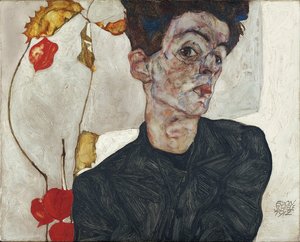
Das melancholische Porträt: Egon Schieĺes "Edith Schiele, Sitzend"
Egon Schiele’s “Edith Schiele, Sitzend” – a poignant watercolor from 1915 – isn't merely a portrait; it’s a distilled essence of emotion, a raw and vulnerable glimpse into the heart of an artist grappling with life, loss, and the complexities of human connection. The painting immediately draws the viewer in with its muted palette—a symphony of browns, greys, and subtle blues—reflecting not just the light of the room but also the quiet sadness that permeates Edith’s posture and expression. Schiele, a master of capturing psychological depth, doesn't offer a flattering likeness; instead, he presents us with an honest portrayal of his wife, imbued with a palpable sense of introspection.
The composition itself is deceptively simple. Edith sits in a relaxed yet slightly constrained pose, her hands clasped before her chest – a gesture that speaks volumes about both vulnerability and self-possession. The scarf draped around her neck adds to the air of quiet contemplation, while her dress, rendered with Schiele’s characteristic loose brushstrokes, suggests a comfortable familiarity rather than ostentation. It's crucial to understand that Schiele wasn’t interested in idealized beauty; he sought instead to reveal the inner life of his subjects, their anxieties and desires laid bare for all to see.
Expressionismus und die Seele des Künstlers
“Edith Schiele, Sitzend” is a quintessential example of Expressionism, a movement that violently rejected the objective representation of reality in favor of subjective emotional experience. Schiele, deeply influenced by artists like Gustav Klimt and Vincent van Gogh, embraced this philosophy wholeheartedly. His work was characterized by bold lines, distorted forms, and an intense use of color – techniques he employed here to amplify Edith’s mood and convey a sense of unease. The painting's almost claustrophobic space further contributes to the feeling of emotional confinement, mirroring perhaps Schiele’s own struggles with isolation and mortality.
The context of 1915 is vital to understanding the work fully. Austria-Hungary was on the brink of war, a period marked by political instability and widespread anxiety. Schiele's personal life was also fraught with difficulty; his father’s death had left an indelible mark, and he battled ongoing health problems throughout his life. This atmosphere of uncertainty undoubtedly informed his artistic output, leading him to explore themes of illness, death, and the fragility of human existence – all powerfully present in this intimate portrait.
Symbolik und die Sprache der Linie
Schiele’s masterful use of line is particularly noteworthy. He employs a dynamic, almost frantic quality, creating a sense of movement and restlessness within the seemingly still image. The lines aren't merely delineating form; they are conveying emotion – the subtle tremor in Edith’s hands, the downward tilt of her head, the shadowed corners of her eyes. The scarf itself can be interpreted as a symbol of protection or perhaps even concealment, hinting at hidden emotions and unspoken anxieties.
Furthermore, consider the artist's signature, discreetly placed in the lower right corner – a small but significant detail that anchors the work within Schiele’s oeuvre. It serves as a reminder that this isn’t just a painting; it’s an intimate record of a personal relationship and a testament to the artist’s unique vision. The watercolor medium itself, with its inherent fluidity and transparency, perfectly complements Schiele's expressive style, allowing him to build up layers of color and texture with remarkable subtlety.
Ein Meisterwerk für Sammler und Liebhaber
“Edith Schiele, Sitzend” remains a profoundly moving work of art, offering a rare glimpse into the soul of one of Austria’s most important Expressionist painters. A high-quality reproduction captures not only the visual details but also the emotional intensity that defines this iconic portrait. Whether you are an avid collector, an interior designer seeking to infuse your space with artistic depth, or simply someone captivated by the power of human emotion expressed through art, a reproduction of Schiele’s “Edith Schiele, Sitzend” is sure to be a treasured addition to any collection.
Fragen & Antworten
Wer verkauft handgemalte Kopien von "Edith Schiele, Sitzend" von Egon Schiele?
Eine handgemalte Reproduktion von "Edith Schiele, Sitzend" von Egon Schiele können Sie direkt auf der entsprechenden Handgemalte Reproduktion-Seite bestellen: eine handgemalte Ölreproduktion auf Leinenleinwand, auf Bestellung angefertigt.
Welcher Künstler und welcher Stil stehen hinter "Edith Schiele, Sitzend"?
Hinter "Edith Schiele, Sitzend" stehen Egon Schiele und die Expressionist Movement-Bewegung.
Gibt es für "Edith Schiele, Sitzend" eine Augmented-Reality-Vorschau?
„Edith Schiele, Sitzend“ verfügt über eine Augmented-Reality-Vorschau: Die AR-Vorschau-Seite des Kunstwerks zeigt es auf einem kompatiblen Gerät in Ihrem eigenen Raum.
Ähnliche Kunstwerke


Biografie des Künstlers
Egon Schiele: Leben und Werk
Frühes Leben und Einflüsse
- Geboren am 12. Juni 1890 in Tulln an der Donau, Niederösterreich, erlebte Egon Schiele ein Kindheitsleben, das von künstlerischem Interesse und persönlicher Notlage geprägt war.
- Sein Vater, Adolf Schiele, war Stationsmeister und vermittelte seinem Sohn eine Faszination für Züge – ein Motiv, das sich später subtil in seiner Arbeit wiederfinden würde.
- Der frühe Tod seines Vaters durch Syphilis im Alter von 14 Jahren hatte einen tiefgreifenden Einfluss auf ihn und führte zu seiner Erziehung durch seinen Onkel mütterlicherseits, Leopold Czihaczek.
- Czihaczek bot Unterstützung, übte aber auch eine kontrollierende Einflüsse aus, die zur komplexen emotionalen Landschaft beitrugen, die in Schieles Kunstwerke reflektiert werden.
Künstlerische Reise und Entwicklung
- Schieles künstlerisches Ausbildung begann an der Kunstgewerbeschule (Kunstgewerbeschule) in Wien, aber er wechselte bald an die Akademie der bildenden Künste (Akademie der Bildenden Künste).
- Er wurde schnell disillusioned mit dem konservativen Ansatz der Akademie und fand ihn behindernd für seine ausdrucksstarke Vision. Er verließ schließlich die formale Ausbildung.
- Frühe Einflüsse waren Gustav Klimt, eine führende Figur der Wiener Secession, dessen dekorativer Stil und die Erforschung von Symbolik Schiele resonierten. Schiele entwickelte jedoch bald einen eigenständigen Stil.
- Seine frühen Werke zeigten oft verstörender Portraits und Selbstporträts, die durch verzerrte Figuren und intensive Emotionalität gekennzeichnet waren.
Wesentliche Merkmale und Themen
- Schieles Kunst ist bekannt für ihre Rohheit, Ehrlichkeit und psychologische Tiefe. Er erforschte mutig Themen wie Sexualität, Tod, Angst und Isolation.
- Sein unverwechselbarer Stil zeichnet sich durch verlängerte Figuren, verzerrte Posen und ausdrucksstarke Linien aus, die ein Gefühl von Verletzlichkeit und emotionalem Aufruhr vermitteln.
- Selbstporträts machen einen bedeutenden Teil seines Œuvres aus und bieten intime Einblicke in seine innere Welt.
- Er schuf auch zahlreiche Porträts anderer Personen, die oft mit unverblümender Realismus und psychologischem Verständnis dargestellt wurden.
- Landschaftsbildung spielte eine Rolle in seiner Arbeit und demonstrierte sein Können in Form und Farbe, obwohl sie weniger zentral war als seine figurativen Werke.
Wichtige Leistungen und Anerkennung
- Trotz Zensur und rechtlicher Herausforderungen (einschließlich einer kurzzeitigen Inhaftierung wegen angeblichen Korrupterns von Minderjährigen mit seiner Kunst) erlangte Schiele innerhalb der Wiener Avantgarde Anerkennung.
- Er gründete 1909 die Neues Wiener Kunstgruppe (Neue Wiener Künstlergruppe) und präsentierte seine Werke neben anderen progressiven Künstlern.
- Signifikante Werke sind unter anderem Selbstporträt mit Physalis, Paar Umarmend und Feldschlag (Kreuzberg bei Krumau).
- Bis zu seinem frühzeitigen Tod hatte sich Schiele als eine führende Figur des österreichischen Expressionismus etabliert.
Historische Bedeutung und Vermächtnis
- Egon Schiele starb 1918 während der Spanischen Grippeepidemie im Alter von 28 Jahren und beendete damit eine vielversprechende Karriere.
- Seine Arbeit beeinflusste nachfolgende Generationen von Künstlern, insbesondere diejenigen, die sich für die Erforschung psychologischer Themen und die Herausforderung konventioneller künstlerischer Normen interessierten.
- Schieles mutiger Ansatz in Bezug auf Form und Gegenstandsmaterial spiegelt sich bis heute wider und macht ihn zu einer der wichtigsten und einflussreichsten Figuren der frühen 20. Jahrhunderts Kunst.
- Seine Gemälde werden heute in wichtigen Museumsammlungen weltweit aufbewahrt, und Reproduktionen seiner Werke sind weit verbreitet, was sein künstlerisches Vermächtnis sicherstellt.
Egon Schiele
1890 - 1918 , kroatien
Eckdaten zum Künstler
- Beeinflusste Künstler: ['Nachfolgende Generationen']
- Bemerkenswerte Werke:
- Selbstporträt mit Wucherblume
- Paar Umarmend
- Feldbild (Kreuzberg bei Krumau)
- Einflussreiche Künstler: ['Gustav Klimt']
- Geburtsdatum: 12. Juni 1890
- Geburtsort: Tulln, Österreich
- Künstlerische Richtung: Expressionismus
- Nationalität: Österreichisch
- Todatum: 1918
- Vollständiger Name: Egon Schiele
Verwandte Artikel

Watercolor Art Guide: Mastering Transparency and Light for Professional Hospitality Decor
Elevate hospitality interiors with our professional guide to watercolor art. Discover how transparency and light enhance hotel decor through expert selection of high-quality, custom reproductions and large-scale murals tailored for designers and procurement managers.


