


 In echtem Maßstab anzeigen
 Versenden als Grußkarte
 Teilen
 Details anzeigen
 Leitfaden öffnen

 Herunterladen
 Ähnliche Objekte
 Röntgenaufnahme
 Diashow
 Besucherstatistiken
The Echo


 Mehr anzeigen
Giclée / Kunstdruck
Giclée- oder Leinwanddruck in Museumsqualität mit schneller Produktion und flexiblen Veredelungsoptionen. ( Handgemalte Reproduktion kaufen Zum digitalen Bild wechseln)




P118B $10

P118H $10

P118W $10

P438Z $10

P508JH $12

P508YH $12

P805H $10

P805Z $10

P919BZ $10

P919G $10

P919XJ $10

P959ZH $10

P968JZ $12

W106C $8

W218G $10

W218JH $8

W218Y $10

W307PJ $10

W316G $10

W316PJ $8

W316Y $10

W398PJ $8

W4111J $10

W500HY $15

W500JH $15

W692G $12

W849H $8

W940BG $15

W953PJ $8




Wählen Sie aus unseren vordefinierten Formaten, die den ursprünglichen Proportionen des Kunstwerks entsprechen.

Sie können Ihre eigenen Maße eingeben, um ein bestimmtes Format oder einen speziellen Platz einzupassen. Wenn das von Ihnen gewählte Format nicht den Proportionen des Originalbildes entspricht, werden wir das Kunstwerk entweder beschneiden oder das Bild mit einem gespiegelten oder einfarbigen Rand erweitern. Ein digitaler Entwurf wird Ihnen zur Genehmigung zugesandt, bevor die Produktion beginnt.
Bitte beachten Sie, dass die Vorschau auf dem Bildschirm nicht den tatsächlichen Zuschnitt oder die Erweiterung widerspiegelt. Nur der Entwurf zeigt die endgültige Komposition präzise an.
Obwohl Sondermaße verfügbar sind, empfehlen wir die Auswahl eines Maßes aus der vordefinierten Liste, um die ursprünglichen Proportionen zu bewahren.
Weltweiter Versand () innerhalb von 2 Wochen statt der üblichen 4/5 Wochen. (26 September)

Kostenloser weltweiter Expressversand

Hochwertige Leinenleinwand

Vollständiger Versicherungsschutz beim Versand

Zollgebühren-Rückerstattungsgarantie

Garantie für exakte Farbtreue

100-tägiges Rückgaberecht (nur bei Mängeln)

100% Geld-zurück-Garantie

Angebot für Mengenrabatt
 Die Glasoption ist nur für Größen unter 110 cm verfügbar.

The Echo
Giclée / Kunstdruck
Format der Reproduktion
-


Gesamtpreis
$ 64
A Moment of Intense Expression: Exploring "The Echo" by Georges Seurat
Georges Pierre Seurat’s “The Echo” is not merely a depiction of a woman; it's an encapsulation of raw emotion, meticulously rendered through the revolutionary technique of Pointillism. Painted in 1880-1881, this work stands as a pivotal moment in the artist’s development and a testament to his unwavering commitment to scientific observation applied to artistic creation. The image immediately draws the viewer into a scene brimming with palpable intensity – a woman caught mid-expression, her mouth open in what could be a cry of anguish or a burst of song, forever frozen in a dramatic tableau.
- The Pointillist Technique: Seurat’s genius lies in his masterful deployment of Pointillism. Rather than applying broad strokes, he meticulously layered tiny dots of pure color – primarily blues, reds, and yellows – upon the canvas. This technique, derived from optical theories championed by Eugène-Louis Mellegren, creates an illusion of depth and luminosity through the viewer’s eye, which blends these individual points into a cohesive image.
- A Portrait of Modern Emotion: The subject's posture and expression resonate with the anxieties and uncertainties of late 19th-century Paris – a period marked by rapid industrialization, social upheaval, and a growing sense of alienation. This isn’t a romanticized portrayal; it’s a stark representation of human vulnerability.
- The Blurry Background: The indistinct background, featuring a hand holding an unseen object, adds to the painting's enigmatic quality. It could represent a microphone, a musical instrument, or perhaps simply a symbol of performance and distraction – elements that contribute to the woman’s isolated emotional state.
Historical Context and Seurat’s Vision
“The Echo” was created during a crucial period in Seurat's artistic journey. Following his initial Impressionistic explorations, he sought a more rigorous approach, influenced by scientific studies of color theory and optics. He was deeply interested in the work of Eugène Mellegren, who had developed theories about how the eye perceives color and light. This fascination led him to develop Pointillism as a method for achieving greater precision and luminosity in his paintings. Seurat’s ambition wasn't simply to capture a visual likeness; he aimed to create an optical illusion that would evoke a profound emotional response in the viewer.
The painting reflects the broader artistic currents of the time, bridging the gap between Impressionism’s focus on capturing fleeting moments and Post-Impressionism’s emphasis on subjective expression. Seurat's work anticipated many of the developments in modern art that would emerge in the 20th century.
Symbolic Layers and Emotional Resonance
The title, “The Echo,” suggests a reverberation – an emotional response to a preceding event or experience. The woman’s open mouth could be interpreted as a desperate plea for connection or a silent scream of frustration. The painting's monochromatic palette amplifies the sense of isolation and vulnerability, drawing attention to the raw emotion at its core.
- Color Psychology: Seurat’s strategic use of color – predominantly blues and reds – further enhances the emotional impact. Blue often represents melancholy or introspection, while red can symbolize passion, anger, or danger.
- The Figure as a Symbol: The woman herself becomes a symbol of human experience—a representation of the complexities of emotion, vulnerability, and perhaps even the struggle for self-expression.
A Masterpiece Recreated – A Statement for Your Space
AllPaintingsStore.com offers meticulously crafted hand-painted reproductions of “The Echo,” allowing you to bring this iconic work of art into your home or office. Each reproduction is created by skilled artisans using the highest quality materials, faithfully replicating Seurat’s groundbreaking Pointillist technique and capturing the painting's profound emotional depth. Whether you are an admirer of modern art, a collector seeking a significant addition to your collection, or an interior designer looking for a statement piece, this reproduction offers a unique opportunity to own a tangible connection to one of the most important figures in 19th-century art.
Ähnliche Kunstwerke


Biografie des Künstlers
Georges Seurat: Ein Pionier des Neoimpressionismus
Frühes Leben und Ausbildung
- Geboren: 2. Dezember 1859 in Paris, Frankreich.
- Seurats Familie zog kurz nach seiner Geburt auf den Boulevard de Magenta um.
- Sein Vater, Antoine Chrysostome Seurat, war ein ehemaliger Jurist, der durch Immobilienhandel reich wurde.
- Er begann seine künstlerische Ausbildung an der École Municipale de Sculpture et Dessin, in der Nähe seines Zuhauses, unter dem Bildhauer Justin Lequien.
- Im Jahr 1878 meldete er sich an der renommierten École des Beaux-Arts an und studierte bei Henri Lehmann.
Künstlerische Entwicklung und Einflüsse
- Seurats künstlerliche Persönlichkeit war eine einzigartige Mischung aus Sensibilität und logischer Abstraktion. Er verband zarte Empfindsamkeit mit mathematischer Präzision.
- Einflüsse: Obwohl spezifische Einflüsse diskutiert werden, studierte er die Farbbtheorien von Wissenschaftlern wie Michel Eugène Chevreul und Ogden Rood.
- Er experimentierte zunächst mit traditionellen Zeichentechniken, bevor er seinen charakteristischen Stil entwickelte.
- Seine frühen Werke zeigen ein Interesse an akademischer Malerei, ging aber allmählich zu einem innovativeren Ansatz über.
Chromoluminarismus und Pointillismus
- Seurat entwickelte die Techniken des Chromoluminarismus (die Wissenschaft der Farbe) und des Pointillismus, indem er kleine, deutliche Punkte reiner Farbe auf eine Leinwand auftrug.
- Er verwendete Conté-Kreide für detaillierte Zeichnungen auf rauer Papiersubstanz als Teil seines Prozesses.
- Ziel des Pointillismus: Die Idee war, dass das Auge des Betrachters diese Farben optisch miteinander mischen und so einen lebendigen und leuchtenden Effekt erzeugt.
Wichtige Leistungen und bemerkenswerte Werke
- Ein Sonntagnachmittag auf der Île de la Grande Jatte (1884-1886): Sein berühmtestes Werk, das den Beginn des Neoimpressionismus markiert. Es veranschaulicht seine Pointillist-Technik und seinen methodischen Ansatz.
- Alfalfa, Saint-Denis (1886-1887): Demonstriert seine Anwendung der Farbbtheorie auf eine ländliche Landschaft.
- Landschaft bei Saint-Ouen (1882-1883): Ein frühes Beispiel, das seinen sich entwickelnden Stil und sein Interesse an Licht und Atmosphäre zeigt.
- Der Eiffelturm (1889): Eine Darstellung des ikonischen Pariser Wahrzeichens, dargestellt mit Pointillist-Techniken.
- Bäderer in Asnières (1884): Ein weiteres bedeutendes Werk, das Freizeit und modernen Lebensstil mit seinem unverwechselbaren Stil erforscht.
Historische Bedeutung und Vermächtnis
- Seureats Werk beeinflusste die Entwicklung der modernen Kunst nachhaltig, insbesondere durch seinen Schwerpunkt auf subjektivem Ausdruck und die Erforschung neuer Techniken.
- Legte den Grundstein: Er legte den Grundstein für Bewegungen wie Fauvismus, Kubismus und Expressionismus.
- Sein wissenschaftlicher Ansatz in der Malerei stellte traditionelle künstlerische Konventionen in Frage.
- Trotz seines kurzen Lebens (er starb im Alter von 31 Jahren) hinterließ Seurat einen unauslöschlichen Eindruck in der Kunstgeschichte und inspirierte Generationen von Künstlern mit seiner innovativen Vision.
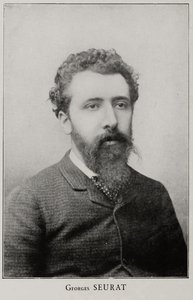
Georges Pierre Seurat
1859 - 1891 , Frankreich
Eckdaten zum Künstler
- Beeinflusste Künstler:
- Fauvismus
- Kubismus
- Bemerkenswerte Werke:
- Ein Sonntagnachmittag...
- Bäufer in Asnières
- Der Eiffelturm
- Einflüsse:
- Michel Eugène Chevreul
- Ogden Rood
- Geburtsdatum: 2. Dezember 1859
- Geburtsort: Paris, Frankreich
- Künstlerische Bewegung: Neo-Impressionismus
- Nationalität: Französisch
- Sterbedatum: 1891
- Vollständiger Name: Georges Pierre Seurat
Verwandte Artikel

The Science of Light: How Seurat and Signac Revolutionized Color with Pointillism
Explore the scientific revolution of Pointillism. Discover how Georges Seurat and Paul Signac utilized optical color mixing and light theory to transform modern art through Neo-Impressionist precision and luminous technique.


