In echtem Maßstab anzeigen
 Versenden
 Teilen
 Details anzeigen

 Herunterladen
 Ähnliche Objekte
 Röntgenaufnahme
 Diashow starten
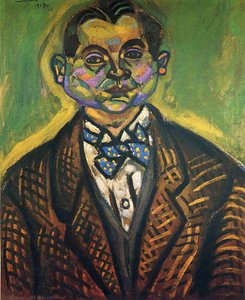
Man with pipe

 Mehr anzeigen
Giclée / Kunstdruck
Giclée- oder Leinwanddruck in Museumsqualität mit schneller Produktion und flexiblen Veredelungsoptionen. ( Zur handgemalten Reproduktion wechseln Zum Bild wechseln)




P118B $10

P118H $10

P118W $10

P438Z $10

P508JH $12

P508YH $12

P805H $10

P805Z $10

P919BZ $10

P919G $10

P919XJ $10

P959ZH $10

P968JZ $12

W106C $8

W218G $10

W218JH $8

W218Y $10

W307PJ $10

W316G $10

W316PJ $8

W316Y $10

W398PJ $8

W4111J $10

W500HY $15

W500JH $15

W692G $12

W849H $8

W940BG $15

W953PJ $8




Wählen Sie aus unseren vordefinierten Formaten, die den ursprünglichen Proportionen des Kunstwerks entsprechen.

Sie können Ihre eigenen Maße eingeben, um ein bestimmtes Format oder einen speziellen Platz einzupassen. Wenn das von Ihnen gewählte Format nicht den Proportionen des Originalbildes entspricht, werden wir das Kunstwerk entweder beschneiden oder das Bild mit einem gespiegelten oder einfarbigen Rand erweitern. Ein digitaler Entwurf wird Ihnen zur Genehmigung zugesandt, bevor die Produktion beginnt.
Bitte beachten Sie, dass die Vorschau auf dem Bildschirm nicht den tatsächlichen Zuschnitt oder die Erweiterung widerspiegelt. Nur der Entwurf zeigt die endgültige Komposition präzise an.
Obwohl Sondermaße verfügbar sind, empfehlen wir die Auswahl eines Maßes aus der vordefinierten Liste, um die ursprünglichen Proportionen zu bewahren.
Weltweiter Versand () innerhalb von 2 Wochen statt der üblichen 4/5 Wochen. (5 August)

Kostenloser weltweiter Expressversand

Hochwertige Leinenleinwand

Vollumfänglicher Versicherungsschutz beim Versand

Zollgebühren-Rückerstattungsgarantie

Garantie für exakte Farbtreue

60 Tage Rückgaberecht (nur bei Mängeln)

100% Geld-zurück-Garantie

Angebot für Mengenrabatt
 Die Glasoption ist nur in Größen unter 110 cm verfügbar.

Man with pipe
Giclée / Kunstdruck
Format der Reproduktion
-


Gesamtpreis
$ 64
Objektbeschreibung
A Catalan Dreamscape: Exploring Joan Miró’s “The Man with a Pipe”
Joan Miró's "The Man with a Pipe," painted in 1935, transcends mere representation; it embodies the artist’s deeply personal vision of Catalonia and the subconscious realm. Created during a period marked by political upheaval—the Spanish Civil War raged on—the painting serves as both an emblem of resilience and a meditation on universal themes of solitude and contemplation. Miró himself described his artistic process as “drawing with my eyes,” prioritizing intuition over meticulous observation, a characteristic that defines his distinctive style.- Style: Surrealist Abstraction
- Miró’s approach to painting aligns squarely with the tenets of Surrealism championed by André Breton and Pablo Picasso. Rejecting rational thought as a guide to artistic creation, he sought inspiration from dreams, myths, and automatic drawing—techniques designed to bypass conscious control.
Technique: Organic Forms and Bold Color Palette
The painting’s surface is characterized by irregular organic forms—circles, squares, spirals—rendered in a vibrant palette dominated by blues, yellows, and reds. Miró employed a layering technique, applying paint in multiple thin washes to build up texture and luminosity. This meticulous process ensured that each brushstroke contributed to the overall expressive quality of the artwork. The artist utilized tempera on canvas, selecting this medium for its ability to achieve brilliant colors and durable finish—a testament to his mastery of artistic craft.Symbolism: Echoes of Catalan Identity and Existential Concerns
“The Man with a Pipe” is laden with symbolic significance. The central figure—a stylized man holding a pipe—represents humanity grappling with existential anxieties, mirroring Miró’s own preoccupation with themes of isolation and the search for meaning. The pipe itself serves as a conduit to inner contemplation, symbolizing both aspiration and acceptance of life's inherent uncertainties. Furthermore, the moon—positioned prominently in the composition—is often interpreted as representing femininity, intuition, and cyclical renewal—elements deeply rooted in Catalan folklore.Historical Context: Navigating Turbulent Times
Painted during the Spanish Civil War (1936-1939), “The Man with a Pipe” reflects the anxieties of its era. Miró’s artistic output during this period was profoundly influenced by the political climate, expressing both defiance and melancholy—a duality that characterizes much of his oeuvre. The painting's dreamlike atmosphere serves as a counterpoint to the grim realities of war, offering solace in the realm of imagination and reminding viewers of the enduring power of beauty amidst darkness.Emotional Impact: A Portrait of Inner Reflection
Ultimately, “The Man with a Pipe” resonates deeply with audiences due to its ability to evoke feelings of serenity and introspection. Its captivating imagery invites contemplation on fundamental questions about human existence—questions that Miró himself wrestled with throughout his life. The painting’s enduring appeal lies in its capacity to transport viewers beyond the confines of everyday experience, fostering a connection to the subconscious mind and celebrating the transformative potential of art.This artwork is currently off view at The Art Institute of Chicago.
Ähnliche Kunstwerke





Künstlerbiografie
**frühes Leben und Karriere**
joan miró, ein renommierter spanischer Maler, Bildhauer und Keramiker, wurde am 20. April 1893 in Barcelona, Spanien, geboren. Seine Familie, von jüdischen (Marrano oder Konverso) Wurzeln, hatte einen bedeutenden Einfluss auf sein frühes Leben. Mirós Vater, Miquel Miró Adzerias, war Goldschmied und Uhrmacher, was möglicherweise der Künstlersein Interesse an komplizierten Details inspirierte.**Künstlerische Entwicklung**
Miró begann mit sieben Jahren mit Zeichenunterricht in einer privaten Schule in Barcelona. Später nahm er am Kunstakademie La Llotja auf, trotz Ablehnung durch seinen Vater. Dies markierte den Beginn von Mirós künstlerischer Reise, die schließlich zu seiner Pionierarbeit im Surrealismus und abstrakter Kunst führte.**Bekannte Werke und Kooperationen**
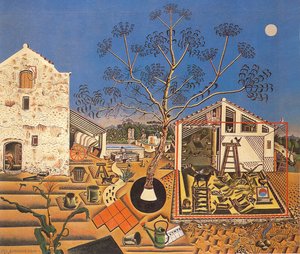
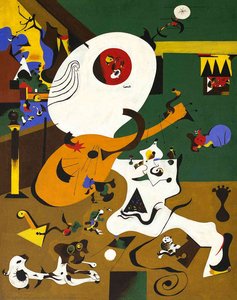
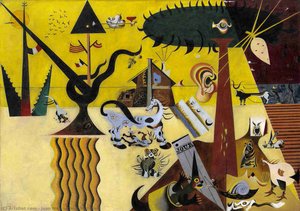
* The Farm (1922), ein Gemälde, das Mirós Übergang zu einem individuelleren Stil zeigt, mit nationalistischen Zügen. * Zusammenarbeit mit Max Ernst bei der Gestaltung von Sergei Diaghilews Ballett 1926, die die Technik des Grattage begründete. * The Dutch Interiors (1928), eine Reihe von Gemälden, inspiriert von Hendrik Martenszoon Sorth und Jan Steen, die Mirós einzigartigen Stil zeigt.**Museen und Vermächtnis**
* Die Fundació Joan Miró in Barcelona, gegründet 1975, die Mirós Werke präsentiert. * Die Fundació Pilar i Joan Miró in Palma de Mallorca, gegründet 1981, festigte Mirós Vermächtnis weiter.**Wichtige Werke und ihre Bedeutung**
- Painting (1933), ein abstraktes Ölgemälde, das Mirós surrealistische Vision veranschaulicht.
- Pintura 11, ein weiteres bemerkenswertes abstraktes Werk, das Mirós einzigartigen Stil zeigt.
- The Ear of Corn (37 x 46 cm), ein surrealistisches Werk, das komplizierte Details zeigt.
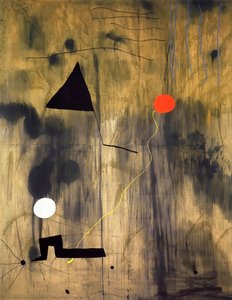
- The Birth of Day, ein abstraktes Kunstwerk, das Mirós Beiträge zur abstrakten Kunst weiter festigt.
**Fazit**
Mirós Vermächtnis als Pionier des Surrealismus und der abstrakten Kunst ist unbestreitbar. Seine Werke, die in verschiedenen Museen ausgestellt werden, darunter die Fundació Joan Miró, inspirieren weiterhin Künstler und Kunstliebhaber gleichermaßen. Für weitere Informationen über Mirós Werke besuchen Sie [https://AllPaintingsStore.com/@/joan-miro](https://AllPaintingsStore.com/@/joan-miro) oder erkunden Sie seine bemerkenswerten Werke unter [https://AllPaintingsStore.com/@@/8ewky5-joan-miro-painting](https://AllPaintingsStore.com/@@/8ewky5-joan-miro-painting).- Mehr Kunstwerke von Joan Miró auf AllPaintingsStore.com
- Entdecken Sie das Museum Fundació Joan Miró in Barcelona, Spanien
- Erkunden Sie die Biografie und bemerkenswerten Werke des Künstlers unter [https://en.wikipedia.org/wiki/joan_mir%c3%b3](https://en.wikipedia.org/wiki/joan_mir%c3%b3)
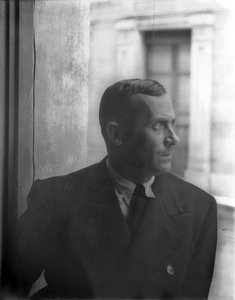
Joan Miró
1893 - 1983 , Spanien
Eckdaten zum Künstler
- Beeinflusste Künstler:
- Vincent van Gogh
- Paul Cézanne
- Bemerkenswerte Werke:
- Die Farm (1922)
- Dutch Interiors (1928)
- Gemälde (1933)
- Geburtsdatum: 20. April 1893
- Geburtsort: Barcelona, Spanien
- Künstlerischer Stil: Surrealismus, abstrakte Kunst
- Nationalität: Spanisch
- Todatum: 1983
- Vollständiger Name: Joan Miró i Ferrà
Verwandte Artikel

André Masson: Automatisme, Surrealismus und die expressive Kraft einer Künstlergeneration
Entdecken Sie das faszinierende Werk André Massons! Wir beleuchten seine Rolle im Surrealismus, die Technik des Automatismus und seinen Einfluss auf die moderne Kunstgeschichte. Expertenwissen & tiefe Einblicke.
Joan Mirós Meisterwerke: Die Top 25 für Kunstliebhaber & stilvolles Wohnen
Entdecken Sie die Top 25 Gemälde von Joan Miró! Tauchen Sie ein in die Welt des Surrealismus, abstrakter Kunst & katalanischer Farben. Hochwertige Kunstdrucke & Reproduktionen für Ihr Zuhause – jetzt auf AllPaintingsStore.com!

Surrealismus: Die 10 Meisterwerke, die eine Kunstbewegung prägten |
Entdecken Sie die 10 prägendsten Meisterwerke des Surrealismus! Von Dalí bis Magritte – erfahren Sie die Geschichten hinter ikonischen Gemälde und lassen Sie sich von traumhaften Welten inspirieren. Hochwertige Art Reproduktionen auf .

Surrealismus: Die 10 Meisterwerke, die eine Kunstbewegung prägten | AllPaintingsStore
Entdecken Sie die 10 Meisterwerke des Surrealismus! Von Dalí bis Magritte – erfahren Sie die Geschichten hinter ikonischen Gemälde und lassen Sie sich von traumartigen Bildern inspirieren. Hochwertige Art Reproduktionen auf AllPaintingsStore.com.

Beyond Form & Color: Geometric Abstraction's Evolution in 20th/21st Century Art
Explore the evolution of geometric abstraction from Cubism to contemporary art. Discover key artists like Malevich & Mondrian, investment insights, and expert collecting advice at AllPaintingsStore.