1635. Oil On Canvas, 72.0 x 65.0 cm. National Gallery of Art.

§ 1Catalogue data
 Oil On Canvas
- WallArt
- Baroque
 1635
1635- Early Modern
 72.0 x 65.0 cm
 National Gallery of Art
§ 2Abstract
Beschreibung des Sammlerstücks
Discover Judith Leyster's 'Self-Portrait,' a captivating Baroque masterpiece showcasing her artistic skill and confident spirit as a pioneering female painter.
 Weiterlesen
Künstlerbiografie
Ein beeindruckendes Gemälde von Rembrandt über einem alten Mann im luxuriösen Fellmantel. Entdecken Sie die Kunstgeschichte und die außergewöhnliche Lichtführung dieses Meisterwerks!
§ 3Commentary
A Glimpse into Genius: Judith Leyster's Self-Portrait
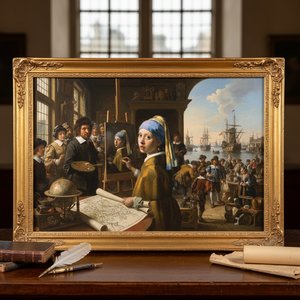
To stand before this self-portrait of Judith Jans Leyster is to encounter not merely a likeness, but a declaration of artistic intent. Painted around 1635, this work captures the essence of a pioneering spirit in an era that often sought to confine female genius. The subject gazes out with an intelligence and poise that transcends the conventions of portraiture from the Dutch Golden Age. She is presented as both the creator and the creation—a masterful self-examination rendered with breathtaking technical skill.
The Artist at Her Station: Symbolism and Subject
Leyster has thoughtfully included the tools of her trade, transforming the act of painting into a central narrative element. In one hand, she delicately holds a brush, poised as if pausing mid-stroke; in the other, rests an artist's palette, suggesting a recent or imminent burst of color and creativity. Her attire, featuring a meticulously rendered ruffled collar, speaks to the fashionable yet structured life of Haarlem society. Yet, it is her bearing that commands attention. Beyond herself, two male figures occupy the background, their engagement—one perhaps playing a musical instrument—adds a layer of social context, suggesting that art was not merely an indoor pursuit but a vibrant part of public life and intellectual discourse.
Mastery in Brushwork: Technique and Detail
The technical brilliance evident in this piece is remarkable. Leyster demonstrates a sophisticated handling of light and shadow, giving depth to the folds of her clothing and lending lifelike dimensionality to her features. The detail captured in the rendering of the background figures and the texture of the palette speaks to an advanced understanding of oil painting techniques popular during the 17th century. One can almost feel the viscosity of the paint and observe the subtle gradations of tone that bring the scene to such vivid life, making it a superb example of Dutch realism.
A Window into History: Context and Impact
Understanding Judith Leyster requires acknowledging her historical context. As one of the first documented female artists to join the prestigious Haarlem Guild of St. Luke, her very existence as a professional painter was an act of defiance and achievement. This portrait, possibly even serving as a presentation piece for the guild itself, is therefore imbued with significance far beyond its surface beauty. It speaks to ambition, perseverance, and the quiet revolution of female artistic autonomy during the Dutch Golden Age.
Bringing Genius Home: Owning the Artistry
For the collector or designer seeking an object that whispers tales of intellectual vigor and unparalleled craftsmanship, this reproduction offers a profound connection to art history. It is more than decoration; it is a conversation piece that celebrates female achievement in the arts. The rich narrative woven into every visible thread and painted highlight ensures that owning this work brings not just beauty, but a deep resonance with the enduring spirit of artistic genius.
Fragen & Antworten
Wie stellt "Self-Portrait" von Judith Leyster eine Verbindung zwischen Baroque und dem Heimatland des Künstlers her?
"Self-Portrait" wurde von Judith Leyster geschaffen, der in Niederlande geboren wurde, und ist der Baroque-Bewegung zuzuordnen. Die Herkunft des Künstlers verbindet das Werk mit der Baroque, wie sie von Künstlern aus Niederlande praktiziert wird.
Wer hat "Self-Portrait" geschaffen und in welchem Stil ist es gehalten?
"Self-Portrait" ist das Werk von Judith Leyster aus der Epoche des Baroque.
Kann ich "Self-Portrait" von Judith Leyster unter verschiedenen Lichtverhältnissen sehen?
„Self-Portrait“ kann auf der Röntgenblick-Seite des Kunstwerks Schicht für Schicht untersucht werden – ein Viewer, inspiriert von der Leuchttisch eines Restaurators, mit elf optischen Ebenen des Bildes.


 Zum Druck wechseln


 Bei Kunstwerken oder Reproduktionen, die an einer Seite größer als 105 cm (ca. 41 Zoll) sind, wird der Rahmen zerlegt als Bausatz geliefert. Diese Methode gewährleistet eine sichere Zustellung und verhindert Schäden während des Transports.