


 Vorschau anzeigen
 Versenden
 Teilen
 Details anzeigen
 Leitfaden

 Herunterladen
 Ähnliche Objekte
 Röntgenaufnahme
 Diashow
 Q&A
Q&A Statistiken
Stehender Akt


 Weiterlesen
Die auf dieser Seite dargestellten Kunstwerke sind urheberrechtlich geschützt, was bedeutet, dass wir keine identische Reproduktion rechtmäßig erstellen oder verkaufen dürfen. Dieser Schutz wird durch internationale Abkommen wie die Berner Übereinkunft und durch nationale Gesetze, einschließlich derer, die von den US-Urheberrecht – Titel 17.
Diese Methode entspricht vollumfänglich den Urheberrechtsbestimmungen, da sie keine Kopie oder Vervielfältigung des geschützten Kunstwerks darstellt. Stattdessen handelt es sich um eine kreative Neuinterpretation – ein neues Gemälde, das vom Original inspiriert, aber nicht identisch mit ihm ist.
Giclée / Kunstdruck
Giclée- oder Leinwanddruck in Museumsqualität mit schneller Produktion und flexiblen Veredelungsoptionen. ( Handgemalte Reproduktion bestellen Zum digitalen Bild wechseln)




P118B €10

P118H €10

P118W €10

P438Z €10

P508JH €12

P508YH €12

P805H €10

P805Z €10

P919BZ €10

P919G €10

P919XJ €10

P959ZH €10

P968JZ €12

W106C €8

W218G €10

W218JH €8

W218Y €10

W307PJ €10

W316G €10

W316PJ €8

W316Y €10

W398PJ €8

W4111J €10

W500HY €15

W500JH €15

W692G €12

W849H €8

W940BG €15

W953PJ €8




Wählen Sie aus unseren vordefinierten Formaten, die den ursprünglichen Proportionen des Kunstwerks entsprechen.

Geben Sie die benötigte Breite und Höhe an, damit der Druck perfekt in Ihren Rahmen oder an Ihre Wand passt. Ein Druck kann nur beschnitten, aber niemals größer als das Originalbild angefertigt werden; daher verliert ein Format mit anderen Proportionen einen Teil des Bildes. Wir senden Ihnen ein digitales Mockup zur Freigabe, bevor wir den Druck ausführen. Das auf dieser Seite gezeigte Bild zeigt nicht den tatsächlichen Beschnitt – dies ist nur im Mockup ersichtlich.
Weltweiter Versand () innerhalb von 2 Wochen statt der üblichen 4/5 Wochen. (30 Oktober)

Kostenloser weltweiter Expressversand

Hochwertige Leinenleinwand

Umfassender Versicherungsschutz beim Versand

Zollgebühren-Rückerstattungsgarantie

Garantie für exakte Farbtreue

100 Tage Rückgaberecht (nur bei Mängeln)

100% Geld-zurück-Garantie

Mengenrabatt verfügbar
 Die Glasoption ist nur für Größen unter 110 cm verfügbar.

Stehender Akt
Giclée / Kunstdruck
Format der Reproduktion
-


Endpreis
€ 57
A Bold Challenge to Artistic Conventions: Marcel Duchamp’s Standing Nude
Standing Nude, created in 1910 by Marcel Duchamp, isn't merely a depiction of the human form; it represents a seismic shift within the artistic landscape of its time—a defiant rejection of traditional aesthetics and an assertion of conceptual art’s nascent potential. The painting captures a woman standing naked against a rugged rocky backdrop, her gaze lowered as she extends her arms outwards, embodying both vulnerability and quiet contemplation. This seemingly simple composition belies a profound intellectual engagement with the core questions surrounding artistic creation.The Fauvist Style: Color as Emotion
Duchamp’s stylistic choice—fauvism—was revolutionary in itself. Unlike Impressionists who sought to capture fleeting moments of light and atmosphere, fauvists prioritized expressive color above all else. Artists like Matisse championed bold hues – vibrant reds, yellows, blues – applied with unrestrained spontaneity, prioritizing emotional impact over accurate representation. Duchamp’s use of intense pigments reflects this ethos; the dominant colors in Standing Nude are deliberately jarring against the muted tones of the rock formation, forcing the viewer to confront not just what is seen but how it feels. This deliberate distortion serves as a powerful commentary on the limitations of visual perception and invites contemplation about alternative modes of artistic expression.Technique and Material Considerations
The painting’s execution demonstrates Duchamp's meticulous attention to detail despite his rejection of representational art. While eschewing traditional brushstrokes, Duchamp employed a technique that nonetheless achieved remarkable textural richness. The artist utilized encaustic—a mixture of beeswax and resin—to create a surface that is both durable and capable of capturing subtle nuances in color and tone. This method allowed for layering pigments onto the wax base, resulting in an image that possesses depth and luminosity. Furthermore, Duchamp’s careful consideration of material contributes to the artwork's overall impact, grounding it in a tangible reality while simultaneously pushing boundaries of artistic convention.Historical Context: Dada and Artistic Rebellion
Standing Nude emerged during the turbulent years of Dada—a movement born out of disillusionment with the horrors of World War I and a vehement critique of bourgeois values. Dada artists deliberately undermined accepted artistic standards, embracing chance, absurdity, and anti-rationalism as tools for challenging societal norms. Duchamp’s démarche – presenting a porcelain urinal signed “R. Mutt” – epitomized this rebellious spirit, sparking controversy and redefining the very definition of art. Standing Nude aligns with Dada's broader project of questioning artistic authority and exploring new avenues for creative expression, cementing Duchamp’s legacy as one of the pioneers of conceptual art.Emotional Resonance: Beyond Representation
Ultimately, Standing Nude transcends mere visual representation; it speaks to fundamental questions about beauty, perception, and human experience. The woman's posture conveys a sense of quiet dignity amidst the starkness of the landscape, inviting viewers to consider themes of vulnerability, resilience, and contemplation. Duchamp’s intention wasn’t to depict a specific subject in a conventional manner but rather to provoke an emotional response—to disrupt complacency and stimulate intellectual curiosity. The painting's enduring appeal lies in its ability to resonate with audiences across generations who recognize the profound significance of its conceptual challenge.Fragen & Antworten
Welche Grundfarbe prägt "Stehender Akt" von Marcel Duchamp?
Die dominante Farbe von "Stehender Akt" von Marcel Duchamp ist Von Bernstein bis Safran. Dieser Farbton bildet die Grundlage der Palette.
Wie verbinden sich Kontrast und Harmonie in "Stehender Akt"?
In "Stehender Akt" trifft ein Kräftig Kontrast auf eine Harmonische Farbpalette Harmonie.
Was stellt "Stehender Akt" von Marcel Duchamp dar?
Die Themen in "Stehender Akt" von Marcel Duchamp umfassen aktfigur, felslandschaft, fauvistischer stil, dadaismus, konzeptkunst, minimalismus, abstraktion und fassen gemeinsam den Gegenstand des Kunstwerks zusammen.
Ähnliche Kunstwerke




Künstlerbiografie
frühes Leben und künstlerische Anfänge
Marcel Duchamp, ein französischer-amerikanischer Maler, Bildhauer, Schachspieler und Schriftsteller, wurde am 28. Juli 1887 in Blainville-Crevon, Normandie, Frankreich, geboren. Seine Familie, die für ihre kulturellen Neigungen bekannt war, förderte sein frühes Interesse an der Kunst. Duchamps künstlerischer Weg begann mit postimpressionistischen Stilen und experimentierte er mit klassischen Techniken und Themen.Künstlerische Entwicklung und bedeutende Werke
- Duchamps Werk ist mit Kubismus, Konzeptkunst und Dada verbunden, obwohl er vorsichtig mit dem Begriff „Dada“ umging.
- Eines seiner bekanntesten Werke, Fountain (1917), ein Urinal mit der Unterschrift „r. mutt“, ist ein Beispiel für seine Readymades und stellt die Vorstellung in Frage, was Kunst ausmacht.
- Portrait of Chess Players (1911), ein kubistisches Werk, zeigt sein Interesse am Spiel und seinen strategischen Aspekten.
- To Be Looked At (From the Other Side of the Glass) With One Eye, Close To, For Almost an Hour (1945) ist ein weiteres bemerkenswertes Werk, das seine dadaistischen Neigungen widerspiegelt.
Einfluss und Vermächtnis
Duchamps Einfluss auf die Kunst des 20. Jahrhunderts ist immens. Zusammen mit Pablo Picasso und Henri Matisse definierten er die bildenden Künste im frühen 20. Jahrhundert. Sein konzeptueller Ansatz zur Kunst hat Generationen von Künstlern beeinflusst.- Entdecken Sie mehr von Duchamps Werken auf AllPaintingsStore: Marcel Duchamp | Werke
- Besuchen Sie das Ohara Museum of Art in Japan, das westliche Kunstsammlungen umfasst, darunter einige, die vom Stil von Duchamp beeinflusst sind: Ohara Museum of Art, Japan
- Erfahren Sie mehr über Lettrismus, eine Bewegung, die von Dada und Surrealismus beeinflusst wurde, der Duchamp angehörte: Lettrismus Kunstbewegung
Fazit
Marcel Duchamps rätselhafter Ansatz zur Kunst, der konzeptuelle und dadaistische Elemente verbindet, hat einen unauslöschlichen Eindruck in der Kunstwelt hinterlassen. Sein Vermächtnis inspiriert weiterhin Künstler und beeinflusst die Entwicklung moderner und zeitgenössischer Kunst. Franck Scurti, ein französischer Künstler, der für seine Konzeptkunst bekannt ist, geht in den Fußstapfen von Duchamp und trägt so zum Vermächtnis dieses Pioniers weiter.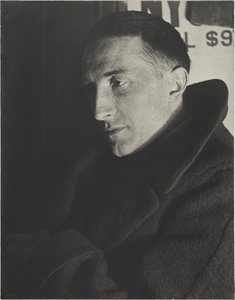
Marcel Duchamp
1887 - 1968 , Frankreich
Kurzinfos
- Bemerkenswerte Werke:
- Fountain
- Porträt der Schachspieler
- Das große Glas
- L.H.O.O.Q.
- Boîte-en-valise
- Geburtsdatum: 28. Juli 1887
- Geburtsort: Blainville-sur-Mer, Frankreich
- Künstler Oder Bewegungen, Von Denen Dieser Künstler Beeinflusst Wurde: ['Franck Scurti']
- Künstlerische Bewegung:
- Kubismus
- Dadaismus
- Konzeptkunst
- Nationalität: Französisch-Amerikanisch
- Todatum: 1968
- Vollständiger Name: Marcel Duchamp
Ähnliche Artikel

The Enduring Form: Exploring Themes & Techniques in Sculpture Across Historical Periods
Explore the rich history of sculpture from ancient masterpieces to contemporary innovations. Discover key techniques, influential artists & investment potential for discerning art collectors.

Die Essenz der Materie: Ein Leitfaden zur Meisterschaft und Technik der Bildhauerei
Erfahren Sie alles über die Meisterschaft der Bildhauerei und Materialkunde. Entdecken Sie die Kunst der Form jetzt!

Bronze-Meisterwerke: Die 10 Skulpturen, die Kunstgeschichte schrieben | AllPaintingsStore
Entdecken Sie die 10 legendärsten Bronze Skulpturen der Kunstgeschichte! Von Michelangelo bis Rodin – erfahren Sie die Geschichten hinter den Meisterwerken und lassen Sie sich von Wanddeko-Ideen inspirieren. Hochwertige Kunstdrucke auf AllPaintingsStore.com.

Marcel Duchamp: Konventionen herausfordern und die Kunst des 20. Jahrhunderts neu definieren
Entdecken Sie das revolutionäre Werk von Marcel Duchamp und seine Bedeutung für die moderne Kunst. Erfahren Sie mehr über Dadaismus, Readymades und den Einfluss auf die Konzeptkunst – fundiert analysiert & verständlich erklärt.

Die 10 legendärsten Bronzestatuen: Meisterwerke, die Kunstgeschichte schrieben | AllPaintingsStore
Entdecken Sie die 10 legendärsten Bronzestatuen der Kunstgeschichte! Von Rodin bis Michelangelo – erfahren Sie die Geschichten hinter ikonischen Skulpturen und finden Sie hochwertige Reproduktionen für Ihr Zuhause. Jetzt bei AllPaintingsStore entdecken!


