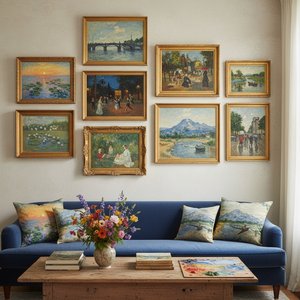
1890. Öl auf Leinwand.

§ 1Catalogue data


§ 2Abstract
Beschreibung des Sammlerstücks
Ein Meisterwerk des Postimpressionismus von Paul Cézanne zeigt einen jungen Mann im Ruhezustand und wird für seine einfache Schönheit gefeiert. Entdecken Sie die Kunstgeschichte!
 Weiterlesen
Künstlerbiografie
Erkunden Sie die revolutionäre Kunst von Paul Cézanne (1839–1906), einem Postimpressionisten, der Impressionismus und Kubismus miteinander verband. Entdecken Sie seine geometrischen Formen, seine einzigartigen Pinselstriche, Stilllebenmalereien und seinen bleibenden Einfluss auf die moderne Kunst. #Cézanne #PostImpressionismus
§ 3Commentary
Paul Cézanne: A Pioneer of Modern Art
Paul Cézanne (1839–1906) stands as an undeniable cornerstone of the artistic landscape transitioning from Impressionism to Cubism, marking a pivotal moment in European art history. His unwavering dedication to exploring new visual languages and challenging conventional academic standards cemented his legacy as “the father of us all,” earning him admiration from artists like Henri Matisse and Pablo Picasso.
Born in Aix-en-Provence, Cézanne’s early artistic influences stemmed from Romanticism and the Barbizon school, where he absorbed the grandeur of landscapes and the expressive power of tonal painting. However, it was his encounter with Impressionist painters—particularly Claude Monet and Camille Pissarro—that fundamentally reshaped his approach to art. Unlike Impressionists who sought to capture fleeting moments of light and color, Cézanne focused on conveying underlying structure and form, prioritizing geometric shapes and planar surfaces.
“Boy Resting,” created in 1890, exemplifies this distinctive style perfectly. The painting depicts a young boy seated outdoors, his head bowed in contemplation—a posture that speaks volumes about Cézanne’s fascination with human psychology and his desire to depict inner states alongside external appearances.
- Composition: Cézanne employed a revolutionary technique known as “picto-métrique,” which involved dissecting objects into geometric planes and reconstructing them on the canvas. This approach departs dramatically from traditional perspective, creating an illusion of depth that feels more organic and psychologically resonant than merely optical.
- Color Palette: Cézanne’s color choices are subdued yet deliberate, favoring earthy tones—ochres, browns, greens—that harmonize with the natural environment depicted in the painting. He utilized color not to reproduce reality faithfully but rather to convey mood and emotion, prioritizing tonal relationships over vibrant hues.
- Brushwork: Cézanne’s characteristic brushstrokes are visible and textured, contributing significantly to the painting's expressive quality. These repetitive strokes build up layers of pigment, creating a palpable sense of physicality and capturing the essence of the subject matter.
The historical context surrounding “Boy Resting” is equally important. Cézanne’s work initially faced considerable criticism from Parisian art critics who deemed it incomprehensible and lacking in aesthetic merit. Yet, fellow artists recognized his genius early on—particularly Camille Pissarro and Ambroise Vollard—who championed his artistic vision and secured him a prominent place within the burgeoning avant-garde movement.
“Boy Resting” continues to captivate viewers today with its serene atmosphere and profound contemplation of human experience. Cézanne’s unwavering commitment to exploring new modes of representation solidified his position as one of the most influential artists of the twentieth century, inspiring generations of painters and shaping the trajectory of modern art.
Fragen & Antworten
Für welche Verwendung und welchen Raum wird "Boy Resting" von Paul Cézanne empfohlen?
Empfohlene Verwendung (Akzentuierung) und Raum (Wohnbereich) sind die zwei Empfehlungen für "Boy Resting" von Paul Cézanne.
Für welches Format wird die Platzierung von „Boy Resting“ im Format Querformat empfohlen?
Format (Querformat) und der empfohlene Raum (Wohnbereich) sind die beiden Platzierungshinweise für "Boy Resting" von Paul Cézanne.
Aus welchem Land stammt das Post-Impressionism-Werk „Boy Resting“?
"Boy Resting" verbindet die Post-Impressionism-Bewegung durch den Geburtsort ihres Schöpfers mit Frankreich.


 Zum Druck wechseln


 Bei Kunstwerken oder Reproduktionen, die an einer Seite größer als 105 cm (ca. 41 Zoll) sind, wird der Rahmen zerlegt als Bausatz geliefert. Diese Methode gewährleistet eine sichere Zustellung und verhindert Schäden während des Transports.