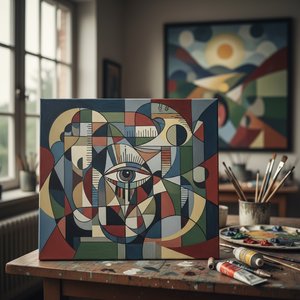
Acryl auf Leinwand.

§ 1Katalogdaten

§ 2Abstrakt
Beschreibung des Sammlerstücks
Entdecken Sie eine beeindruckende Aquarellabbildung von Paul Klee – 'Grenze'. Minimalistisch und voller Farbe, inspiriert von Musik und Natur. Jetzt hochwertige Reproduktionen auf AllPaintingsStore!
 Weiterlesen
Künstlerbiografie
Entdecken Sie Paul Klee (1879-1940): Schweizer-Deutscher Künstler, der Expressionismus, Kubismus und Surrealismus vereint. Erkunden Sie seine Farbtheorie, den Einfluss der Bauhaus-Schule und seine spielerisch intelligente Kunst.
§ 3Kommentar
Ein Blick auf „Monument on the Border of the Fertile Country“ von Paul Klee
Paul Klee’s “Monument on the Border of the Fertile Country” stands as a testament to his singular artistic vision—a deceptively simple watercolor that encapsulates profound philosophical contemplation alongside breathtaking visual beauty. Painted in 1937 during a period marked by increasing anxieties surrounding the looming Second World War, this artwork transcends mere representation; it delves into themes of balance, harmony, and the interplay between organic forms and geometric abstraction. Klee’s masterful use of color—primarily muted blues and greens—creates an atmosphere of serene contemplation, mirroring the artist's own reflections on humanity’s relationship with nature and spirituality. The composition itself is deliberately asymmetrical, emphasizing a central vertical element that draws the eye upwards, symbolizing aspiration and transcendence. It’s remarkable how Klee achieves such depth through seemingly minimal means – a technique rooted in his belief that “the most important thing is to see.”Die Kunst des Einfachen: Eine Analyse von Klees Stil
Klee's stylistic approach distinguishes him from many of his contemporaries, rejecting the dominant trends of Expressionism and Cubism in favor of a uniquely personal aesthetic. He embraced a method he termed "automatische Malerei," or automatic painting—a technique designed to bypass conscious thought and tap into subconscious impulses. This process involved letting ink flow freely onto paper while simultaneously manipulating it with brushes and blots, resulting in spontaneous patterns and textures that defied rational control. While seemingly chaotic on the surface, these automatisms served as a crucial springboard for Klee’s creative exploration, allowing him to access hidden layers of emotion and intuition. The resulting images—often characterized by fragmented shapes, overlapping planes, and vibrant hues—are imbued with an unmistakable sense of childlike wonder and imaginative freedom. This stylistic choice reflects Klee's conviction that art should be liberated from the constraints of realism, prioritizing emotional resonance over literal accuracy.Farbe und Form: Techniken und Materialien bei „Monument on the Border of the Fertile Country“
The watercolor medium itself—a relatively fragile material—was chosen deliberately by Klee to convey a sense of vulnerability and impermanence. He employed thin washes of pigment applied in multiple layers, building up tonal variations with painstaking precision. The artist’s meticulous attention to detail is evident in the subtle gradations of color and the delicate rendering of organic forms—particularly the stylized flowers that punctuate the composition. Klee experimented extensively with different brushes and blotting techniques, achieving textural effects that contribute significantly to the artwork's overall impact. Furthermore, he incorporated elements of collage—small pieces of paper adhered to the watercolor surface—adding visual interest and reinforcing the theme of interconnectedness. These innovative approaches underscore Klee’s commitment to pushing the boundaries of artistic expression and exploring new possibilities within established mediums.Historischer Kontext und Bedeutung
“Monument on the Border of the Fertile Country” emerged during a turbulent period in European history, coinciding with the rise of Fascism and the escalating tensions leading up to World War II. Klee’s artwork can be interpreted as an expression of humanist ideals—a yearning for peace, beauty, and spiritual harmony amidst the pervasive anxieties of his time. The painting's understated elegance serves as a counterpoint to the grand narratives of political propaganda, reminding viewers of the importance of individual contemplation and ethical responsibility. Moreover, it aligns with Klee’s broader philosophical concerns regarding the role of art in confronting existential dilemmas—a quest for meaning and transcendence that resonates powerfully across generations.Emotionale Wirkung und Interpretationen
Ultimately, “Monument on the Border of the Fertile Country” captivates viewers not merely through its visual splendor but also through its profound emotional depth. The artwork evokes feelings of serenity, wonder, and contemplation—inviting us to consider our place within the natural world and to embrace the transformative power of imagination. Critics have noted Klee’s masterful ability to convey complex ideas—such as the tension between order and chaos—through deceptively simple visual elements. It's a painting that speaks to the human spirit, prompting viewers to engage in an ongoing dialogue with its enduring beauty and intellectual richness.Fragen & Antworten
Welche Stellung nimmt „Grenze“ unter den wiederkehrenden Motiven von Paul Klee ein?
"Grenze" stellt color palette, geometric shapes, bird motif, floral elements, watercolor technique, minimalist composition, swiss art style dar, während die dokumentierten Themen von Paul Klee expressionist color harmony, bauhaus geometric forms, swiss folklore imagery, symbolic bird representation, exploring artistic depth sind. Ein Vergleich der beiden zeigt, wie das Werk mit den üblichen Sujets des Künstlers in Verbindung steht.
Welche Atmosphäre verleiht "Grenze" von Paul Klee einem Raum?
Mit seiner Gelassenheit Stimmung wird „Grenze“ für ein Wohnbereich empfohlen.
Welche Farbpalette und welche Leitfarbe prägen "Grenze"?
Die Farbidentität von "Grenze" von Paul Klee: eine Dunkle Farbtöne-Palette, dominiert von Treibholzfarben (#c39359).


 Zum Druck wechseln


 Bei Kunstwerken oder Reproduktionen, die an einer Seite größer als 105 cm (ca. 41 Zoll) sind, wird der Rahmen zerlegt als Bausatz geliefert. Diese Methode gewährleistet eine sichere Zustellung und verhindert Schäden während des Transports.