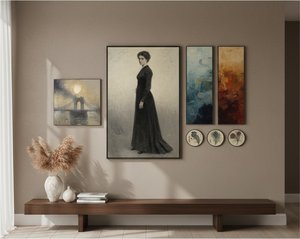
1841. Acrylic On Canvas. Royal College of Physicians Museum.

§ 1Catalogue data


§ 2Abstract
Beschreibung des Sammlerstücks
Admire "James Hope" by Thomas Phillips (1841), a captivating portrait of a distinguished gentleman. Explore the artist's masterful technique and historical context within the Royal College of Physicians.
 Weiterlesen
Künstlerbiografie
Entdecken Sie Thomas Phillips (1770-1845), britischen Porträt- & Historiker, bekannt für Detailreichtum & königliche Portraits! #BritishArt #PortraitPainting
§ 3Commentary
A Portrait of Intellectual Intensity: James Hope by Thomas Phillips
Thomas Phillips’s “James Hope,” painted in 1841, is more than simply a likeness; it's a carefully constructed tableau of Victorian intellect and restrained emotion. The portrait captures James Hope (1801-1841), a prominent English physician and cardiologist, not as a flamboyant figure, but as a man deeply engaged with the complexities of his profession and the world around him. Phillips, a master of the British portrait style, eschews dramatic gestures or overtly expressive features, instead favoring a subtle yet profound exploration of Hope’s inner life.
The painting's composition is remarkably restrained. Hope sits in a simple, dark-toned chair, his gaze fixed directly on the viewer – an act of directness that immediately establishes a connection. His hands, resting calmly on his lap, are rendered with meticulous detail, hinting at both intellectual prowess and a quiet dignity. The background is deliberately muted, almost entirely devoid of distraction, drawing all attention to the subject himself. This deliberate lack of ornamentation speaks volumes about Phillips’s approach: he believed that true character resided not in outward display but in the subtle nuances of expression and demeanor.
The Language of Victorian Portraiture
Phillips was a key figure in the development of Victorian portraiture, a style characterized by its realism, psychological depth, and often, a sense of moral seriousness. He inherited much from his mentor, Benjamin West, but he developed a distinctive approach that prioritized capturing the inner life of his subjects. Unlike earlier portraits which frequently emphasized wealth or social status, Phillips sought to reveal something deeper about the individual’s character – their intellect, their values, and perhaps even their anxieties.
The painting's palette is deliberately subdued, dominated by dark browns, grays, and greens. This somber coloration contributes to the overall sense of introspection and gravitas. The use of light is equally strategic; it highlights Hope’s face and hands, drawing the viewer’s eye to these points of focus while leaving the rest of the composition in shadow. This chiaroscuro effect – the dramatic contrast between light and dark – was a hallmark of Phillips's technique and creates a powerful sense of depth and atmosphere.
Symbolism and Context
“James Hope” must be viewed within the context of 19th-century British society, a period marked by rapid scientific advancement, social reform, and a growing emphasis on education and intellectual pursuits. Hope’s profession as a physician reflected this era's burgeoning interest in science and medicine, and his portrait serves as a testament to the rising status of the medical profession. The serious expression on Hope’s face suggests a man deeply committed to his work, burdened perhaps by the responsibility of caring for others.
Furthermore, the painting can be interpreted through the lens of Victorian moral philosophy. The restrained demeanor and thoughtful gaze reflect the Victorian ideal of self-control and intellectual rigor. Phillips was known for portraying subjects who embodied these values, suggesting that true virtue lay in cultivating one’s mind and resisting impulsive desires.
A Legacy of Psychological Realism
“James Hope” remains a compelling example of Victorian portraiture's ability to capture the complexities of human character. Phillips’s masterful use of light, color, and composition creates an image that is both visually striking and psychologically profound. It’s not merely a representation of a man; it’s a window into his soul – a testament to the enduring power of art to reveal the hidden depths of the human experience. Reproductions of this work offer a valuable opportunity to appreciate Phillips's skill and gain insight into the intellectual currents of Victorian England.
Fragen & Antworten
In welchem Museum befindet sich das Original von „James Hope“?
"James Hope" von Thomas Phillips wird im Royal College of Physicians Museum, London, Vereinigtes Königreich ausgestellt. Die Museumsangabe bezieht sich auf das Originalwerk, nicht auf Reproduktionen.
Wo kann ich einen Druck von "James Hope" von Thomas Phillips kaufen?
"James Hope" ist als ein Fine Art Print auf Baumwollkanvas oder Archiv-Leinwandpapier erhältlich. Bestellungen können in der gewünschten Größe auf der Kunstdruck in Premiumqualität-Seite aufgegeben werden.
In welchem Jahr und welcher Stilrichtung wurde "James Hope" geschaffen?
"James Hope" entstand im Jahr 1841 als Werk der Victorian Portraiture-Bewegung. Entstehungsjahr und Stilrichtung verankern das Kunstwerk in der Kunstgeschichte.


 Zum Druck wechseln


 Bei Kunstwerken oder Reproduktionen, die an einer Seite größer als 105 cm (ca. 41 Zoll) sind, wird der Rahmen zerlegt als Bausatz geliefert. Diese Methode gewährleistet eine sichere Zustellung und verhindert Schäden während des Transports.