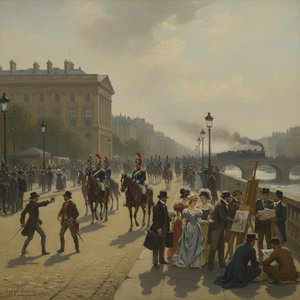
Emile Auguste Hublin: A Painter of Quiet Dignity
Emile Auguste Hublin (1830-1891) was a French painter whose work, often overlooked in the grand narratives of 19th-century art, offers a profoundly intimate glimpse into rural life and the quiet dignity of everyday people. Born in Zurich, Switzerland, to a family deeply involved in philanthropic endeavors – his father was a prominent humanitarian – Hublin’s early life instilled within him a strong sense of social responsibility and a keen awareness of human suffering. This sensibility would become a defining characteristic of his artistic vision, shaping his choice of subjects and the empathetic tone of his paintings.
Hublin's artistic journey began with studies in Zurich under Wilhelm Leibl, a pioneering figure in German Realism who emphasized psychological depth and naturalistic representation. However, it was his time in Paris that truly cemented his style. He enrolled at the École des Beaux-Arts, where he encountered the burgeoning Impressionist movement, though he never fully embraced its radical experimentation with color and light. Instead, Hublin developed a distinct approach – a meticulous realism tempered by a delicate sensitivity and an almost melancholic atmosphere. His palette remained largely subdued, favoring earthy tones and muted blues and greens to evoke the landscapes of Brittany and Normandy, regions that would become central to his oeuvre.
The World of Breton Peasants
Hublin’s most celebrated works depict the lives of Breton peasants – farmers, fishermen, and their families – in the rugged coastal region of Finistère. These paintings are not romanticized depictions of rural idyll; rather, they offer a poignant portrayal of hardship, resilience, and quiet dignity. He meticulously observed his subjects, capturing their weathered faces, calloused hands, and the weariness etched into their lives. His compositions often feature figures engaged in mundane tasks – mending nets, tending to livestock, or simply sitting together in contemplative silence – yet these seemingly simple scenes are imbued with a profound sense of humanity.
A particularly poignant example is “A Friend in Need” (1879), which portrays a woman offering assistance to another, conveying a powerful message of compassion and mutual support within a community grappling with poverty. Similarly, "Le chemin du marché, Finistère" (circa 1880) captures the bustling activity of a Breton market, showcasing the vibrant yet challenging realities of rural commerce. Hublin’s ability to render such subtle emotional nuances – the weight of responsibility, the quiet strength of character, and the enduring bonds of kinship – is what distinguishes his work from more overtly dramatic depictions of peasant life.
Technique and Influences
Hublin's technique was characterized by a painstaking attention to detail and a remarkable ability to capture the textures of fabric, wood, and skin. He employed a layered approach to painting, building up thin glazes of color to create a sense of depth and luminosity. His brushwork is generally smooth and controlled, reflecting his commitment to realism. While influenced by Realism, particularly Leibl’s emphasis on psychological portrayal, Hublin also absorbed elements from the Barbizon School, known for its focus on landscape painting and its rejection of academic conventions.
Furthermore, Hublin's personal experiences profoundly shaped his artistic vision. His family’s commitment to social justice instilled in him a deep empathy for the marginalized and vulnerable. He was also deeply affected by the poverty and hardship he witnessed during his travels throughout France and Switzerland. These observations informed his choice of subjects and imbued his paintings with a sense of quiet sorrow and moral concern.
Legacy and Significance
Despite not achieving widespread fame during his lifetime, Emile Auguste Hublin’s work has gained increasing recognition in recent decades as a significant contribution to French Realism and a poignant reflection on the lives of ordinary people. His paintings offer a valuable counterpoint to the grand narratives of history, focusing instead on the quiet dignity and enduring spirit of those often overlooked by mainstream art. Hublin's legacy lies not only in his beautiful and evocative paintings but also in his unwavering commitment to portraying the human condition with honesty, compassion, and profound sensitivity.
His works are now housed in several prominent museums, including the Musée d’Orsay in Paris, testament to their enduring artistic merit and historical significance. Hublin's art serves as a reminder of the importance of looking beyond the surface and recognizing the beauty and dignity that can be found even in the most humble of lives.
Fragen & Antworten
In welchen Stilrichtungen war Emile Auguste Hublin tätig?
Die Seite Alle Stilrichtungen gruppiert die Kunstwerke von Emile Auguste Hublin nach Kunstströmungen.
Wo kann ich alle Kunstwerke von Emile Auguste Hublin sehen?
Alle Werke von Emile Auguste Hublin auf diese Website können auf der Alle Kunstwerke-Seite des Künstlers durchstöbert werden.
Gibt es eine Zeitachse der Werke von Emile Auguste Hublin?
Die Kunstwerke von Emile Auguste Hublin können in chronologischer Reihenfolge auf der Zeitstrahl der Kunstwerke-Seite des Künstlers eingesehen werden.
Gibt es eine virtuelle 3D-Tour durch die Werke von Emile Auguste Hublin?
Ein virtueller Besuch ist möglich: Die Seite 3D-Museum von Emile Auguste Hublin präsentiert die Werke des Künstlers in einer dreidimensionalen Galerie.
Wie finde ich Werke von Emile Auguste Hublin in einer bestimmten Farbpalette?
Die Werke von Emile Auguste Hublin können auf der Nach Farbpaletten-Seite des Künstlers nach Farbpaletten durchsucht werden.
Wo sind die Kunstwerke von Emile Auguste Hublin nach Schlagworten gruppiert?
Die Werke von Emile Auguste Hublin können über die Nach Schlagworten-Seite nach Schlagworten durchsucht werden. Jedes Schlagwort gruppiert die entsprechenden Kunstwerke.
Wo kann ich die Kunstwerke von Emile Auguste Hublin nach Stimmung sortiert sehen?
Die Seite Stimmungswelt des Künstlers zeigt die Kunstwerke von Emile Auguste Hublin, sortiert nach ihrer Atmosphäre.
Kann ich die Kunstwerke von Emile Auguste Hublin nach Farben sortieren?
Die Werke von Emile Auguste Hublin können auf der Spektraler Index-Seite des Künstlers nach Farben sortiert erkundet werden.