Gilbert Rogers (1881 – 1956): Witnessing War Through Impressionistic Vision
Gilbert Rogers was a British painter whose artistic output primarily focused on capturing the visceral experience of World War I, specifically depicting stretcher bearers and the medical corps. Born in London in 1881, Rogers possessed an innate fascination with art from a young age, honing his skills through self-study and experimentation before embarking on a formal artistic education at Slade School of Fine Art. This formative period instilled in him a deep appreciation for Impressionism, influencing his distinctive style and palette—characterized by loose brushstrokes and vibrant colors intended to convey mood and atmosphere rather than precise detail.- Early Life & Artistic Influences:
- Rogers’s upbringing fostered an interest in sketching and drawing landscapes, establishing a foundational understanding of composition and tonal variation.
The WWI Canvas: Capturing the Front Line Experience
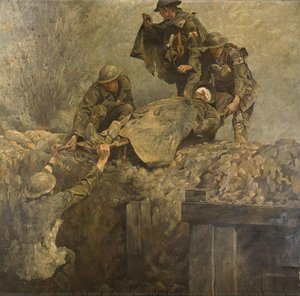
Rogers's artistic career gained prominence during the First World War. Recognizing the urgent need for visual documentation of the conflict’s realities—particularly the grueling conditions faced by medical personnel—he volunteered his talents to depict scenes from hospitals and ambulance convoys. His most celebrated works include “First World War A Convoy of Ambulances of the Royal Army Medical Corps after a Battle,” an evocative portrayal of stretcher bearers navigating the aftermath of combat, meticulously rendered in oil on canvas. This painting exemplifies Rogers’s commitment to conveying emotion through color and brushwork—a hallmark of Impressionistic technique—creating a powerful impression of both chaos and compassion amidst the horrors of war. He collaborated closely with photographers like Bertram Wooster to produce composite images that combined photographic realism with artistic interpretation, furthering the effort to document the war's impact on human experience.- Notable Paintings:
- "First World War A Convoy of Ambulances of the Royal Army Medical Corps after a Battle" (1917): Demonstrates Rogers’s masterful use of Impressionistic brushstrokes to convey the emotional intensity of wartime trauma.
Technique & Artistic Style: Impressionism's Impact
Rogers embraced Impressionist principles wholeheartedly, prioritizing subjective perception over objective representation. He eschewed meticulous detail in favor of capturing fleeting moments and atmospheric conditions—a deliberate choice that aligns with the broader artistic movement’s rejection of academic conventions. Rogers skillfully blended pigments to achieve luminous color harmonies, layering brushstrokes to build up tonal depth and creating a sense of immediacy and dynamism on his canvases. His approach mirrored the pioneering efforts of artists like Monet and Renoir, who sought to capture the essence of light and color as experienced by the human eye—a stylistic decision that cemented Rogers’s legacy as a significant contributor to British Impressionism.Legacy & Historical Significance
Gilbert Rogers's paintings stand as poignant reminders of the First World War’s profound psychological toll on soldiers and medical staff alike. Beyond their aesthetic beauty, they serve as invaluable historical records—offering insights into the daily lives of those involved in treating wounded veterans. Rogers’s artistic vision transcended mere visual depiction; he aimed to communicate empathy and understanding for the suffering endured by individuals confronting unimaginable circumstances. His work continues to resonate with audiences today, prompting reflection on themes of resilience, compassion, and the enduring power of art to bear witness to human experience during times of crisis.Fragen & Antworten
Kann ich die Kunstwerke von Gilbert Rogers nach Farben sortieren?
Die Werke von Gilbert Rogers können auf der Spektraler Index-Seite des Künstlers nach Farben sortiert erkundet werden.
Wie finde ich alle Werke von Gilbert Rogers in einem bestimmten Medium?
Um alle Werke von Gilbert Rogers in einem bestimmten Medium zu finden, nutzen Sie die Alle Medien-Seite des Künstlers.
Wie finde ich Werke von Gilbert Rogers in einer bestimmten Farbpalette?
Um Werke von Gilbert Rogers in einer bestimmten Farbpalette zu finden, nutzen Sie die Nach Farbpaletten-Seite des Künstlers.
Wo kann ich die Kunstwerke von Gilbert Rogers in chronologischer Reihenfolge sehen?
Die Kunstwerke von Gilbert Rogers können in chronologischer Reihenfolge auf der Zeitstrahl der Kunstwerke-Seite des Künstlers eingesehen werden.
In welcher historischen Epoche war Gilbert Rogers tätig?
Gilbert Rogers war in der Epoche der Modern tätig. Diese Periode ordnet das künstlerische Schaffen historisch ein.
Wie hat sich die Kunst von Gilbert Rogers im Laufe der Zeit entwickelt?
Eine chronologische Übersicht des Werks von Gilbert Rogers ist auf der Chronik-Seite des Künstlers verfügbar, wo die Kunstwerke kapitelweise in ihrer Entstehungsreihenfolge präsentiert werden.
In welchen Stilrichtungen war Gilbert Rogers tätig?
Die Werke von Gilbert Rogers können auf der Seite Alle Stilrichtungen nach Kunstströmungen durchsucht werden.
Wie viele Kunstwerke von Gilbert Rogers können durchstöbert werden?
Sie können 17 Kunstwerke Werke von Gilbert Rogers auf der Seite Alle Kunstwerke durchstöbern.