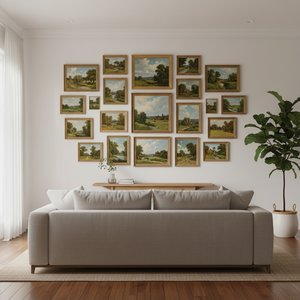
A Life Rooted in the Suffolk Landscape: The World of Harry Becker
Harry Becker, born in 1865 and passing in 1928, was an English painter and printmaker whose artistic vision was inextricably linked to the rural beauty of East Anglia, particularly his native Suffolk. While not a household name like some of his contemporaries, Becker carved out a significant niche for himself as a chronicler of the changing countryside, a sensitive observer of wildlife, and a skilled illustrator who captured the essence of agricultural life with remarkable detail and empathy. His work offers a poignant glimpse into a world on the cusp of transformation, bridging the gap between Victorian traditions and the burgeoning modern era. Becker’s artistic journey wasn't one of dramatic stylistic shifts or avant-garde experimentation; rather, it was a deepening exploration of subjects he knew intimately – the fields, hedgerows, birds, and animals that populated his surroundings. He possessed an exceptional ability to convey atmosphere and light, imbuing his paintings with a quiet sense of reverence for the natural world.Early Influences and Artistic Development
Becker’s formal artistic training remains somewhat obscure, but it is clear he benefited from exposure to the established art schools of London. The influence of Victorian realism is readily apparent in his early works – a meticulous attention to detail, a subdued palette, and a focus on accurate representation. However, Becker wasn't merely a copyist; he quickly developed a distinctive style characterized by loose brushwork and a subtle use of color that captured the nuances of light and shadow. He was drawn to the Barbizon school painters, whose emphasis on plein air painting – working directly from nature – resonated with his own artistic inclinations. The works of Jean-François Millet, in particular, seem to have left an impression, inspiring Becker’s sympathetic portrayal of rural laborers and their connection to the land. His early paintings often depict scenes of farm life, livestock, and idyllic landscapes, rendered with a delicate precision that belies a deep understanding of his subjects. He wasn't interested in grand historical narratives or mythological themes; instead, he found beauty and meaning in the everyday rhythms of rural existence.The Suffolk Trilogy and Beyond: Major Works & Themes
Becker is perhaps best known for his illustrations accompanying Adrian Bell’s trilogy of autobiographical novels – Corduroy, Silver Farm, and The Youngest Householder. These works, published in the 1920s, offer a vivid portrayal of life on a Suffolk farm during the interwar period. Becker’s illustrations are not merely decorative embellishments; they are integral to the narrative, capturing the atmosphere, characters, and emotional landscape of Bell's stories with remarkable sensitivity.- His depictions of agricultural labor – ploughing, harvesting, tending livestock – are particularly noteworthy, conveying both the physical hardship and the inherent dignity of rural work.
- Becker’s wildlife paintings also form a significant part of his oeuvre. He was an avid ornithologist and naturalist, and his portrayals of birds – skylarks, larks, pheasants, and other native species – are characterized by their accuracy and vitality.
- Beyond the Bell illustrations, Becker produced numerous independent paintings depicting Suffolk landscapes, often focusing on scenes near his home in Hadleigh. These works capture the changing seasons, the play of light across fields and meadows, and the quiet beauty of the countryside.
Historical Significance & Legacy
While Becker never achieved widespread fame during his lifetime, his work has gained increasing recognition in recent years as scholars and collectors have rediscovered his unique contribution to British art. He stands as an important representative of the East Anglian school of painting, a group of artists who shared a common interest in depicting the rural landscape with honesty and sensitivity. His paintings offer valuable insights into the social and economic changes that were transforming Britain in the early 20th century – the decline of traditional agriculture, the impact of industrialization, and the changing relationship between humans and nature. Becker’s legacy lies not in groundbreaking innovation but in his ability to capture the essence of a particular place and time with quiet grace and enduring beauty. His work continues to resonate with viewers today, offering a poignant reminder of the importance of preserving our natural heritage and celebrating the simple pleasures of rural life. He is remembered as a skilled craftsman, a keen observer, and a sensitive interpreter of the Suffolk landscape he loved so deeply.Fragen & Antworten
Unter welchen anderen Namen ist Harry Becker bekannt?
Harry Becker erscheint unter den Alternativnamen Henry Becker, H. Becker, Harry William Becker.
Wie finde ich Werke von Harry Becker zu einem bestimmten Thema?
Die Werke von Harry Becker können über die Nach Schlagworten-Seite nach Schlagworten durchsucht werden. Jedes Schlagwort gruppiert die entsprechenden Kunstwerke.
Gibt es eine vollständige Liste der Kunstwerke von Harry Becker?
Alle Werke von Harry Becker auf diese Website können auf der Alle Kunstwerke-Seite des Künstlers durchstöbert werden.
Kann ich die Werke von Harry Becker nach Stimmung durchsuchen?
Die Seite Stimmungswelt des Künstlers zeigt die Kunstwerke von Harry Becker, sortiert nach ihrer Atmosphäre.
Gibt es eine Zeitachse der Werke von Harry Becker?
Die Zeitstrahl der Kunstwerke-Seite des Künstlers präsentiert die Werke von Harry Becker, chronologisch nach Jahren geordnet.
Wie viele Kunstwerke von Harry Becker können durchstöbert werden?
Sie können 17 Kunstwerke Werke von Harry Becker auf der Seite Alle Kunstwerke durchstöbern.
Kann ich die Werke von Harry Becker nach dem Farbspektrum erkunden?
Die Spektraler Index von Harry Becker ist eine Seite, auf der die Kunstwerke des Künstlers nach ihren Farben sortiert sind.
Gibt es eine Übersicht über alle Motive, die Harry Becker gemalt hat?
Die Seite Themenatlas ordnet die Kunstwerke von Harry Becker nach Themen an.