A Quiet Observer of the English Landscape: The Life and Art of James Poole
James Poole, born in 1804, remains a somewhat enigmatic figure within the pantheon of British landscape painters. While not achieving the widespread renown of contemporaries like Turner or Constable, his serene and meticulously rendered depictions of the English countryside offer a compelling glimpse into the Victorian appreciation for natural beauty and the evolving artistic sensibilities of the era. Poole’s life, though relatively undocumented, appears to have been one dedicated to observation and faithful representation – qualities that permeate his entire *oeuvre*. He spent much of his career documenting the landscapes surrounding Norwich, Norfolk, becoming particularly associated with scenes of Skiddaw in Cumbria, a testament to his willingness to travel for compelling subject matter. His work provides valuable insight into the visual world experienced by those living through a period of rapid industrialization and social change, offering a counterpoint of tranquility and enduring natural form.Early Influences and Artistic Development
Poole’s artistic formation is difficult to trace with precision, but it's reasonable to assume he benefited from the thriving Norwich School of painting. This regional movement, active in the first half of the 19th century, emphasized direct observation of nature and a relatively unidealized approach to landscape. Artists like John Crome and Joseph Stannard championed a realistic style focused on local scenes, and Poole’s early works clearly reflect this influence. He began by capturing the intimate details of Norfolk's fields, waterways, and skies with a delicate watercolor technique. However, unlike some of his Norwich School peers who embraced a more dramatic or expressive brushstroke, Poole favored precision and clarity. His paintings are characterized by a subtle palette, careful attention to atmospheric effects, and a commitment to accurately portraying the topography of the land. This dedication suggests a strong foundation in topographical drawing and possibly early training as a surveyor or cartographer.The Cumbria Series: Capturing the Majesty of Skiddaw
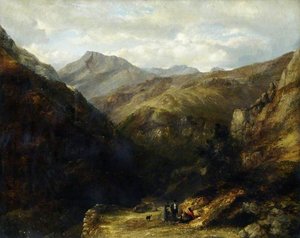
A significant portion of Poole’s artistic output is devoted to scenes of Skiddaw, one of the highest peaks in the Lake District. These paintings are arguably his most accomplished and reveal a deepening understanding of light, shadow, and form. He wasn't merely recording the appearance of the mountain; he was capturing its *essence* – the way sunlight played across its slopes, the shifting moods of the weather, and the sense of scale and grandeur it inspired. The Cumbria series demonstrates Poole’s ability to move beyond purely local subject matter and engage with a more monumental landscape tradition. He skillfully rendered the rugged terrain, often including figures in his compositions to emphasize the human relationship with nature. These works were popular with collectors seeking evocative depictions of the English countryside, and they helped establish Poole's reputation as a skilled landscape painter.Beyond Landscape: Portraiture and Historical Record
While best known for his landscapes, Poole also undertook portrait commissions, notably one depicting the Mayor of Norwich in 1846. This painting provides a fascinating glimpse into Victorian civic life and demonstrates Poole’s versatility as an artist. More remarkably, he is credited with painting a depiction of Donati's Comet as it appeared over England in 1858. This work isn’t simply a scientific record; it’s a dramatic interpretation of a celestial event, blending observation with artistic license. The comet streaks across the night sky above a recognizable landscape, creating a powerful visual statement about humanity’s place within the vastness of the universe. It's a unique example of Poole applying his skills to an extraordinary subject and highlights his willingness to engage with contemporary events.Legacy and Historical Significance
James Poole died in 1886, leaving behind a substantial body of work that continues to resonate with collectors and art historians. Though he may not be a household name, his paintings offer valuable insights into the Victorian aesthetic sensibility and the evolving landscape tradition. His meticulous technique, subtle palette, and dedication to accurate representation provide a compelling counterpoint to the more dramatic styles of his contemporaries. Poole’s work reminds us that beauty can be found in quiet observation, faithful depiction, and a deep appreciation for the enduring power of nature. He stands as a testament to the many skilled artists who documented the English countryside during a period of rapid change, preserving its visual heritage for future generations.- Key Characteristics: Meticulous detail, subtle palette, atmospheric effects, accurate topographical representation.
- Influences: Norwich School of painting, John Crome, Joseph Stannard.
- Notable Works: Scenes of Skiddaw (Cumbria), Portrait of the Mayor of Norwich, Depiction of Donati's Comet (1858).
Fragen & Antworten
Kann ich die Werke von James Poole nach dem Farbspektrum erkunden?
Die Seite Spektraler Index sortiert die Kunstwerke von James Poole nach Farben.
Kann ich die Farbwahl von James Poole über das gesamte Werk hinweg studieren?
Die Verwendung von Farbe in den Werken von James Poole, die auf diese Website aufgeführt sind, kann auf der Farbgenom der Palette-Seite des Künstlers untersucht werden.
Wo finde ich Statistiken zu den Werken von James Poole?
Statistiken zu den Werken von James Poole finden Sie auf der Statistiken-Seite des Künstlers.
Kann ich die Werke von James Poole nach Farbpalette durchsuchen?
Um Werke von James Poole in einer bestimmten Farbpalette zu finden, nutzen Sie die Nach Farbpaletten-Seite des Künstlers.
Wo kann ich die Kunstwerke von James Poole in chronologischer Reihenfolge sehen?
Die Zeitstrahl der Kunstwerke-Seite des Künstlers präsentiert die Werke von James Poole, chronologisch nach Jahren geordnet.
Wo kann ich die Kunstwerke von James Poole in einer 3D-Galerie sehen?
Die Kunstwerke von James Poole können in einer 3D-Galerie auf der Seite 3D-Museum des Künstlers besichtigt werden.
In welcher historischen Epoche war James Poole tätig?
James Poole war in der Epoche der 19th Century tätig. Diese Periode ordnet das künstlerische Schaffen historisch ein.
Wo sind die nach Themen sortierten Kunstwerke von James Poole zu finden?
Die Seite Themenatlas ordnet die Kunstwerke von James Poole nach Themen an.