The Silent Visionary: The Life and Legacy of John Carlin
In the vibrant tapestry of nineteenth-century American art, few figures possess a narrative as profound and uniquely textured as John Carlin. Born in Philadelphia in 1813, Carlin’s existence was defined by a profound silence that did not signify an absence of expression, but rather a heightened state of visual perception. As the first published deaf poet in the United States, his life was a testament to the power of the senses beyond sound. This early experience with deafness instilled in him a singular sensitivity to the nuances of light, gesture, and facial expression—elements that would become the cornerstone of his celebrated artistic language.
Carlin’s journey from a child in Philadelphia to a respected figure in the American art scene was marked by resilience and an unwavering commitment to communication. His early education at the Mount Airy School, which later became the Pennsylvania School for the Deaf, provided him with the foundational tools to navigate a world often inaccessible to those with hearing impairments. It was during this formative period that his talent for meticulous detail began to emerge, eventually leading him to study under the guidance of Thomas Beale. Under Beale’s mentorship, Carlin mastered the delicate art of watercolor and drawing, skills that would later evolve into a sophisticated command of oil painting.
Mastery of Portraiture and the Romantic Spirit
As his technical proficiency grew, Carlin established himself as a premier miniature portraitist, a role that required immense psychological depth. He possessed an uncanny ability to capture more than just a likeness; he sought to translate the very essence of his subjects onto the canvas. His portraits of Philadelphia’s social elite were noted for their remarkable precision and their ability to convey character through subtle shifts in expression and posture. Whether depicting the dignified presence of James Suydam or the tender innocence found in his watercolor Singleton van Buren as a Child, Carlin’s work breathed with a quiet, internal life.
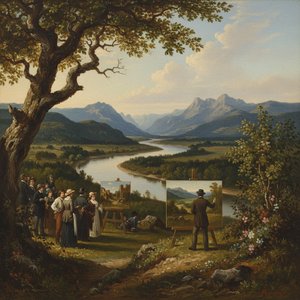
Beyond the intimate scale of miniatures, Carlin embraced the sweeping ideals of the Romantic era. His larger works often explored the dynamism of American life and the sublime beauty of the natural world. In his oil painting After a Long Cruise, one can witness his ability to orchestrate complex scenes of maritime activity, using dramatic lighting and expressive brushwork to evoke the bustling energy of a nineteenth-century harbor. This mastery of atmosphere allowed him to move seamlessly between the psychological intimacy of portraiture and the grand, theatrical narratives of genre painting.
A Legacy of Advocacy and Artistic Significance
The significance of John Carlin extends far beyond the borders of the art gallery. His life was inextricably linked to the burgeoning movement for deaf education and social inclusivity in America. His close collaboration with Laurent Clerc, a pivotal figure in the establishment of Gallaudet University, underscores his role as an advocate for the empowerment of individuals with disabilities. Through his poetry and his art, Carlin bridged the gap between the silent experience and the hearing world, proving that profound communication transcends the spoken word.
Today, Carlin is remembered not only as a pioneer of deaf portraiture but as a vital contributor to the American Romantic movement. His work serves as a window into a bygone era, reflecting the social complexities, historical intimacy, and spiritual contemplations of the nineteenth century. The enduring power of his canvases lies in their ability to speak across the ages, inviting every viewer to witness the world through the eyes of a man who found infinite beauty in the quietude.
Fragen & Antworten
Kann ich ein virtuelles Museum mit den Werken von John Carlin besuchen?
Die 3D-Museum von John Carlin ist eine Seite, die die Kunstwerke des Künstlers in einer virtuellen dreidimensionalen Galerie präsentiert.
Wo sind die Kunstwerke von John Carlin nach Farben sortiert zu finden?
Die Seite Spektraler Index sortiert die Kunstwerke von John Carlin nach Farben.
Wo finde ich Statistiken zu den Werken von John Carlin?
Die Seite Statistiken von John Carlin zeigt Statistiken, die aus den auf diese Website gelisteten Kunstwerken des Künstlers berechnet wurden.
Kann ich die Werke von John Carlin nach Kunstrichtung durchsuchen?
Die Stilrichtungen, in denen John Carlin tätig war, finden Sie auf der Alle Stilrichtungen-Seite des Künstlers, auf der die Kunstwerke nach Stilrichtung gruppiert sind.
Wo sind die nach Themen sortierten Kunstwerke von John Carlin zu finden?
Die Werke von John Carlin können nach Themen auf der Themenatlas-Seite des Künstlers erkundet werden.
Gibt es eine vollständige Liste der Kunstwerke von John Carlin?
Alle Werke von John Carlin auf diese Website können auf der Alle Kunstwerke-Seite des Künstlers durchstöbert werden.
Wie finde ich alle Werke von John Carlin in einem bestimmten Medium?
Die Werke von John Carlin können nach Medium auf der Alle Medien-Seite des Künstlers durchsucht werden.
In welcher historischen Epoche war John Carlin tätig?
John Carlin war in der Epoche der 19th Century tätig. Diese Periode ordnet das künstlerische Schaffen historisch ein.