**early life and training**
Quinten Massijs, also known as quentin metsys, was born around 1466 in Leuven, Belgium. He descended from a family of Flemish artists—his father, Joost Massys (d. 1483), was a smith and superintendent of the chapel belonging to the Leuven metalsmiths’ Guild of St Eligius—and he received an education that blended practical skills with humanist ideals. While precise details about his formative years remain elusive due to incomplete guild records, it is believed that Massijs honed his artistic talents through apprenticeship under masters like Jan van Eyck and Hans Memling, absorbing the stylistic innovations of the Burgundian Renaissance. The myth surrounding his autodidactic origins grew throughout the 17th Century, portraying him as a genius who emerged from obscurity—a narrative bolstered by accounts of his exceptional craftsmanship and unwavering dedication to artistic excellence.**artistic style and techniques**
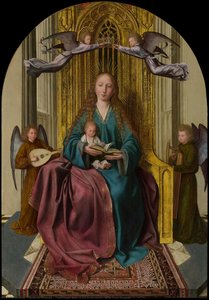
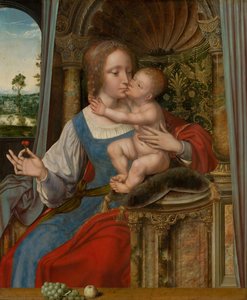
Massijs distinguished himself as a painter whose oeuvre embraced both religious fervor and satirical commentary. He skillfully blended traditional Flemish iconography with groundbreaking techniques, notably the use of oil on panel, which afforded unprecedented depth and luminosity compared to tempera—the dominant medium of his time. This mastery of oil painting is vividly exemplified in *The Judgment of the Apostles*, where Massijs achieved a remarkable illusionistic effect through meticulous layering and glazing, mirroring the advancements pioneered by artists like Albrecht Dürer and Leonardo da Vinci. His compositions were characterized by balanced symmetry and precise detailing—traits evident in masterpieces such as *Virgin and St John the Evangelist* and *The Lamentation*. Massijs’s artistic vision was profoundly shaped by his contemporaries, yet he forged a unique path marked by innovation and emotional resonance.**notable works and their significance**
Massijs's artistic legacy rests upon several monumental paintings that continue to captivate audiences worldwide. Among these are *The Virgin and St John the Evangelist*, considered one of the finest depictions of Mary Magdalene and St John—a testament to Massijs’s ability to convey profound spiritual contemplation through nuanced facial expressions and gestures. Similarly, *The Lamentation* stands as a poignant portrayal of grief—characterized by masterful use of chiaroscuro to heighten emotional intensity and create a dramatic visual experience. Furthermore, *The Judgment of the Apostles*, commissioned for the St Pieterskerk in Leuven, represents a pivotal moment in Flemish art history—demonstrating Massijs’s mastery of perspective and his commitment to capturing complex psychological states within a grand architectural setting.**museums featuring massijs' works**
Quinten Massijs’s artistic achievements are celebrated in prominent museums across Europe. The Royal Museum of Fine Arts Antwerp houses an extensive collection of Flemish paintings, including several masterpieces by Massijs—such as *Saint Christopher* and *The Crucifixion*, which offer invaluable insights into his stylistic evolution and artistic sensibilities. Visitors can admire these works alongside other treasures from the Renaissance era at this renowned institution. Moreover, the Musée Royal Beaux-Arts Bruxelles showcases a remarkable panorama of European art history—featuring masterpieces by Massijs alongside paintings by artists from diverse cultural traditions. Exploring these collections provides an unparalleled opportunity to engage with the artistic heritage of Flanders and its enduring influence on Western art.**legacy and influence**
Quinten Massijs’s contribution to the Antwerp School cemented his place as one of the foremost painters of the Renaissance—inspiring generations of artists who followed in his footsteps. His innovative techniques—particularly the adoption of oil painting—established a new standard for artistic excellence and profoundly impacted the stylistic trajectory of Flemish art. Notably, Jan Massys—Massijs’s son—carried on his father's artistic legacy, perpetuating the Antwerp School’s distinctive aesthetic principles. Massijs’s influence extended beyond Belgium’s borders, reaching into Italy and Germany—where artists like Albrecht Dürer embraced his stylistic innovations and incorporated Flemish techniques into their own creative endeavors. Consequently, Quinten Massijs remains a pivotal figure in European art history—a testament to the transformative power of artistic experimentation and the enduring legacy of humanist ideals.Fragen & Antworten
Wo und in welchem Jahr wurde Quentin Matsys geboren?
Quentin Matsys wurde 1466 in Leuven geboren.
Woher kommt Quentin Matsys?
Quentin Matsys wurde in Belgien geboren.
In welcher historischen Epoche war Quentin Matsys tätig?
Quentin Matsys war in der Epoche der Renaissance tätig. Diese Periode ordnet das künstlerische Schaffen historisch ein.
Wo kann ich die Kunstwerke von Quentin Matsys in einer 3D-Galerie sehen?
Die Kunstwerke von Quentin Matsys können in einer 3D-Galerie auf der Seite 3D-Museum des Künstlers besichtigt werden.
In welcher Stadt und in welchem Land wurde Quentin Matsys geboren?
Quentin Matsys wurde in Leuven, in Belgien, geboren.
Kann ich die Kunstwerke von Quentin Matsys nach Farben sortieren?
Die Seite Spektraler Index sortiert die Kunstwerke von Quentin Matsys nach Farben.
Kann ich die Werke von Quentin Matsys nach Themen durchsuchen?
Der Themenatlas von Quentin Matsys ist eine Seite, auf der die Kunstwerke des Künstlers nach ihren Motiven geordnet sind.