A Venetian Voice Amidst the Shadows of Tintoretto
Rocco Marconi (c. 1490 – 1529) stands as a singular figure within the vibrant tapestry of Venetian Renaissance painting, a talent whose brilliance shone briefly but powerfully amidst the towering presence of masters like Tintoretto and Veronese. While often overshadowed by his more prolific contemporaries in the annals of art history, Marconi’s contribution to the Venetian school is undeniable—a testament to artistic sensitivity and an exploration of religious iconography that reveals a deeply distinctive stylistic voice. His life, though relatively short, captured the essence of a period defined by intense spiritual fervor and the transformative power of light.
Born in Treviso, Marconi’s formative years were steeped in the rich artistic traditions of the Veneto region. He entered the prestigious workshop of the legendary Giovanni Bellini, spending over twenty-five years absorbing the master's profound understanding of perspective, chiaroscuro, and the expressive potential of color. Alongside fellow pupils such as Vittore Belliniano and Girolamo Santacroce, Marconi internalized the humanist ideals that characterized Bellini’s oeuvre. This rigorous tutelage instilled in him a technical foundation that allowed him to navigate the complexities of the Venetian style, yet he would eventually move beyond mere imitation to find his own rhythmic grace.
The Mastery of Light and Devotion
Marconi’s artistic style is distinguished by a remarkable subtlety and emotional depth, qualities that often provided a serene counterpoint to the more dramatic, turbulent canvases produced during the later Venetian Renaissance. Unlike the aggressive shadows found in Tintoretto’s work, Marconi favored a more restrained palette and luminous brushwork, prioritizing atmospheric perspective and nuanced tonal gradations. His compositions frequently centered on biblical narratives, particularly depictions of Christ, which served as a mirror to the spiritual preoccupations of his era.
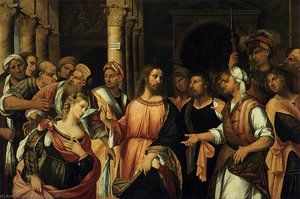
One of his most breathtaking achievements, Christ and the Adulteress (c. 1525), exemplifies this mastery. In this large-scale oil on canvas, Marconi orchestrates a scene of profound spiritual tension. The painting serves as a window into a crowded assembly, where the central figure of Christ acts as a calm, moral anchor amidst a sea of human emotion and whispered judgment. Through a sophisticated interplay of light and shadow, he lends a sculptural quality to his figures, breathing life into a diverse cast of characters—from men draped in intricate turbans to subtle, peripheral observers. This ability to balance the monumental with the intimate is what defines his unique legacy.
Legacy and Historical Significance
Though his career was cut short by his death in 1529, Marconi’s integration into the professional fabric of Venice was significant. His membership in the Venetian painters' guild (fraglia) in 1517 and his later involvement with the Scuola di Sant’Anna in 1526 demonstrate his standing within the prestigious artistic community of the time. His work remains a vital link in the evolution of the Venetian school, representing the transition from the balanced classicism of Bellini to the more emotive, atmospheric explorations of the mid-sixteenth century.
Today, the significance of Rocco Marconi lies in his ability to capture the human condition through a lens of divine grace. His paintings do not merely recount religious stories; they invite the viewer into a living, breathing world caught in transformative moments of sanctity and struggle. For collectors and historians alike, his oeuvre offers a precious glimpse into a period where the brushstroke was used not just to depict form, but to illuminate the very soul of the Renaissance.
Fragen & Antworten
Kann ich die Werke von Rocco Marconi nach Schlagworten durchsuchen?
Um Werke von Rocco Marconi zu einem bestimmten Thema zu finden, nutzen Sie die Nach Schlagworten-Seite des Künstlers, auf der die Kunstwerke nach Schlagworten gruppiert sind.
Gibt es eine virtuelle 3D-Tour durch die Werke von Rocco Marconi?
Ein virtueller Besuch ist möglich: Die Seite Virtuelle 3D-Galerie von Rocco Marconi präsentiert die Werke des Künstlers in einer dreidimensionalen Galerie.
In welche Zeitperioden lässt sich die Karriere von Rocco Marconi unterteilen?
Eine chronologische Übersicht des Werks von Rocco Marconi ist auf der Werdegang-Seite des Künstlers verfügbar, wo die Kunstwerke kapitelweise in ihrer Entstehungsreihenfolge präsentiert werden.