William Duffield (1816–1863): A Pioneer of Victorian Still Life
William Duffield was a British painter born in Bath, Somerset, in 1816, the second son of Charles Duffield, who had established the Royal Union Library. From an early age, Duffield demonstrated exceptional artistic talent and fascination with drawing—a passion nurtured by George Doo, the engraver, who recognized his remarkable ability to reproduce engravings faithfully and create detailed pen-and-ink sketches. Encouraged by Doo’s mentorship, Duffield pursued formal training at the Royal Academy in London, diligently honing his skills and immersing himself in the artistic traditions of his time. Upon graduating, he returned to Bath and later traveled to Antwerp, Belgium, where he studied under Egide Charles Gustave Wappers, gaining invaluable experience in mastering oil painting techniques. Tragically, Duffield succumbed to tuberculosis at the young age of 47 in September 1863, leaving behind a legacy of evocative still life paintings that continue to captivate audiences today.Early Life and Artistic Training
Duffield’s formative years were marked by a privileged upbringing within a literary family—his father was instrumental in establishing the Royal Union Library, fostering an environment conducive to intellectual curiosity and artistic exploration. Recognizing his innate aptitude for drawing, Doo skillfully guided Duffield's artistic development, emphasizing precision and meticulous observation—skills honed during his time at the Royal Academy where he studied alongside prominent artists of the era. This rigorous training instilled in Duffield a deep understanding of classical composition and technique, shaping his artistic sensibilities and informing his subsequent oeuvre.Style and Technique
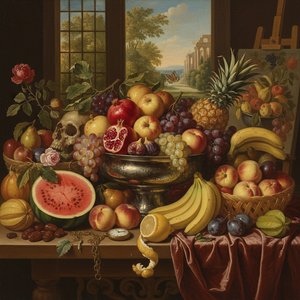
Duffield’s distinctive style is characterized by its masterful depiction of fruit and animal subjects—often rendered with remarkable realism and imbued with subtle tonal nuances. He excelled at capturing the textures and colors of organic matter, employing a meticulous approach to brushwork that conveyed both accuracy and expressive emotion. Duffield's compositions frequently incorporated classical influences, reflecting the prevailing aesthetic sensibilities of Victorian England. His use of color palettes was restrained yet harmonious, prioritizing tonal gradations to create atmospheric depth and enhance visual impact.Notable Works
Among Duffield’s most celebrated paintings are “Still Life with Dead Game,” a poignant portrayal of avian specimens rendered in exquisite detail—a testament to his technical prowess and artistic sensitivity. Similarly impressive is “Francis Thomas Allen,” a portrait capturing the dignified countenance of Allen, executed in oil paint with meticulous attention to anatomical accuracy and stylistic elegance. Furthermore, Duffield’s “Still Life with Dead Rabbits” exemplifies his ability to convey emotion through visual representation—a captivating study demonstrating his command of color and texture. These artworks stand as enduring symbols of Victorian artistic achievement, showcasing Duffield's unwavering commitment to capturing the beauty and complexity of the natural world.Legacy and Recognition
William Duffield’s contribution to British art history is recognized through the designation of “The Duffield Memorial” in Great Baddow Churchyard as a Grade II listed building—a unique blend of Art Nouveau metalwork and ecclesiastical sculpture commemorating Marianne Duffield and William Ward Duffield, alongside their son, William Bartleet Duffield. Historic England lauded the memorial’s architectural merit and artistic innovation, solidifying Duffield's place among Britain’s most influential artists of his generation. His enduring influence continues to inspire contemporary painters and scholars alike, ensuring that Duffield’s legacy persists as a beacon of Victorian artistic excellence.Fragen & Antworten
In welcher historischen Epoche war William Duffield tätig?
William Duffield war in der Epoche der 19th Century tätig. Diese Periode ordnet das künstlerische Schaffen historisch ein.
Kann ich die Kunstwerke von William Duffield nach Farben sortieren?
Die Spektraler Index von William Duffield ist eine Seite, auf der die Kunstwerke des Künstlers nach ihren Farben sortiert sind.
Kann ich die Farbwahl von William Duffield über das gesamte Werk hinweg studieren?
Die Verwendung von Farbe in den Werken von William Duffield, die auf diese Website aufgeführt sind, kann auf der Farbgenom der Palette-Seite des Künstlers untersucht werden.
Wo kann ich alle Kunstwerke von William Duffield sehen?
Alle Werke von William Duffield auf diese Website können auf der Alle Kunstwerke-Seite des Künstlers durchstöbert werden.
Kann ich die Werke von William Duffield nach Schlagworten durchsuchen?
Um Werke von William Duffield zu einem bestimmten Thema zu finden, nutzen Sie die Nach Schlagworten-Seite des Künstlers, auf der die Kunstwerke nach Schlagworten gruppiert sind.
Wie viele Kunstwerke von William Duffield können durchstöbert werden?
Sie können 11 Kunstwerke Werke von William Duffield auf der Seite Alle Kunstwerke durchstöbern.
Kann ich die Werke von William Duffield nach Kunstrichtung durchsuchen?
Die Werke von William Duffield können auf der Seite Alle Stilrichtungen nach Kunstströmungen durchsucht werden.
Welche Kunstwerke von William Duffield werden am häufigsten aufgerufen?
Für William Duffield existiert eine Statistiken-Seite, die Statistiken zu den Kunstwerken des Künstlers auf diese Website präsentiert.