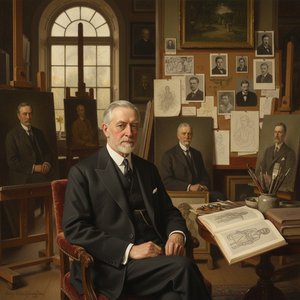
William Scott Myles: Bridging Arctic Landscapes and Artistic Vision
William Scott Myles (1850 – 1911) stands as a singular figure in British watercolor painting, renowned for his evocative depictions of the Arctic wilderness and imbued with the stylistic hallmarks of the Arts and Crafts movement. Born in Tunbridge Wells, Kent, Myles’s artistic journey began amidst the burgeoning aesthetic fervor of Victorian England, where he honed his skills under the tutelage of John Atkinson Grimshaw, a prominent landscape painter who championed atmospheric perspective and meticulous observation—influences that would profoundly shape Myles's distinctive oeuvre.- Early Life & Training: Myles’s formative years were marked by exposure to the artistic milieu of Tunbridge Wells, fostering an appreciation for craftsmanship and detailed realism. His formal training at Grimshaw’s studio instilled in him a disciplined approach to painting, prioritizing accuracy and capturing the essence of natural beauty.
- Arctic Explorations & Artistic Inspiration: Myles's fascination with polar exploration propelled him into uncharted artistic territory. He embarked on expeditions to Svalbard and Greenland during the late Victorian era, documenting the dramatic landscapes and challenging conditions of these remote regions. These voyages served as a catalyst for his artistic creativity, inspiring compositions characterized by luminous color palettes and expressive brushwork—a stylistic signature that distinguishes his work from contemporaries.
- The Arts and Crafts Movement Influence: Myles’s artistic sensibilities aligned seamlessly with the tenets of the Arts and Crafts movement, spearheaded by William Morris. Like Morris, Myles championed handcrafted artistry, rejecting industrial mass production in favor of meticulous attention to detail and celebrating the beauty inherent in natural materials. This commitment to craftsmanship is evident throughout his paintings—particularly ‘The Sheep Farm,’ where textured surfaces and subtle tonal gradations convey a palpable sense of atmosphere.
Notable Works & Artistic Style
Myles’s artistic style can be characterized by several key features: Firstly, he mastered atmospheric perspective, skillfully rendering depth and luminosity to recreate the grandeur of Arctic vistas. Secondly, his use of color—particularly muted blues and greens—captured the ethereal quality of polar light. Thirdly, Myles employed loose brushwork combined with meticulous layering techniques—a deliberate departure from academic conventions—to imbue his paintings with dynamism and emotional resonance. Pieces like “Berlin Blues 6” exemplify this expressive approach, conveying a mood of contemplative solitude amidst breathtaking scenery.- ‘The Sheep Farm’ (1893): Considered Myles's magnum opus, ‘The Sheep Farm’ exemplifies his mastery of atmospheric perspective and tonal gradation. The painting depicts a serene Arctic landscape bathed in soft sunlight, capturing the sublime beauty of the tundra environment.
- ‘Orange and White’ (1896): This evocative watercolor portrays a dramatic Arctic sunset—a testament to Myles's ability to convey emotion through color and brushwork.
Legacy & Historical Significance
William Scott Myles’s contribution to British watercolor painting extends beyond mere stylistic innovation; he represents a pivotal voice in documenting the Arctic landscape during its formative years of scientific exploration. His paintings serve as invaluable visual records of expeditions undertaken by prominent scientists and explorers—including Robert Falcon Scott and Ernest Shackleton—providing insights into the challenges faced by pioneers venturing into these unforgiving environments. Furthermore, Myles’s unwavering dedication to craftsmanship and artistic integrity solidified his place within the Arts and Crafts movement's broader ethos—a legacy that continues to inspire artists today. His work resides in collections across Europe and North America, ensuring that his vision of Arctic beauty persists as a timeless masterpiece.Further Exploration
For deeper insights into Myles’s life and artistic achievements, consult resources at Tunbridge Wells Museum & Art Gallery and Peter Scott Gallery. The Scott Polar Research Institute offers comprehensive archival materials documenting his expeditions and furthering scholarly understanding of his oeuvre.Fragen & Antworten
Kann ich die Werke von William Scott Myles nach Themen durchsuchen?
Die Seite Themenatlas ordnet die Kunstwerke von William Scott Myles nach Themen an.
Gibt es eine chronologische Übersicht zu William Scott Myles?
Die Chronik von William Scott Myles ist eine scrollbare Zeitachse, die die Werke des Künstlers in chronologischer Reihenfolge präsentiert, unterteilt in Kapitel nach Schaffensperioden.
Gibt es eine vollständige Liste der Kunstwerke von William Scott Myles?
Alle Werke von William Scott Myles auf diese Website können auf der Alle Kunstwerke-Seite des Künstlers durchstöbert werden.
Wo sind die Kunstwerke von William Scott Myles nach Technik gruppiert zu finden?
Um alle Werke von William Scott Myles in einem bestimmten Medium zu finden, nutzen Sie die Alle Medien-Seite des Künstlers.
Kann ich die Farbwahl von William Scott Myles über das gesamte Werk hinweg studieren?
Das Farbprofil der Werke von William Scott Myles wird auf der Farbgenom der Palette-Seite des Künstlers angezeigt.
In welcher historischen Epoche war William Scott Myles tätig?
William Scott Myles war in der Epoche der 19th Century tätig. Diese Periode ordnet das künstlerische Schaffen historisch ein.
Kann ich die Kunstwerke von William Scott Myles nach Farben sortieren?
Die Werke von William Scott Myles können auf der Spektraler Index-Seite des Künstlers nach Farben sortiert erkundet werden.
Wie viele Kunstwerke von William Scott Myles können durchstöbert werden?
Sie können 10 Kunstwerke Werke von William Scott Myles auf der Seite Alle Kunstwerke durchstöbern.