

1601. Acrílico sobre lienzo, 107.0 x 90.0 cm.

§ 1Catalogue data

- 107.0 x 90.0 cm


§ 2Abstract
Descripción del objeto
"{ \"meta_description\": \"Una impresionante obra maestra de El Greco en estilo manierista que captura la solemnidad y el conocimiento intelectual de un alto funcionario religioso. Descubre esta reproducción exclusiva.\""
 Ver más
Biografía del artista
Explore el arte dramático y expresivo de El Greco (Doménikos Theotokopoulos). Descubra sus pinturas manieristas icónicas, temas religiosos, figuras alargadas e influencia duradera en el Expresionismo y el Cubismo. Admire obras maestras como 'Vista de Toledo'!
§ 3Commentary
A Prelate: An Exploration of Mannerist Drama and Spiritual Reflection
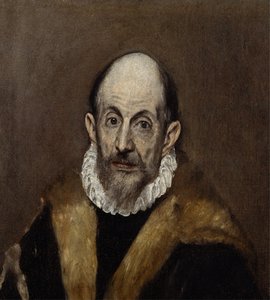
Doménikos Theotokópoulos, universally known as El Greco – “the Greek” – stands apart from his contemporaries as a painter whose artistic vision transcended the conventions of his time. Born in Crete around 1541, amidst the turbulent currents of Venetian rule, El Greco embarked on an extraordinary journey that propelled him through Venice and Rome before establishing himself definitively in Toledo, Spain—a city steeped in religious fervor and serving as the crucible for his most profound artistic achievements. He wasn’t merely responding to stylistic trends; he fundamentally reshaped them, forging a style that foreshadowed the expressive power of Expressionism and anticipating the fragmented forms characteristic of Cubism centuries later. His formative years spent studying Byzantine iconography instilled within him an unwavering dedication to meticulous detail and a deep understanding of religious symbolism—a foundation that would nevertheless liberate him from rigid artistic constraints. He famously signed his canvases in Greek, appending “Krḗs” – Cretan – as a defiant assertion of his heritage, even as he embraced new artistic horizons. The genesis of El Greco’s distinctive aesthetic resided in the interplay between Byzantine tradition and Renaissance innovation, resulting in an oeuvre that remains perpetually captivating.- Subject Matter: This portrait depicts a prelate—likely a high-ranking ecclesiastical official—seated at a table with an open book. The deliberate positioning underscores themes of intellect, piety, and authority, reflecting the societal values prevalent during El Greco’s era.
- Style & Technique: El Greco's artistic approach embodies Mannerism, a stylistic movement that prioritized dramatic lighting, elongated figures, and expressive brushwork. He achieved this effect through layering paint with visible strokes, creating a textured surface that conveys both physicality and spiritual depth.
- Color Palette: Doménikos employed a muted color palette dominated by blacks, browns, and creams. The bold juxtaposition between the black robe and white collar highlights the figure’s solemn dignity while emphasizing the flesh tones of his face—a subtle yet impactful element of visual storytelling.
- Composition & Perspective: The composition adheres to a three-quarter pose, maximizing detail in the subject's facial expression and upper body. Distortion of perspective—a hallmark of Mannerist art—further enhances the painting’s dramatic impact, creating an illusion of depth that contributes to its ethereal quality.
Preguntas y respuestas
¿Cuáles son las dimensiones reales de "El Prelado" de El Greco?
La obra original "El Prelado" de El Greco mide 107 x 90 cm.
¿Para qué se recomienda una reproducción de "El Prelado" de El Greco?
Se recomienda una reproducción de "El Prelado" de El Greco para Acento cromático, basándose en el tema, la atmósfera y los colores de la obra.
¿De qué manera el estilo de "El Prelado" se relaciona con la época de su creador?
En "El Prelado" de El Greco, el movimiento Mannerist Style se funde con la era Renacimiento.


 Cambiar a impresiones


 Para obras de arte o reproducciones que midan más de 105 cm (aproximadamente 41 pulgadas) en cualquiera de sus lados, el marco se enviará como un kit desmontado. Este método garantiza una entrega segura y evita daños durante el transporte.


