![[untitled] — Miné Okubo](/media/artworks/images-full/e9/79/e97929bc85eb4d67705f5d2644bd43c2.jpg)
 Vista previa
 Compartir
 Compartir
 Ver detalles
 Guía
Guía

 Descargar
 Ver artículos similares
 Radiografía
 Presentación de diapositivas
 Estadísticas
[Untitled]


 Leer más
La obra de arte que se muestra en esta página está protegida por las leyes de propiedad intelectual, lo que significa que no podemos crear ni vender legalmente una reproducción idéntica. Esta protección se hace cumplir en virtud de acuerdos internacionales como el Convenio de Berna y por las leyes nacionales, incluidas aquellas establecidas por el Ley de derechos de autor de los EE. UU. - Título 17.
Como una alternativa respetuosa y legal, ofrecemos obras de arte personalizadas y pintadas a mano inspiradas en la original. Nuestros expertos y profesionales del arte estudian cuidadosamente el estilo, el sentimiento y la esencia artística de la obra original para crear una pieza nueva y única que evoque la misma sensación, siendo al mismo tiempo una creación original por derecho propio.
Este método cumple plenamente con las normativas de derechos de autor, ya que no implica la copia ni la duplicación de la obra protegida. En su lugar, se trata de una reinterpretación creativa: una nueva pintura influenciada por la original, pero que no es idéntica a ella.
Reproducción al óleo hecha a mano
Óleo sobre lienzo pintado a mano en el tamaño y marco de su elección, realizado por encargo por nuestros artistas. ( Cambiar a formato impreso Ver versión en imagen digital)




P118B €10

P118H €10

P118W €10

P438Z €10

P508JH €12

P508YH €12

P805H €10

P805Z €10

P919BZ €10

P919G €10

P919XJ €10

P959ZH €10

P968JZ €12

W106C €8

W218G €10

W218JH €8

W218Y €10

W307PJ €10

W316G €10

W316PJ €8

W316Y €10

W398PJ €8

W4111J €10

W500HY €15

W500JH €15

W692G €12

W849H €8

W940BG €15

W953PJ €8




Elija entre nuestros tamaños predefinidos que respetan las proporciones originales de la obra.

Puede ingresar sus propias dimensiones para adaptarse a un marco o espacio específico. Si el tamaño seleccionado no coincide con las proporciones de la imagen original, recortaremos la obra o extenderemos la pintura con elementos adicionales pintados a mano. Se le enviará una maqueta digital para su aprobación antes de comenzar la producción.
Tenga en cuenta que la vista previa en pantalla no refleja el recorte o la extensión reales. Solo la maqueta mostrará con precisión la composición final.
Si bien existen tamaños personalizados, recomendamos seleccionar una dimensión de la lista predefinida para preservar las proporciones originales.
Tras realizar el pedido, el equipo de AllPaintingsStore.com enviará un correo electrónico al cliente para solicitar instrucciones y proporcionarle una vista previa del boceto.
Envío a todo el mundo () en 3-4 semanas en lugar de las 5 semanas estándar. (10 octubre). Sin comprometer la calidad.

Envío exprés gratuito a todo el mundo

Lienzo de lino de alta calidad

Seguro de envío completo

Garantía de reembolso de impuestos aduaneros

Garantía de fidelidad cromática exacta

Política de devolución de 100 días (solo por defectos)

Garantía de devolución del 100% del dinero

Oferta por volumen
 La opción de vidrio solo está disponible en tamaños inferiores a 110 cm.
![[Untitled]](/static/images/allpaintingsstore/artworks/painting.a1e74a1cb7dc.png)
[Untitled]
Técnica de reproducción
Tamaño de la reproducción
-


Precio total
€ 222
A Chronicle in Color: Unveiling Miné Okubo’s “Untitled”
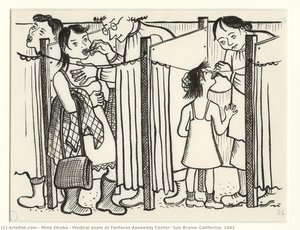
Miné Okubo's "Untitled," painted in 1974, isn't merely a depiction of flowers within a vase; it’s a vibrant testament to resilience forged during a profoundly challenging period. Created amidst the upheaval of World War II and the subsequent internment of Japanese Americans, this artwork embodies a complex tapestry of memory, displacement, and ultimately, an enduring spirit. The painting pulses with a raw energy, born from Okubo's direct observation of life within the Topaz Relocation Center in Utah – a place that simultaneously represented confinement and a space for creative expression.
The style is decidedly abstract expressionist, yet grounded in a meticulous attention to detail. Thick, impasto brushstrokes dominate the composition, lending a tactile quality to the work and suggesting layers of experience. The colors—bold reds, deep blues, sunny yellows, and crisp whites—aren’t employed with photographic realism but rather as vehicles for emotional resonance. Notice how the red dominates the central floral forms, perhaps symbolizing both the intensity of life within the camp and the fiery determination of its inhabitants. The background is a dynamic interplay of fractured planes and contrasting hues, creating a sense of movement and instability that mirrors the psychological landscape of those enduring confinement.
Decoding Symbolism: Flowers, Vessels, and the Human Spirit
While seemingly a still life, “Untitled” is rich with symbolic weight. The arrangement of flowers within a vase immediately evokes traditional Japanese aesthetics – a connection to Okubo’s heritage and a subtle nod to the beauty that persisted even in the face of adversity. However, these aren't delicate, idealized blossoms; they are rendered with a forceful energy, their petals slightly distorted, their forms imbued with a sense of urgency. The vase itself acts as a container, not just holding the flowers but also representing the constraints and limitations imposed by the internment experience.
Crucially, the painting’s power lies in its ambiguity. Okubo deliberately avoids explicit representation, allowing viewers to project their own interpretations onto the scene. The fragmented background hints at a disrupted world, while the vibrant colors suggest an unwavering hope for the future. The signature “Mine Okubo 1974” in the lower right corner serves as a grounding element, anchoring the work within its historical context and reminding us of the artist’s personal journey.
A Window into History: Contextualizing the Artwork
To fully appreciate "Untitled," it's essential to understand the tumultuous era in which it was created. Following Executive Order 9066, nearly 120,000 Japanese Americans – including citizens and legal residents – were forcibly removed from their homes and incarcerated in camps across the Western United States. Miné Okubo’s art became a vital record of this injustice, documenting the daily realities of camp life through her meticulous drawings and paintings. Her work is part of a larger body of art created by Japanese Americans during this period—a powerful collective response to an unprecedented act of discrimination.
The fact that Okubo continued to create art *during* her confinement speaks volumes about her resilience and commitment to bearing witness. Her decision to document her experiences through visual means offered a form of agency and control in the face of overwhelming circumstances. It’s a poignant reminder of the enduring power of art as a tool for survival, remembrance, and social commentary.
Bringing “Untitled” Home: Reproduction and Artistic Impact
Reproductions of Miné Okubo's "Untitled" offer a remarkable opportunity to bring this powerful artwork into your home or office. The vibrant colors and dynamic composition will undoubtedly serve as a focal point, injecting energy and emotion into any space. Consider framing the piece in a simple dark wood frame – allowing the artwork’s intensity to truly shine through—or opting for a more contemporary setting that complements its bold aesthetic.
Beyond its visual appeal, “Untitled” carries a profound historical significance. Owning or displaying a reproduction of this work is an act of remembrance and solidarity with the Japanese American community. It’s a chance to engage with a crucial chapter in American history and honor the artistic legacy of Miné Okubo – a woman who transformed personal suffering into a testament to human resilience.
Preguntas y respuestas
¿Cómo se puede utilizar "[Untitled]" de Miné Okubo en la decoración del hogar?
Se recomienda "[Untitled]" de Miné Okubo para Reflective, idealmente en un/a Living Room. El uso y el espacio juntos orientan dónde encaja una reproducción.
¿Qué edad tenía Miné Okubo cuando se creó "[Untitled]"?
Miné Okubo realizó "[Untitled]" a la edad de 62. El artista nació en 1912 y la obra data de 1974.
¿Cómo se construye la composición cromática de "[Untitled]" de Miné Okubo?
El análisis cromático de "[Untitled]" de Miné Okubo registra un Gentle contraste y una Discordant Palette armonía.
¿Quién creó "[Untitled]"?
"[Untitled]" fue creada por Miné Okubo. La información en esta página describe la obra original de Miné Okubo.
¿Qué tan luminosa es "[Untitled]" en su conjunto?
La luminosidad percibida de "[Untitled]" de Miné Okubo es balanced. Puede armonizarse con la luz del espacio destinado.
¿Cuál es la fecha de creación de "[Untitled]" de Miné Okubo?
"[Untitled]" de Miné Okubo fue creada en 1974.
¿Cuál es el tamaño de impresión recomendado para "[Untitled]" de Miné Okubo?
El tamaño de impresión recomendado para "[Untitled]" de Miné Okubo es Medium.
Obras relacionadas


Biografía del artista
Miné Okubo: Vida, Arte y Legado
Primeros Años y Educación
- Nacimiento: 27 de junio de 1912 en Riverside, California, hija de padres inmigrantes japoneses.
- Okubo demostró un talento temprano para el arte, alentada por su familia.
- Estudió arte formalmente, asistiendo a la Universidad de California, Berkeley, y posteriormente viajando a Europa en 1938 para continuar sus estudios.
- Su tiempo en Suiza se vio interrumpido por las crecientes tensiones políticas que precedieron a la Segunda Guerra Mundial.
Internamiento y Respuesta Artística
- Tras el ataque a Pearl Harbor, Okubo, junto con su hermano Benji, fueron removidos por la fuerza de sus hogares e internados en los campos de concentración japoneses americanos.
- Primero enviados al Tanforan Assembly Center en 1942, luego fueron trasladados al Topaz War Relocation Center en Utah.
- Durante su confinamiento, Okubo comenzó un proyecto notable: documentó meticulosamente la vida cotidiana dentro de los campos a través de más de 2.000 dibujos y bocetos.
- Estas obras capturaron las duras realidades de la existencia en el campo, las condiciones de vida hacinadas, los procesos burocráticos, el impacto emocional y la resiliencia de los internados.
Ciudadano 13660: Un Testimonio Poderoso
- Después de su liberación en 1944, Okubo compiló una selección de 198 dibujos y texto acompañante en un libro titulado Ciudadano 13660.
- Publicado en 1946, el libro se considera una obra fundamental que documenta la experiencia del internamiento japonés americano.
- El título hace referencia a su número asignado dentro del sistema de internamiento, enfatizando el aspecto deshumanizador de la reubicación forzada.
- Los dibujos se caracterizan por su directividad, honestidad y profundidad emocional, ofreciendo un registro visual conmovedor de un capítulo oscuro en la historia americana.
Carrera Post-Guerra y Desarrollo Artístico
- Okubo se trasladó a Nueva York City después de la guerra, donde continuó su carrera artística.
- Trabajó como artista independiente, creando ilustraciones para revistas y libros, y también realizó proyectos de murales.
- Su estilo evolucionó con el tiempo, pero mantuvo constantemente un enfoque en el comentario social y los temas humanísticos.
- Okubo recibió numerosos premios y reconocimientos a lo largo de su carrera, incluyendo subvenciones del Fondo Nacional para las Artes.
Influencias y Legado
- La obra de Okubo fue influenciada por el movimiento Social Realista, que enfatizaba la representación de los problemas sociales y la vida cotidiana con un enfoque en el realismo.
- Se inspiró en artistas como Käthe Kollwitz, conocida por sus poderosas representaciones del sufrimiento humano.
- Su legado reside en su valiente documentación de la experiencia del internamiento y su contribución a crear conciencia sobre los derechos civiles y la justicia social.
- “Ciudadano 13660” sigue siendo un documento histórico vital y continúa resonando con el público actual, sirviendo como un recordatorio de la importancia de la vigilancia contra la discriminación y el prejuicio.
Muerte y Remembrance
- Miné Okubo falleció el 10 de febrero de 2001, dejando atrás un poderoso cuerpo de trabajo que continúa inspirando y educando.
- Su arte se conserva en numerosas colecciones públicas y privadas, asegurando que su historia y mensaje perduren para las generaciones venideras.

Miné Okubo
1912 - 2001 , Estados Unidos de América
Datos clave
- Artistic Movement Or Style: Social Realism
- Artists Or Movements Influenced By This Artist: ['Diego Rivera']
- Artists Who Influenced This Artist: ['Käthe Kollwitz']
- Date Of Birth: Jun 27, 1912
- Date Of Death: Feb 10, 2001
- Full Name: Miné Okubo
- Nationality: American
- Notable Artworks:
- Citizen 13660
- Interior of Mine and Toku
- Place Of Birth: Riverside, USA
Artículos relacionados

Lyrical Abstraction: The Emotional Power of Color and Form in Modern Art History
Explore the profound emotional depth of Lyrical Abstraction. Discover how masters like Raymond Parker used color and form to bridge Impressionism and Abstract Expressionism. Learn about this pivotal movement through our expert-led art history guide.

Expresionismo Abstracto: 10 Obras Maestras que Transformaron el Arte |
Descubre las 10 obras maestras del Expresionismo Abstracto: Pollock, Rothko y más. Explora la historia, técnica y significado de estos lienzos icónicos. Reproducciones de arte exclusivas en .

Beyond the Lines: Mastering the High-Impact World of Contemporary Abstraction
Master the high-impact world of contemporary abstraction. Discover how bold colors, textures, and modern movements like Abstract Expressionism can transform your space with premium, high-energy art curated for the design-conscious professional.

Arthur Dove: Pioneering American Abstraction & the Poetic Language of Modernism
Explore the groundbreaking work of Arthur Dove, a pioneer of American abstraction. Discover his artistic evolution, influences, and investment potential with AllPaintingsStore's expert guide.

Abstracción Geométrica: 10 Obras Maestras que Transformaron el Arte Moderno | AllPaintingsStore
Descubre las 10 obras maestras de la abstracción geométrica que revolucionaron el arte moderno. Explora a Mondrian, Malevich y Kandinsky en AllPaintingsStore.com. Reproducciones de alta calidad para tu hogar.
![[Sin título]](/media/artworks/images-thumb/da/f5/daf58ec86f2a4b9d0b02cc6cd4383556.jpg)