Eelvaade
 Saada
Saada Jaga
Jaga
 Teave teose kohta

 Laadi alla
 Sarnased teosed
 Röntgenuuring
 Slaidietendus
Crucifixion
 Tempera On Panel
- WallArt
- Late Gothic
 1333
1333- Late Medieval
 24.0 x 15.0 cm
 Koninklijk Museum voor Schone Kunsten
 Loe lähemalt
Giclée / Kunstiprint
Muuseumikvaliteediga giclée- või kangasprint kiire tootmisega ja paindlikud viimistlusvõimalused. ( Osta käsitsi maalitud maal Osta pilt)




P118B $10

P118H $10

P118W $10

P438Z $10

P508JH $12

P508YH $12

P805H $10

P805Z $10

P919BZ $10

P919G $10

P919XJ $10

P959ZH $10

P968JZ $12

W106C $8

W218G $10

W218JH $8

W218Y $10

W307PJ $10

W316G $10

W316PJ $8

W316Y $10

W398PJ $8

W4111J $10

W500HY $15

W500JH $15

W692G $12

W849H $8

W940BG $15

W953PJ $8




Vali meie eelmääratud suurused, mis vastavad teose algupärastele proportsioonidele.

Saate sisestada oma mõõdud, et need sobiks konkreetse raami või ruumi sisse. Kui valitud suurus ei vasta originaalteose proportsioonidele, lõigame teose ära või laiendame pilti peegeldatud või ühtlase servaga. Enne tootmisprotsessi algust saadetakse Teie kinnitamiseks digitaalne näidis.
Palun märka, et ekraanil kuvatav eelvaade ei kajasta tegelikku lõigamist või laiendamist. Ainult näidis kujutab täpselt lõplikku kompositsiooni.
Kuigi erimõõdu on saadaval, soovitame originaaproportsioonide säilitamiseks valida mõõt ette määratud nimekirjast.
Ülemaailmne tarne () 2 nädala jooksul, tavalise 4/5 nädala asemel. (17 august)

Tasuta ekspresssaatmine üle maailma

Kõrgekvaliteediline linakangas

Täielik transpordikindlustus

Tollimaksude tagastamise garantii

Värvitoime täpsuse garantii

60-päevane tagastusõig: ainult tootmisdefektide korral

100% raha tagasi garantii

Hulgusoodustus
 Klaasivalik on saadaval ainult suuruses kuni 110 cm

Crucifixion
Giclée / Kunstiprint
Reproduktsiooni suurus
-


Kogusumma
$ 64
Kogumuse kirjeldus
A Divine Drama in Miniature: The Elegance of Simone Martini
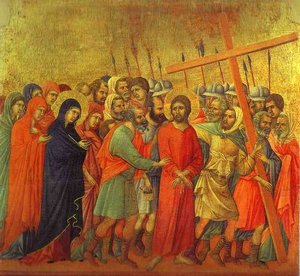
In the quiet intimacy of a small panel, measuring a mere 24 by 15 centimeters, Simone Martini captures an event of cosmic significance with unparalleled grace. His Crucifixion, painted around 1333, is far more than a historical record of Christian passion; it is a masterclass in the Sienese Gothic aesthetic, where spiritual agony meets courtly refinement. To gaze upon this work is to enter a realm where the heavy weight of suffering is balanced by an ethereal, almost weightless beauty. The scene unfolds with a breathtaking precision that belies its diminutive scale, inviting the viewer into a profound moment of contemplation that feels both deeply personal and universally monumental.
The technical mastery displayed in this piece reflects the pinnacle of 14th-century Italian innovation. Utilizing tempera on panel, Martini employs a technique that allows for a luminous, jewel-like quality, particularly evident in the way light interacts with the delicate surfaces. Unlike the more grounded, earthy realism found in the Florentine works of his contemporary Giotto, Martini’s hand is characterized by an aristocratic elegance. He utilizes subtle hatching and scumbling to create soft gradations of tone, lending a palpable sense of atmosphere to the air surrounding the cross. The figures are rendered with elongated, lyrical lines and drapery that flows with a rhythmic, musical quality, transforming a scene of execution into a dance of divine sorrow.
Siena’s Golden Age and the Language of Faith
To understand the soul of this painting, one must look to the vibrant streets of 14th-century Siena. During this period, Siena was a flourishing center of commerce and culture, a city defined by its intense religious devotion and sophisticated patronage. Martini, a pivotal figure in the transition from the medieval to the Renaissance, worked within an environment shaped by the Dominican Order and a wealthy merchant class that craun for art reflecting both piety and prestige. This Crucifixion serves as a testament to that era's spiritual fervor, embodying the Sienese school's unique ability to blend Byzantine-influenced iconography with a new, more emotive humanism.
The symbolism embedded within the composition invites layers of interpretation for the discerning collector. The positioning of Christ, suspended between heaven and earth, acts as a bridge for the faithful. Surrounding him, the figures of mourners and angels are not merely spectators but participants in a shared emotional experience. The vibrant colors and intricate details—from the subtle glint of gold to the poignant expressions of grief—work in harmony to convey the central tenets of the Christian faith: sacrifice, redemption, and eternal hope. For those looking to integrate such a piece into a curated collection or a sophisticated interior, it offers a profound focal point that commands attention through its quiet, dignified intensity.
Whether viewed as a historical masterpiece or an exquisite decorative element, Martini’s Crucifixion remains an enduring icon of beauty. It possesses the rare ability to anchor a room with its historical gravity while elevating the surrounding space with its delicate, luminous spirit. For the art lover and the interior designer alike, this work represents a timeless intersection of technical brilliance and emotional depth, making it a truly incomparable treasure for any high-quality reproduction collection.
Sarnased teosed




Kunstniku elulugu
Simone Martini (c.1284–1344) – A Sienese Master of Elegance and Grace
Simone Martini, born around 1284 in Siena, Italy—though precise birthdates remain elusive—stands as a cornerstone figure in the transition from medieval to Renaissance art. He wasn’t merely a painter; he was an architect of elegance, a master of line and color who infused his works with a courtly refinement that distinguished him from contemporaries like Giotto di Bondone. Historical accounts regarding Martini’s formative years are fragmentary—scholarly debate centers on whether he apprenticed under Duccio di Buoninsegna, the dominant Sienese artist of his time, or if Florence and Giotto exerted a more profound influence—yet Martini undeniably forged an artistic path uniquely his own.
Origins and Education – The Seeds of Style
The exact circumstances surrounding Simone’s upbringing are shrouded in obscurity. Tradition suggests he was born in Siena’s Sant’Egidio district, possibly the son of Martino Senese, a craftsman specializing in preparing arriccio—the initial plaster layer applied to wall surfaces destined for fresco painting—though corroborating evidence remains scant. Regardless of his precise origins, Martini’s artistic training undoubtedly commenced within Duccio di Buoninsegna’s workshop, where he absorbed the stylistic precepts of Sienese Gothic.
The Siena Workshop – Collaboration and Patronage
Martini’s formative years were marked by close association with Memmo di Filippuccio, another artisan active in San Gimignano—a partnership that fostered not only professional growth but also exposure to the burgeoning artistic culture of Tuscany. Crucially, Martini secured his first major civic commission in 1311: the frescoing of the *Maestà* for Siena’s Palazzo Pubblico—a monumental undertaking that cemented Duccio’s legacy and established Martini as a rising talent.
The Maestà – A Synthesis of Tradition
The *Maestà*, completed in 1315, represents a pivotal moment in Martini’s artistic trajectory. It served as an homage to Duccio’s own masterpiece—a stylistic echo that underscored Martini’s commitment to established Sienese conventions. Yet, Martini transcended mere imitation; he innovated through meticulous attention to detail and the incorporation of groundbreaking techniques—particularly the use of metallic pigments and punching—resulting in a painting that embodies both grandeur and exquisite refinement.
International Gothic – Influence and Artistic Vision
Martini’s stylistic hallmark is undeniably International Gothic, a movement characterized by its delicate beauty, elongated figures, flowing drapery, and opulent ornamentation. This aesthetic was profoundly shaped by artistic currents originating from France—specifically the illuminated manuscripts and ivory carvings of Parisian ateliers—which Martini skillfully assimilated into his own distinctive vision.
Later Career – Avignon and Artistic Circles
Martini’s renown extended beyond Siena, attracting commissions from papal patrons in Avignon—a city at the epicenter of European power during the thirteenth century. His presence within Francesco Petrarca’s intellectual circle further enriched his artistic milieu—a connection underscored by Vasari’s account of Martini’s portrait of Laura de Noves—demonstrating Martini's ability to capture not only physical likeness but also the essence of beauty and inspiration.
Legacy – An Enduring Influence
Simone Martini’s contribution to European art history is undeniable. He championed International Gothic style, disseminating its aesthetic principles across the continent and shaping the artistic sensibilities of subsequent generations. His frescoes in San Francesco d’Assisi exemplify his mastery of large-scale decorative painting—a testament to Martini's unparalleled command of color, form, and compositional harmony. Martini died in Avignon in 1344, leaving behind a legacy that continues to inspire awe and admiration centuries later—a beacon of elegance and artistic innovation.

Simone Martini
1284 - 1344 , Itaalia
Lühikesed faktid
- Artistic Movement Or Style: International Gothic
- Artists Who Influenced This Artist:
- Duccio di Buoninsegna
- Francesco Petrarca
- Date Of Birth: c. 1284
- Date Of Death: 1344
- Full Name: Simone Martini
- Nationality: Italian
- Notable Artworks:
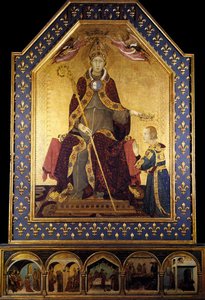
- Saint Louis Crowning Robert
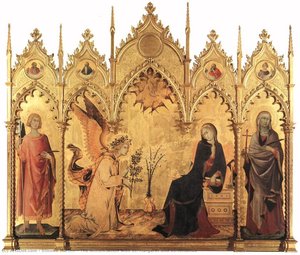
- Annunciation (Uffizi)
- Consecration of Chapel
- Place Of Birth: Siena, Italy
Seotud artiklid

Tempera on Panel: A Procurement Guide to Durable, High-Quality Art for Large-Scale Hospitality Projects
A professional procurement guide for hotel designers on the durability and prestige of tempera on panel. Discover how these high-quality, large-scale artworks offer unmatched longevity and architectural impact for premium hospitality projects and commercial interiors.

Gothic Art Guide for Hotel Designers: Leveraging Dramatic Shadows and Architectural Grandeur in Luxury Interiors
Elevate hospitality interiors with our expert guide to Gothic art. Discover how to leverage dramatic shadows, architectural grandeur, and high-end reproductions to create sophisticated, atmospheric hotel spaces that captivate guests.

The Professional Guide to Tempera Paint: History, Techniques, and Applications for High-End Interior Design
Master the art of tempera painting with our expert guide. Explore its historical significance, technical precision, and professional applications for luxury hotel design and large-scale architectural projects.