Acrylique sur toile.

§ 1Catalogue data


§ 2Abstract
Description de la pièce
Explore 'Gerti Schiele' par Egon Schiele : un portrait expressionniste saisissant capturant le style unique et la profondeur émotionnelle de l'artiste. Une œuvre essentielle !
 Lire la suite
Biographie de l'artiste
Découvrez l'art expressionniste émotionnellement chargé d'Egon Schiele (1890-1918) : portraits audacieux, thèmes psychologiques et lignes uniques. Explorez les reproductions sur AllPaintingsStore.
§ 3Commentary
A Glimpse into the Soul: Egon Schiele’s Portrait of Gerti Schiele
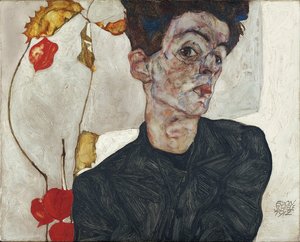
Egon Schiele's portrayal of his sister, Gerti Schiele, is more than just a likeness; it’s a hauntingly beautiful exploration of youth, vulnerability, and the burgeoning anxieties of a rapidly changing era. Painted around 1909, during a pivotal moment in both Schiele’s artistic development and the broader cultural landscape of Vienna, this work embodies the transition from Art Nouveau's decorative elegance to the raw emotional intensity that would define Expressionism. The painting captures Gerti with her back partially turned, an elegant black dress clinging to her form, hinting at a nascent maturity while simultaneously preserving a sense of youthful mystery. The subtle suggestion of a corset beneath the fabric speaks to societal constraints and expectations placed upon women during this period, adding layers of symbolic weight to the composition.
Vienna’s Artistic Climate and Schiele's Early Style
To understand “Gerti Schiele” is to understand the artistic ferment of early 20th-century Vienna. The city was a crucible of ideas, grappling with the decline of the Austro-Hungarian Empire and the rise of modern psychology. Gustav Klimt, a dominant figure in the Viennese art scene, served as an early mentor to Schiele, influencing his use of decorative elements and flowing lines. However, Schiele quickly diverged from Klimt’s opulent style, stripping away ornamentation to reveal the underlying emotional core of his subjects. This painting demonstrates that transitional phase beautifully – the elegant curves and refined color palette echo Art Nouveau sensibilities, but a nascent psychological depth begins to emerge in Gerti’s posture and the overall mood of introspection. Schiele wasn’t merely interested in *how* something looked; he was obsessed with conveying *what it felt like* to exist within its form.
Technique and Emotional Resonance
Schiele’s technique in this portrait is masterful, even at this early stage in his career. The delicate rendering of Gerti’s hair, styled in an updo and adorned with a pearl necklace, contrasts sharply with the more angular lines defining her back and shoulders. This interplay between softness and sharpness creates a visual tension that mirrors the emotional complexity of the subject. The limited color palette—dominated by blacks, grays, and subtle flesh tones—further enhances the painting’s somber mood. Schiele’s use of line is particularly striking; it isn’t simply used to define form but to convey emotion, with each stroke imbued with a sense of nervous energy and psychological insight. The way Gerti glances over her shoulder adds an element of unease, as if she is both inviting and withdrawing from the viewer’s gaze. This ambiguity invites us to project our own emotions onto the figure, forging a deeply personal connection with the artwork.
Symbolism and Context
Beyond its aesthetic qualities, “Gerti Schiele” resonates profoundly with biographical details surrounding Schiele’s sister. Recent discoveries have illuminated previously unknown facets of Gerti’s life—her institutionalization and untimely death—adding layers of poignant reflection to the artwork. The corset symbolizes societal pressures on women during this era, representing restrictions imposed upon their freedom and autonomy. Simultaneously, it hints at Gerti's vulnerability and inner turmoil. Schiele’s masterful use of chiaroscuro—the dramatic interplay between light and shadow—intensifies the emotional impact, emphasizing Gerti’s isolation and conveying a sense of profound melancholy.
Conclusion: An Icon of Expressionism
“Gerti Schiele” stands as an emblem of Schiele's pioneering contribution to Expressionist art. It exemplifies his unwavering commitment to portraying psychological states with uncompromising honesty, marking him as one of the most influential artists of his time. Its enduring appeal lies in its ability to capture a moment of profound human experience—a glimpse into the soul—and to provoke contemplation on themes of vulnerability, identity, and mortality.
Questions et réponses
Où puis-je acheter une impression de «Gerti Schiele» de Egon Schiele ?
« Gerti Schiele » est disponible en tant que une impression d'art sur toile de coton ou sur papier canvas d'archive. Les commandes s'effectuent sur sa page Tirage d'art fine art, dans le format de votre choix.
Quel format choisir pour l'impression de "Gerti Schiele" afin qu'il s'adapte à ma pièce ?
Pour une Salon, nous suggérons un format d'impression de Grand format pour « Gerti Schiele ».
Où puis-je voir un aperçu de « Gerti Schiele » ?
La page Aperçu en situation de « Gerti Schiele » vous permet de prévisualiser l'œuvre avant de passer commande.


 Passer au format impression


 Pour les œuvres ou reproductions dont un côté mesure plus de 105 cm (environ 41 pouces), le cadre sera expédié sous forme de kit démonté. Cette méthode garantit une livraison sécurisée et prévient tout dommage pendant le transport.