


 Aperçu en situation
 Envoyer
 Partager
 Détails de l'œuvre
 Guide
Guide

 Télécharger l'image
 Articles similaires
 Radiographie
 Diaporama
 Q&A
Q&A Statistiques
Éléments mécaniques


 Lire la suite
Giclées et impressions d'art
Impressions giclées ou sur toile de qualité musée, avec une production rapide et des finitions au choix. ( Commander la reproduction peinte à la main Passer au format numérique)




P118B €10

P118H €10

P118W €10

P438Z €10

P508JH €12

P508YH €12

P805H €10

P805Z €10

P919BZ €10

P919G €10

P919XJ €10

P959ZH €10

P968JZ €12

W106C €8

W218G €10

W218JH €8

W218Y €10

W307PJ €10

W316G €10

W316PJ €8

W316Y €10

W398PJ €8

W4111J €10

W500HY €15

W500JH €15

W692G €12

W849H €8

W940BG €15

W953PJ €8




Choisissez parmi nos formats prédéfinis qui respectent les proportions originales de l’œuvre.

Saisissez la largeur et la hauteur souhaitées pour qu'elles s'adaptent à votre cadre ou à votre mur. Une impression peut être recadrée, mais jamais agrandie au-delà de l'image originale ; ainsi, un format de forme différente entraînera la perte d'une partie de l'image. Nous vous envoyons une maquette numérique pour approbation avant toute impression. L'image présentée sur cette page ne montre pas le recadrage réel — seule la maquette le permet.
Livraison dans le monde entier () en 2 semaines au lieu des 4/5 semaines habituelles. (29 octobre)

Livraison express gratuite dans le monde entier

Toile de lin de qualité supérieure

Assurance transport complète

Garantie de remboursement des droits de douane

Garantie de fidélité des couleurs

Politique de retour de 100 jours (uniquement en cas de défaut)

Garantie de remboursement à 100%

Offre de tarifs dégressifs
 L'option verre n'est disponible que pour les dimensions inférieures à 110 cm.

Éléments mécaniques
Giclées et impressions d'art
Format de la reproduction
-


Prix total
€ 56
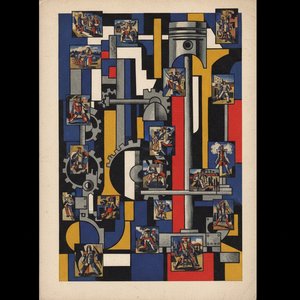
Fernand Léger’s Mechanical Elements: A Vision of Modernity Captured in Geometric Form
Fernand Léger's "Mechanical Elements," painted in 1926, stands as an arresting testament to the burgeoning fascination with industrial progress and its influence on artistic expression during the interwar period. More than just a depiction of machinery—though undeniably prominent—the painting embodies Léger’s core belief that art could actively engage with the transformative forces reshaping human experience. This analysis delves into the artwork's stylistic nuances, technical considerations, historical significance, and enduring emotional resonance.Stylistic Roots: Cubism Revisited
Léger firmly established himself within the vanguard of Cubist thought, yet he deftly steered away from its purely analytical dissection of form. Instead, he embraced a synthesis that prioritized geometric abstraction while retaining an awareness of observable reality. Unlike Picasso’s fragmented portraits and sculptures—which sought to dismantle traditional representation—Légers approach was to reconstruct visual experience through simplified shapes—cylinders, cones, cubes—creating a dynamic interplay between solidity and emptiness. This stylistic choice reflects Léger's conviction that Cubism could serve as a springboard for exploring the new aesthetic sensibilities of the machine age. The painting’s palette is deliberately restrained, favoring shades of gray and white to convey the austere materiality of industrial components, punctuated by a bold yellow element—a deliberate counterpoint—that injects vibrancy into the composition.Technique: Flat Planes and Sharp Edges – A Deliberate Aesthetic
The execution of "Mechanical Elements" is characterized by meticulous attention to detail within a remarkably reductive visual language. Léger employed flat planes of color applied with thick brushstrokes, creating a textured surface that mimics the roughness of metal surfaces. The sharp edges defining each geometric form contribute to an overall sense of precision and dynamism—a stylistic hallmark of Tubism, which Léger championed as a natural progression from Cubism. This technique wasn’t merely about replicating visual appearances; it was about conveying a feeling of immediacy and capturing the energy inherent in industrial processes. Léger's masterful blending of color and texture underscores his ambition to transcend mere imitation and forge an entirely new artistic idiom.Historical Context: Embracing the Machine Age
Painted during the height of Léger’s “mechanical period,” "Mechanical Elements" captures the zeitgeist of a society grappling with unprecedented technological advancements. The aftermath of World War I had irrevocably altered perceptions of time, space, and human existence—themes that Léger powerfully addressed through his art. He envisioned a future where humanity would coexist harmoniously with machines, recognizing their potential to liberate individuals from drudgery while simultaneously presenting new challenges to artistic creativity. Léger’s work anticipates the stylistic innovations of Pop Art, demonstrating how abstraction could serve as a conduit for communicating complex ideas about modernity and its impact on human consciousness.Symbolism Beyond Representation
While eschewing literal depictions, Léger imbues "Mechanical Elements" with profound symbolic significance. The dominant cylindrical forms represent not just physical objects but also the pervasive influence of machinery—the relentless rhythm of industrial production—upon daily life. The yellow element symbolizes optimism and vitality—a deliberate assertion of human agency amidst the perceived bleakness of postwar anxieties. Léger’s intention wasn't to offer a didactic commentary on societal transformations; rather, he sought to evoke an emotional response—a sense of wonder and apprehension—regarding the unfolding drama of technological progress.Concluding Reflection: An Enduring Legacy
“Mechanical Elements” remains a captivating masterpiece because it embodies Léger’s unwavering conviction that art could engage with the complexities of its time without sacrificing aesthetic beauty. Its bold geometric forms, textured surface, and carefully considered palette continue to inspire artists and collectors alike—a testament to Léger's enduring legacy as one of the most influential figures in twentieth-century abstraction.Questions et réponses
À quel artiste est attribuée l'œuvre "Éléments mécaniques" ?
« Éléments mécaniques » est attribué à Fernand Léger.
Quelle est la technique et la date de création de «Éléments mécaniques» de Fernand Léger ?
«Éléments mécaniques» de Fernand Léger est une œuvre réalisée en Acrylique sur toile, datant de 1926.
À quelle étape de la carrière de Fernand Léger appartient « Éléments mécaniques » (1926) ?
«Éléments mécaniques», créé en 1926, appartient à la période Mechanical Period de la carrière de Fernand Léger.
Œuvres similaires


Biographie de l'artiste
jeune vie et formation
fernand léger, peintre, sculpteur et cinéaste français, est né le 4 février 1881 à Argentan, Orne, en Normandie inférieure. Son père élevait du bétail, et léger a initialement été formé à l'architecture de 1897 à 1899. Il s’est ensuite installé à Paris en 1900, se débrouillant comme dessinateur architectural.développement artistique
Le travail précoce de léger a été influencé par l'impressionnisme, comme le montrent le jardin de ma mère (mon jardin) (1905). Après avoir fréquenté l'école des beaux-arts et l’académie Julian, il a commencé à travailler sérieusement comme peintre à 25 ans. Son style s'est développé en une forme personnelle de cubisme, que les critiques ont qualifié de "tubisme" pour son accent sur les formes cylindriques.cubisme et le groupe des Puteaux
En 1910, léger a exposé au Salon d’automne aux côtés de jean metzinger et henri le fauconnier. Il a rejoint le groupe des Puteaux, également connu sous le nom de section d’or (la section dorée), avec d'autres artistes tels que francis picabia et marcel duchamp.guerre et son influence sur le travail de léger
Les expériences de léger à la Première Guerre mondiale ont eu un impact significatif sur son œuvre. Pendant son séjour au front, il a produit des croquis d'artillerie, d'avions et de soldats. Sa peinture soldier avec un tuyau (1916) reflète cette période.œuvre ultérieure et héritage
L'œuvre post-guerre de léger, caractérisée par des formes machine-like élégantes, le lia à la tradition de la peinture figurative française. Ses paysages animés de 1921 ont présenté des figures et des animaux dans des formes harmonieuses et rationalisées.- voir les œuvres de fernand léger sur AllPaintingsStore
- en savoir plus sur fernand léger sur wikipedia
- découvrez le musée national fernand léger (france) avec AllPaintingsStore
- la femme assise (100 x 81 cm, tubisme)
- élément de machine (cubisme)

Fernand Léger
1881 - 1955 , France
L'essentiel de l'artiste
- Artistes Influents:
- Cézanne
- Impressionnisme
- Date De Décès: 1955
- Date De Naissance: 4 février 1881
- Influences Artistiques: ['Pop Art']
- Lieu De Naissance: Argentan, France
- Mouvement Artistique: Cubisme, Tubisme
- Nationalité: Française
- Nom Complet: Fernand Léger
- Oeuvres Notables:
- La Grande Parade
- Machine Élément
- Femme assise
- Paysages animés
Articles connexes

10 chefs-d'œuvre iconiques qui ont révolutionné l'abstraction géométrique
Plongez dans l'ordre pur de l'abstraction géométrique. De Mondrian à Kandinsky, explorez 10 chefs-d'œuvre intemporels et trouvez l'inspiration pour votre décor avec nos reproductions de qualité musée sur AllPaintingsStore.com. Explorez la collection complète en ligne.
Fernand Léger : Les 25 Œuvres Maîtresses d'un Pionnier du Modernisme | AllPaintingsStore
Plongez dans l'univers vibrant de Fernand Léger ! Découvrez les 25 œuvres majeures du cubisme et du tubisme, explorant formes géométriques et couleurs audacieuses. Retrouvez des reproductions d'art exceptionnelles sur AllPaintingsStore.com.

Acier & Âme : 10 chefs-d'œuvre qui capturent l'esprit industriel
Explorez 10 chefs-d'œuvre capturant l'âme industrielle : de la force du cubisme de Léger au dynamisme de Warhol. Trouvez l'inspiration pour votre décor avec nos reproductions de qualité musée. Découvrez tous ces chefs-d'œuvre sur AllPaintingsStore.com.

Déconstruction de la réalité : L'impact révolutionnaire du cubisme sur l'art du XXe siècle
Explorez l'impact révolutionnaire du cubisme sur l'art moderne. Découvrez Picasso, Braque et les maîtres de ce mouvement clé. Guide pour collectionneurs éclairés.

Maîtriser le Cubisme : Les 25 chefs-d'œuvre incontournables de Georges Braque
Plongez dans l'univers révolutionnaire de Georges Braque. Explorez 25 chefs-d'œuvre du Cubisme, entre textures et formes géométriques. Trouvez l'inspiration avec nos reproductions d'art de qualité musée sur AllPaintingsStore.com. Découvrez toute la collection en ligne.


