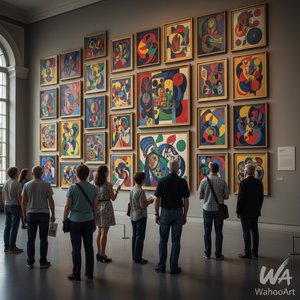
1914. Huile sur toile, 112.0 x 84.0 cm.

§ 1Catalogue data

- 112.0 x 84.0 cm


§ 2Abstract
Description de la pièce
Plongez dans "Formes Brisées" de Franz Marc, une œuvre cubiste emblématique. Vibrant et expressif, ce tableau explore l'âme de la nature à travers des formes géométriques audacieuses. Une explosion de couleurs et d'émotions.
 Lire la suite
Biographie de l'artiste
Explorez Franz Marc (1880-1916), un pionnier de l'expressionnisme allemand et cofondateur du Der Blaue Reiter. Découvrez ses icônes tableaux sur les animaux, ses couleurs vibrantes et ses thèmes spirituels. Apprenez à connaître son héritage !
§ 3Commentary
L'Élan Brisé : Une Exploration de l'Âme à Travers les Formes
Franz Marc’s “Broken Forms,” painted in 1914, isn’t merely a painting; it’s an immersion into the heart of early 20th-century artistic revolution. This canvas, measuring 112 x 84 cm, pulsates with a raw energy born from a profound desire to capture not just what is seen, but what *feels* – a core tenet of Expressionism and a key element in Marc’s unique approach to Cubism. The work immediately draws the eye, not through meticulous representation, but through an audacious fragmentation of reality, transforming familiar forms into a vibrant tapestry of geometric shapes. The dominant hues—a fiery red, a melancholic blue, a sunny yellow, a verdant green, and a warm orange—don’t simply decorate; they engage in a dynamic dialogue, creating a palpable tension that mirrors the anxieties and aspirations of a world on the cusp of profound change.
Marc's artistic journey was deeply rooted in spiritual contemplation. His early flirtation with theology, followed by his rigorous training at the Munich Academy of Fine Arts, instilled within him a belief that art could be a vehicle for accessing something beyond the purely visual. This conviction is powerfully evident in “Broken Forms.” The artist’s fascination with animals – particularly horses and deer – served as a conduit to explore themes of vulnerability, instinct, and the interconnectedness of all living things. The abstracted forms within the painting aren't simply decorative; they embody these primal emotions, inviting viewers to contemplate their own relationship with nature and the spiritual realm.
La Déconstruction et la Réinvention de l’Objet
“Broken Forms” exemplifies the radical innovations of Cubism, pioneered by Picasso and Braque. Marc doesn't aim for a single, fixed perspective; instead, he dissects objects – reducing them to their fundamental geometric components: circles, triangles, squares, and rectangles—and reassembles them in an unconventional manner. This process isn’t about creating illusionistic depth but rather about presenting multiple viewpoints simultaneously, forcing the viewer to actively engage with the artwork and reconstruct its meaning. The prominent circles, particularly the large one at the top left and the smaller one near the center-left, act as focal points, drawing the eye across the composition while the scattered geometric shapes contribute to a sense of dynamic movement and visual complexity. Notice how these forms seem to vibrate with an internal life, suggesting a hidden energy beneath their seemingly simple structure.
Influences et Contexte Historique
Marc’s artistic vision was shaped by a confluence of influences. The bold colors and expressive distortions of Fauvism, alongside the proto-Cubist explorations of Picasso, undoubtedly informed his approach. However, perhaps even more significantly, Marc drew inspiration from African tribal masks – objects that communicated complex narratives through simplified forms and symbolic imagery. This encounter with non-Western art profoundly impacted his understanding of abstraction and its potential to convey deeper meaning. Painted in 1914, a year marked by escalating political tensions and the burgeoning avant-garde movements, “Broken Forms” reflects the spirit of an era grappling with tradition and embracing radical new possibilities. It’s a testament to the artistic ferment that was transforming European art at the time.
L'Impact Émotionnel et la Reproduction
“Broken Forms” is more than just a visually striking artwork; it possesses a profound emotional resonance. The painting evokes feelings of both excitement and unease, mirroring the turbulent times in which it was created. The vibrant colors and fragmented forms create a sense of dynamism and movement, while the underlying geometric structure suggests an underlying order—a subtle counterpoint to the apparent chaos. For those seeking to bring this powerful artwork into their home or office, AllPaintingsStore offers meticulously crafted hand-painted reproductions that faithfully capture the essence of Marc’s vision. These high-quality reproductions allow you to experience the emotional depth and artistic innovation of “Broken Forms” in a tangible way, transforming it from a historical artifact into a vibrant element of your personal space. Consider how these colors and forms might interact with your existing décor – creating a focal point that sparks conversation and invites contemplation.
Questions et réponses
Quelle est la technique et la date de création de «Formes Brisées» de Franz Marc ?
« Formes Brisées » a été réalisé en 1914 selon la technique du Huile sur toile. Le matériau et la date précisent comment et quand l'œuvre originale a été créée.
Puis-je voir «Formes Brisées» de Franz Marc sous différents éclairages ?
La vue X de «Formes Brisées» de Franz Marc est disponible sur la page Radiographie de l'œuvre : une exploration interactive de l'image à travers onze couches optiques.
Quelle harmonie de couleurs «Formes Brisées» de Franz Marc présente-t-il ?
Les couleurs de «Formes Brisées» de Franz Marc présentent une harmonie Palette aux nuances subtiles. L'harmonie décrit la relation entre les couleurs.


 Passer au format impression


 Pour les œuvres ou reproductions dont un côté mesure plus de 105 cm (environ 41 pouces), le cadre sera expédié sous forme de kit démonté. Cette méthode garantit une livraison sécurisée et prévient tout dommage pendant le transport.