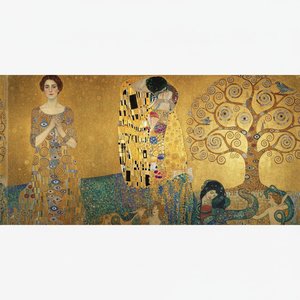
1901. Acrylique sur toile, 84.0 x 42.0 cm.

§ 1Catalogue data

- 84.0 x 42.0 cm


§ 2Abstract
Description de la pièce
Gustav Klimt : Judith et Holopherne (1901). Cette œuvre emblématique de la Secession viennoise explore la sensualité et le symbolisme dans une interprétation originale de la mythologie biblique. Découvrez son contexte artistique et son héritage.
 Lire la suite
Biographie de l'artiste
Explorez Gustave Klimt (1862-1918) : icône symboliste autrichienne de la Sécession viennoise et du Art Nouveau ! Découvrez sa phase dorée, ses portraits sensuels et ses chefs-d'œuvre décoratifs tels que Le Baiser.
§ 3Commentary
Judith et Holopherne : Une Symphonie Dorée de Sensualité et Mystère
Gustav Klimt’s Judith and Holopherne stands as a cornerstone of Viennese Symbolism and Art Nouveau, captivating viewers with its opulent gold leaf application and intricate patterns—a testament to Klimt’s singular artistic vision. Painted in 1901, this monumental canvas delves into the biblical narrative of Judith, portraying her decisive act of defiance against Holofernes, Assyrian general intent on subjugating Bethulia. Yet, Klimt eschews traditional heroic depictions, focusing solely on Judith herself—a deliberate choice that amplifies the painting’s enigmatic aura and invites contemplation about female desire and moral fortitude.Le Contexte Artistique et Historique
Klimt's interpretation aligns with a broader artistic movement seeking to transcend mere representation, mirroring influences from Byzantine mosaics and classical sculpture. Unlike contemporaneous artists who emphasized Judith’s bravery—a virtue celebrated throughout European art—Klimt prioritizes the psychological complexity of his subject. The omission of Holofernes’ severed head—a crucial element in many earlier portrayals—is particularly striking; it suggests Klimt's intention to explore Judith’s inner turmoil and her confrontation with mortality, rather than glorifying military conquest. This stylistic decision reflects a fascination with the subconscious and foreshadows Surrealist explorations decades later.La Symbolique Dorée et la Sensualité Évocatrice
The painting’s dominant motif—the shimmering gold leaf—is more than mere decoration; it embodies divine illumination and represents the transformative power of spiritual contemplation. Klimt meticulously crafted a visual language steeped in symbolism, utilizing geometric shapes and flowing lines to convey emotion and intellect simultaneously. Judith's exposed breasts serve as focal point, symbolizing fertility and maternal instinct—a deliberate provocation against societal norms of the time. Her gaze downward, seemingly directed at Holofernes’ decapitated head, reinforces this sensual preoccupation while hinting at a deeper meditation on death and resurrection. The positioning of Judith’s body is deliberately asymmetrical, creating tension and dynamism within the composition.Influences Byzantines et Antiquité Classique
Klimt's artistic sensibilities drew heavily from Byzantine iconography—specifically the shimmering mosaics adorning churches—demonstrating an awareness of artistic traditions that prioritized spiritual grandeur over naturalistic detail. Simultaneously, he revisited classical ideals of beauty and proportion, mirroring the humanist spirit of Renaissance art. The depiction of Judith’s nude figure echoes statues of goddesses found in ancient Greece and Rome, highlighting Klimt's desire to engage with timeless themes of femininity and heroism. This fusion of influences underscores Klimt’s ambition to elevate painting beyond mere imitation—aiming instead for an expression of profound psychological insight.Un Héritage Durable et une Oeuvre Iconique
Judith and Holopherne resides at the Österreichische Galerie Belvedere in Vienna, Austria—a testament to Klimt’s enduring legacy within Viennese art history. Its impact extends far beyond its time, inspiring subsequent artists and influencing stylistic trends throughout Europe. For those seeking to immerse themselves in Klimt's artistic universe, explore /art/list/?Filter=8XY64T/$File/Gustav-Klimt-Judith-and-Holopherne.JPG , Gustav Klimt: Judith I, oil on canvas, Österreichische Galerie and Gustav Klimt: Judith01 to discover exquisite hand-painted reproductions of this unforgettable masterpiece.- Gustav Klimt: Judith and Holopherne
- Gustav Klimt: Judith I, oil on canvas, Österreichische Galerie
- Gustav Klimt: Judith01
Questions et réponses
Quand "Judith et Holopherne" a-t-il été créé, et à quel mouvement appartient-il ?
«Judith et Holopherne» a été réalisé en 1901, au sein du mouvement Golden Phase.
Quelle ambiance et quelle émotion «Judith et Holopherne» de Gustave Klimt exprime-t-il ?
L'atmosphère qui se dégage de «Judith et Holopherne» de Gustave Klimt est Romantique, et sa tonalité émotionnelle est Mystérieux.
Comment le mouvement et l'époque se rencontrent-ils dans «Judith et Holopherne» de Gustave Klimt ?
« Judith et Holopherne » appartient au mouvement Golden Phase, et son créateur a œuvré à l'époque XIXe siècle.


 Passer au format impression


 Pour les œuvres ou reproductions dont un côté mesure plus de 105 cm (environ 41 pouces), le cadre sera expédié sous forme de kit démonté. Cette méthode garantit une livraison sécurisée et prévient tout dommage pendant le transport.