

Huile sur toile.

§ 1Données du catalogue


§ 2Abstrait
Description de la pièce
Explorez "Composition 1916" de Piet Mondrian, une œuvre abstraite fondamentale présentant des formes géométriques et des couleurs primaires. Une pièce clé du De Stijl, ce tableau illustre l'influence du Néo-plasticisme.
 Lire la suite
Biographie de l'artiste
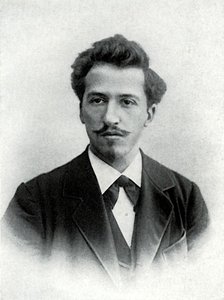
Explorez l'art de Piet Mondrian (1872-1944), un pionnier de l'art abstrait et du mouvement De Stijl. Découvrez ses peintures géométriques emblématiques, son style néoplasticiste et son influence durable sur le design moderne, l'architecture et l'art du 20e siècle.
§ 3Commentaire
Composition 1916: A Prelude to Neoplasticism – Exploring Mondrian’s Vision
Piet Mondrian's ‘Composition 1916’ stands as an undeniable cornerstone of modern art, marking a decisive shift from representational painting towards the radical simplification that would define his groundbreaking Neoplastic style. More than just an arrangement of geometric forms and primary colors; it embodies Mondrian’s profound intellectual and spiritual convictions—a quest for universal harmony rooted in Theosophy's belief in underlying order. This artwork isn’t merely aesthetically pleasing; it’s a manifesto of artistic philosophy, reflecting the artist’s unwavering commitment to distilling reality into its purest essence.Deconstructing Reality: Style & Technique
The painting firmly establishes itself within Constructivism and De Stijl movements, prioritizing pure abstraction and universal forms. However, ‘Composition 1916’ diverges subtly from Mondrian's later grid system—a deliberate choice that underscores the dynamism inherent in its visual language. The technique is meticulous, suggesting careful planning and precise application of oil paint on canvas. Layers of pigment create a palpable depth, achieved not through traditional perspective but by manipulating form and color relationships. Masking techniques likely ensured sharp edges and overlapping planes, contributing to the artwork’s distinctive textural quality. Despite appearing flat at first glance, this illusion of depth speaks volumes about Mondrian's mastery of visual perception.A Journey Towards Universal Harmony
Born in 1872, Piet Mondrian was deeply influenced by Theosophy—a spiritual movement seeking universal truths beyond the material world. He believed that art should transcend the mundane and represent the fundamental structure of existence. ‘Composition 1916’ powerfully articulates this belief. The absence of recognizable objects isn't a mere stylistic decision; it’s a conscious effort to liberate the viewer from superficial distractions, revealing instead the underlying geometric framework—the building blocks of reality itself. The interplay of vertical and horizontal lines, combined with the restrained palette of red, blue, yellow, grey, and black, symbolizes balance and harmony – core tenets of Mondrian's artistic worldview.Symbolism & Emotional Resonance
While abstract in appearance, ‘Composition 1916’ is imbued with symbolic significance. The intersecting lines can be interpreted as representing interconnectedness—the fundamental unity of all things—while the geometric shapes embody elemental principles. Notably, the artwork possesses a palpable tension between order and chaos—control and freedom—creating a visual energy that stimulates contemplation alongside serenity. These colors carry profound emotional weight: red signifies vitality; blue embodies spirituality; yellow represents earthly energy. Together, they evoke an intellectual rigor tempered by spiritual aspiration.Historical Significance & Legacy
Created around 1916, ‘Composition 1916’ precedes the formal establishment of De Stijl in 1917 but foreshadows its core principles—a deliberate step towards Mondrian's revolutionary artistic vision. Co-founder of De Stijl alongside Theo van Doesburg, Mondrian sought to create a “universal style” applicable to all forms of art and design. Its impact reverberates throughout the 20th century and continues to inspire contemporary artists and designers alike. Consider pairing it with furniture featuring clean lines and geometric forms for a cohesive aesthetic—a testament to Mondrian’s enduring influence on visual culture. Owning a reproduction of ‘Composition 1916’ is more than acquiring art; it's embracing a legacy of innovation and upholding the pursuit of universal beauty.Questions et réponses
L'œuvre « Composition 1916 » de Piet Mondrian est-elle dans le domaine public, et pourquoi ?
«Composition 1916» de Piet Mondrian est dans le dans le domaine public - ses droits d'auteur sont tombés dans le domaine public. La durée du droit d'auteur court à partir du décès de l'artiste, survenu en 1944.
Quel type d'œuvre est "Composition 1916" ?
Dans le catalogue, «Composition 1916» de Piet Mondrian est répertorié sous la catégorie Décoration murale. Cette classification permet de découvrir des œuvres similaires.
Comment la palette de «Composition 1916» de Piet Mondrian est-elle décrite ?
Les couleurs de "Composition 1916" forment une palette Sombre et profond. Cette classification décrit les familles de couleurs dominantes.


 Passer au format impression


 Pour les œuvres ou reproductions dont un côté mesure plus de 105 cm (environ 41 pouces), le cadre sera expédié sous forme de kit démonté. Cette méthode garantit une livraison sécurisée et prévient tout dommage pendant le transport.


