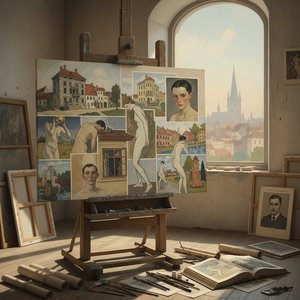
1980. , 74.0 x 116.0 cm. Souls Grown Deep.

§ 1Données du catalogue

- 74.0 x 116.0 cm


Cette œuvre est protégée par le droit d'auteur
L’œuvre d'art présentée sur cette page est protégée par le droit d'auteur, ce qui signifie que nous ne pouvons légalement créer ou vendre de reproduction identique. Cette protection est appliquée en vertu d'accords internationaux tels que la Convention de Berne et par les lois nationales, notamment celles énoncées par le Loi américaine sur le droit d'auteur - Titre 17.
En tant qu'alternative respectueuse et légale, nous proposons des œuvres d'art personnalisées, peintes à la main et inspirées de l'original. Nos artistes talentueux et professionnels étudient avec soin le style, l'ambiance et l'essence artistique de l'œuvre originale pour créer une pièce nouvelle et unique qui évoque la même émotion — tout en restant une création originale en soi.
Cette méthode est pleinement conforme aux réglementations sur le droit d'auteur car elle ne repose pas sur la copie ou la duplication de l'œuvre protégée. Il s'agit plutôt d'une réinterprétation créative — une nouvelle peinture qui s'inspire de l'original sans pour autant lui être identique.
 En savoir plus
§ 2Abstrait
Description de la pièce
A poignant depiction of a man seated in a chair by Purvis Young captures the raw essence of 1980s street art through an evocative and soulful lens, inviting you to explore this powerful piece for your collection.
Biographie de l'artiste
Découvrez Purvis Young (1943-2010), artiste américain autodidacte de Miami. Ses collages et peintures vibrantes explorent l'expérience afro-américaine dans le Sud, reflétant la vie urbaine et un commentaire social poignant.
§ 3Commentaire
The Soul of Overtown Captured in Ink and Memory
In the quiet, weathered pages of an old book, a profound fragment of American street art emerges, inviting the viewer into the visceral world of Purvis Young. This particular piece, titled Untitled, serves as more than just a visual encounter; it is a window into a life forged in the heart of Miami’s Overtown and Liberty City. The artwork, captured within the textured, torn edges of a vintage volume, presents a poignant scene of a solitary figure seated upon a chair, perhaps cradling a bowl, rendered with the raw, uninhibited energy that defined Young's autodidactic mastery. There is an undeniable intimacy in this presentation, where the art exists not just on a canvas, but as a living part of a historical narrative, nestled among the yellowed and orange hues of a decaying book cover.
The technique employed by Young is a testament to his resilience and his ability to transform found materials into profound statements. Eschewing formal academic training, he utilized the grit of his environment to develop a style that is both frantic and deeply rhythmic. In this work, the brushstrokes—or perhaps the marks of a marker or crayon—convey a sense of urgent storytelling. The composition, though seemingly simple, carries a heavy symbolic weight; the seated man becomes an archetype of the human condition, reflecting the struggles, the stillness, and the quiet dignity of the community Young so fiercely protected through his art. The surrounding imagery within the book, including the spectral drawing in the upper corner, adds layers of complexity, suggesting that the art is part of a larger, interconnected tapestry of urban life.
A Masterpiece of Raw Emotion and Urban Texture
For the discerning collector or interior designer, this reproduction offers an unparalleled opportunity to introduce a piece of authentic street history into a contemporary space. The visual impact of the work lies in its ability to command attention through its ruggedness. It does not seek to blend into the background with polished perfection; rather, it demands engagement through its textured imperfections and its evocative subject matter. The interplay between the dark, soulful figures and the vibrant, aged tones of the book's pages creates a sophisticated palette that complements both minimalist modern settings and more eclectic, maximalist decors.
Investing in a reproduction of Purvis Young’s work is an act of preserving a vital chapter of American art history. It brings into a home or gallery the spirit of a man who turned incarceration and hardship into a prolific creative legacy. The emotional resonance of the piece—a mixture of melancholy, strength, and profound observation—provides a conversational centerpiece that inspires deep thought. Whether placed in a sunlit study or a moody, dimly lit lounge, this artwork serves as a powerful reminder of the beauty that can be unearthed from the most overlooked corners of our society, making it an essential acquisition for those who value art with a heartbeat.
Questions et réponses
Puis-je commander une reproduction à l'huile de « Untitled » ?
Les reproductions peintes à la main de «Untitled» de Purvis Young sont disponibles sur ce site : une reproduction à l'huile peinte à la main sur toile de lin, via sa page Reproduction peinte à la main.
Quel usage est suggéré pour «Untitled» de Purvis Young ?
Une reproduction de «Untitled» de Purvis Young est recommandée pour Conversation. Cette suggestion découle du sujet, de l'atmosphère et des couleurs de l'œuvre.
L'œuvre « Untitled » se trouve-t-elle dans le pays de son créateur ?
Non - l'œuvre est conservée à l'étranger. « Untitled » est conservée en États-Unis, tandis que Purvis Young est né(e) en États-Unis d'Amérique.


 Passer au format impression


 Pour les œuvres ou reproductions dont un côté mesure plus de 105 cm (environ 41 pouces), le cadre sera expédié sous forme de kit démonté. Cette méthode garantit une livraison sécurisée et prévient tout dommage pendant le transport.