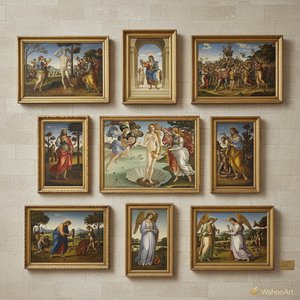
Acrylique sur toile.

§ 1Catalogue data


§ 2Abstract
Description de la pièce
Magnifique panneau peint en tempera par Sandro Botticelli vers 1489 pour le monastère de Cestello à Florence ! Découvrez l'Annonciation, symbole de pureté et de foi au cœur du Renaissance italienne.
 Lire la suite
Biographie de l'artiste
Explorez l'art captivant de Sandro Botticelli (1445-1510), un maître de la peinture de la Renaissance primitive. Connu pour sa ligne élégante, ses œuvres emblématiques telles que 'La Naissance de Vénus' & 'Le Printemps', et pour avoir relié les styles gothique et renaissance. Découvrez son héritage !
§ 3Commentary
A Moment Suspended in Time: Botticelli’s *Cestello Annunciation*
Sandro Botticelli’s Cestello Annunciation, painted around 1489, is not merely a depiction of a biblical event; it’s an intimate and profoundly moving encounter frozen in time. The scene unfolds with a quiet grace that defines Botticelli’s signature style – the Archangel Gabriel delivering his momentous news to Mary, poised on the cusp of accepting her divine destiny. The painting, originally created for the chapel of the Florentine monastery of Cestello (now Santa Maria Maddalena de’Pazzi), immediately draws the viewer into a space both sacred and deeply human. It’s a testament to Botticelli’s ability to blend religious narrative with an exquisite sensitivity to form and emotion.
The Language of Line and Light
Botticelli, born Alessandro di Mariano di Vanni Filipepi in Florence, was a master of line. In the Cestello Annunciation, this mastery is strikingly evident. The figures are defined not by robust modeling or dramatic chiaroscuro, but by elegant, flowing contours that lend them an ethereal quality. The delicate drapery folds and the graceful gestures of Gabriel and Mary seem to ripple with a life of their own. He bridges the gap between the Gothic past and the burgeoning Renaissance aesthetic, retaining a certain decorative elegance while embracing emerging principles of perspective and naturalism. The use of tempera on wood contributes to the painting’s luminous quality; colors are applied in thin, translucent layers, creating a subtle interplay of light and shadow that enhances the scene’s serene atmosphere. Notice how Botticelli employs a limited palette – rich blues, reds, and golds – to create a harmonious visual experience.
Symbolism Woven into Every Detail
The Cestello Annunciation is rich in symbolic meaning. The lily held by Gabriel isn't simply a beautiful flower; it represents Mary’s purity and virginity, a traditional symbol within Christian iconography. The enclosed garden visible through the window alludes to Mary as the *hortus conclusus*, the “closed garden,” symbolizing her inviolate state. Even the architectural details contribute to the narrative – the room itself is sparsely furnished, drawing attention to the spiritual significance of the encounter rather than worldly possessions. The inscriptions in Latin, taken from the Gospel of Luke, further reinforce the theological weight of the scene. Botticelli doesn’t simply *show* us the Annunciation; he invites us to contemplate its profound implications.
A Reflection of Florentine Piety and Artistic Innovation
To fully appreciate the Cestello Annunciation, it's crucial to understand its historical context. Florence in the late 15th century was a city undergoing significant religious and political upheaval. The sermons of Girolamo Savonarola, a Dominican friar who preached against corruption and excess, had a profound impact on Florentine society. Botticelli himself was influenced by Savonarola’s austere piety, which is reflected in the painting’s restrained emotionality and emphasis on spiritual devotion. However, despite this religious fervor, Botticelli remained committed to artistic innovation. The use of linear perspective, borrowed from Flemish painters, demonstrates his engagement with contemporary artistic trends. This blending of traditional symbolism and modern technique makes the Cestello Annunciation a remarkable example of Early Renaissance art.
An Enduring Legacy
The emotional impact of Botticelli’s *Cestello Annunciation* lies in its ability to convey a sense of quiet reverence. It’s not a scene of dramatic fanfare, but rather an intimate moment of divine communication. The painting invites contemplation and offers a glimpse into the profound mystery of faith. For collectors and interior designers alike, a reproduction of this masterpiece brings a touch of Renaissance elegance and spiritual depth to any space. Its harmonious colors and graceful composition make it a versatile addition to a variety of décor styles, while its rich symbolism provides endless opportunities for conversation and reflection. The Cestello Annunciation is more than just a painting; it’s a window into the soul of the Renaissance, and a testament to Botticelli’s enduring artistic genius.
- Artist: Sandro Botticelli
- Birth Year: 1445
- Death Year: 1510
- Birth City: Florence
- Birth Country: Italy
Botticelli’s *Cestello Annunciation* is a tempera painting on wood created in 1489 for Benedetto di Ser Giovanni Guardi, moneychanger and Florentine noble family patron. The chapel of Santa Maria Maddalena de' Pazzi was Botticelli’s home during his formative years.
- Style: Early Renaissance
- Technique: Tempera on Wood
- Notable Features: Elegant Line Drawing, Sparse Furnishing, Minimal Chiaroscuro
The painting’s luminous quality stems from the application of thin, translucent tempera layers—a technique that Botticelli adopted from Flemish painters. This method prioritizes subtle tonal variations and enhances the serene atmosphere of the scene.
- Historical Context: Savonarola’s Sermons & Florentine Religious Upheaval
- Symbolism: Lily (Mary's Purity), Enclosed Garden (*Hortus Conclusus*)
Botticelli’s artistic vision was profoundly influenced by Savonarola’s moral fervor, resulting in a painting characterized by restrained emotion and an unwavering focus on spiritual devotion. This careful consideration of symbolism contributes to the enduring power of *Cestello Annunciation*.
A reproduction of this masterpiece adds a touch of Renaissance elegance and contemplative beauty to any interior space. Its harmonious palette and graceful composition resonate with timeless artistic principles.
Questions et réponses
Quel est le niveau de contraste de «L'Annonciation de Cestello» de Sandro Botticelli ?
Le contraste clair-obscur de « L'Annonciation de Cestello » est évalué à Contrasté. Le contraste décrit l'intensité de la différence entre les zones claires et les zones sombres.
Quelle est la luminosité globale de « L'Annonciation de Cestello » ?
La luminosité perçue de «L'Annonciation de Cestello» de Sandro Botticelli est ombreux. Elle peut être harmonisée avec la lumière de l'espace prévu.
Qui est l'artiste derrière « L'Annonciation de Cestello » ?
« L'Annonciation de Cestello » est attribué à Sandro Botticelli.


 Passer au format impression


 Pour les œuvres ou reproductions dont un côté mesure plus de 105 cm (environ 41 pouces), le cadre sera expédié sous forme de kit démonté. Cette méthode garantit une livraison sécurisée et prévient tout dommage pendant le transport.