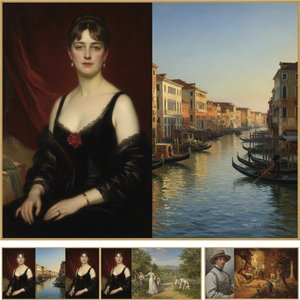
1830. Oil On Canvas, 75.0 x 62.0 cm. Salle des Marchands Aventuriers.

§ 1Données du catalogue

- 75.0 x 62.0 cm


§ 2Abstrait
Description de la pièce
A somber and dignified 1832 portrait by William Etty captures the intense gaze of John Thornton through masterful Victorian realism, offering a profound sense of history for your private collection.
 Lire la suite
Biographie de l'artiste
Découvrez William Etty (1787-1849), artiste britannique audacieux ! Ses peintures historiques, souvent à nu, ont marqué l'art victorien par leur réalisme et leur sensualité.
§ 3Commentaire
John Thornton By William Etty
William Etty’s “John Thornton” stands as a cornerstone of Victorian British portraiture—a testament to meticulous observation and an unflinching portrayal of human emotion. Painted in 1832, this monumental canvas captures the solemn dignity of John Lawson Thornton (1954), a prominent Welsh sculptor known for his evocative depictions of Victorian public memorials and naturalistic works reflecting the New Sculpture movement. More than just a likeness, Etty’s masterpiece delves into themes of grief, resilience, and the profound connection between man and nature—elements that resonate powerfully even today.- Composition & Perspective: The painting's central focus is Thornton’s bust, dominating the frame with unwavering presence. Two indistinct figures flank him on either side, subtly establishing a contextual backdrop without distracting from the primary subject. This balanced arrangement utilizes shallow perspective to convey intimacy and immediacy, drawing viewers directly into Thornton’s gaze.
- Color Palette & Lighting: Etty employs a restrained color palette dominated by deep browns and blacks—reflecting the somber mood of the scene—contrasted sharply by creamy whites and pale yellows used for Thornton's shirt collar and hair. The diffused lighting emanating from above illuminates Thornton’s face, highlighting his features with delicate precision and emphasizing the emotional weight conveyed through his expression.
- Technique & Texture: Executed in oil paints on canvas, Etty’s technique demonstrates remarkable skill in achieving realistic textures. Soft brushstrokes skillfully render the fabric of Thornton's suit—smooth yet subtly textured—while capturing the nuanced contours of skin tones with meticulous detail. The artist’s mastery is evident in his ability to convey both physicality and psychological depth.
- Symbolism & Emotion: Thornton’s direct gaze embodies confidence and solemn contemplation, conveying a palpable sense of grief – likely stemming from the loss of his son—a poignant reflection of Victorian sensibilities. The dark clothing symbolizes mourning and seriousness, reinforcing the painting's emotional core and inviting viewers to contemplate themes of mortality and remembrance.
- Historical Context: “John Thornton” emerged during a period marked by significant social and artistic upheaval—the Romantic era giving way to Realism—and Etty’s work exemplifies the Victorian preoccupation with capturing human experience with unflinching honesty. It aligns perfectly with the New Sculpture movement, prioritizing naturalistic representation over idealized forms, mirroring the broader artistic trends of the time.
Questions et réponses
Qui est l'auteur de "John Thornton" ?
« John Thornton » est attribué à William Etty.
Quand "John Thornton" a-t-il été créé, et à quel mouvement appartient-il ?
«John Thornton» de William Etty date de 1830 et appartient au mouvement Early Romanticism.
En quoi "John Thornton" s'inscrit-il dans l'œuvre de William Etty ?
«John Thornton» partage avec les autres œuvres de William Etty son style Early Romanticism ainsi que ses thèmes récurrents : classical idealism, victorian morality, dignified figure, anatomical accuracy, portrait tradition.


 Passer au format impression


 Pour les œuvres ou reproductions dont un côté mesure plus de 105 cm (environ 41 pouces), le cadre sera expédié sous forme de kit démonté. Cette méthode garantit une livraison sécurisée et prévient tout dommage pendant le transport.