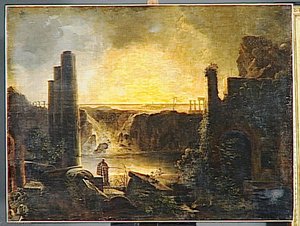
Auguste de Forbin: A Painter Caught Between Romantic Idealism and Napoleonic Pragmatism
Auguste de Forbin (1777 – 1841) stands as a fascinating figure in French art history, embodying the complexities of his era—a period marked by turbulent political upheaval and burgeoning artistic innovation. Born into a noble family at Château La Roque-d’Anthéron, Provence, he possessed an innate talent for drawing from a young age, nurtured by a formative friendship with François Marius Granet, a relationship that would endure throughout their lives. This early training instilled in him a sensitivity to observation and detail, qualities that would characterize his artistic endeavors. His artistic journey began amidst the fervor of the French Revolution, where he witnessed firsthand the dramatic shifts reshaping French society. The assassination of his father, Marquis de Pont-à-Mousson, during the Lyon insurrection profoundly impacted Forbin’s life, highlighting the dangers inherent in political instability. Remarkably resilient, he escaped unscathed thanks to his youth and continued his artistic pursuits alongside Granet, honing their skills in the tranquil countryside—a deliberate contrast to the tumultuous urban landscape of Paris. David's Studio: The Crucible of Style The Directory offered Forbin a crucial opportunity for artistic advancement – access to Jacques-Louis David’s prestigious studio, a bastion of neoclassical ideals. Here, he collaborated closely with Granet, absorbing the stylistic influences of David and establishing himself firmly within the dominant artistic movement. This association proved invaluable in shaping his aesthetic sensibilities and propelling him toward mastery of technique. The meticulous realism championed by David—a stark departure from the expressive fervor of Romanticism—served as a formative influence on Forbin’s artistic vision. He diligently studied David's compositions, mastering chiaroscuro and striving for anatomical accuracy – skills that would define his oeuvre. From Rome to Napoleon: Artistic Pilgrimage and Imperial Patronage Forbin’s travels to Rome in 1804 solidified his commitment to classical art principles, immersing him in the vibrant intellectual atmosphere of francophile Roman society. He embraced a carefree lifestyle, indulging in leisure pursuits alongside Granet—a period marked by considerable artistic experimentation. Notably, he secured the patronage of Princess Pauline Borghese, Napoleon’s sister, forging a romantic relationship that lasted until 1807 and produced a celebrated villa at Aix-en-Provence. His military service during the Napoleonic Wars – Portugal and Austria – earned him recognition and honors, including the Croix d'honneur. He returned to Italy, producing monumental history paintings that showcased his ambition and artistic prowess—works imbued with grandeur and symbolic resonance. Notable Works & Legacy Forbin’s oeuvre comprises a diverse range of subjects—primarily landscapes and historical scenes—characterized by meticulous realism combined with subtle expressive qualities. “Vue de Jérusalem” exemplifies his masterful depiction of architectural grandeur and atmospheric perspective, capturing the majesty of the Holy City with breathtaking precision. Similarly, "Vue de Cazzafani" presents a hauntingly beautiful portrayal of ruin—a poignant reflection on the passage of time and decay—executed with remarkable sensitivity to tonal gradation and textural detail. His exploration of color palettes and brushwork demonstrates an evolving artistic style that anticipates elements of Impressionism, signaling a pivotal moment in French art history. Auguste de Forbin’s contribution to French art is significant not only for his technical skill but also for representing the intellectual currents of his era, bridging the gap between Romantic idealism and Napoleonic pragmatism—a testament to a painter who navigated the complexities of history with unwavering dedication and artistic vision. He died in Paris in 1841, leaving behind a legacy of enduring beauty and scholarly insight.Questions et réponses
Quelles couleurs Auguste de Forbin a-t-il le plus souvent utilisées ?
L'usage de la couleur par Auguste de Forbin à travers les œuvres répertoriées sur ce site peut être étudié sur la page ADN de la palette de l'artiste.
Puis-je visiter un musée virtuel des œuvres de Auguste de Forbin ?
Une visite virtuelle est possible : la page Musée en 3D de Auguste de Forbin présente les œuvres de l'artiste dans une galerie en trois dimensions.
Où trouver les œuvres de Auguste de Forbin classées par couleur ?
L'Par couleur de Auguste de Forbin permet de parcourir les œuvres de l'artiste par couleur.