The Enigmatic Master of Flemish Serenity
In the golden age of seventeenth-century Northern Europe, few artists captured the quiet majesty of the natural world with as much ethereal grace as Gilles Neyts. A figure shrouded in a certain historical mist, Neyts—also known as Gillis or Aegidius—emerged from the vibrant artistic landscape of Flanders to become a master of the tranquil vista. While definitive biographical records remain tantalizingly sparse, we know that he was likely baptized in Ghent on May 4, 1623, a beginning that placed him at the heart of a rich tradition of Flemish landscape painting. His life was one of movement and observation; from his early years in Ghent to his documented presence in Antwerp, where he joined the prestigious Guild of Saint Luke in 1647, Neyts navigated the shifting cultural currents of the Southern Netherlands with the eye of a true wanderer.
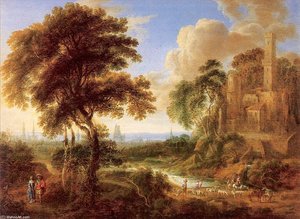
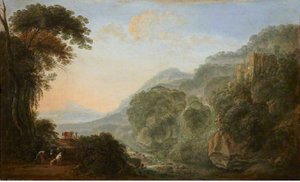
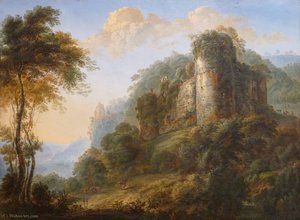
The artistry of Neyts was not merely about documentation, but about the creation of atmosphere. His works often serve as windows into a lost world of Italianate beauty and topographical charm. Whether he was sketching the steep-banked valleys of the Meuse region or capturing the crumbling grandeur of ancient castle ruins, his hand possessed a unique ability to marry realism with a dreamlike luminosity. Scholars have often looked toward the style of Antwerp masters like Lucas van Uden for clues to his training, noting how Neyts’s landscapes reflect a similar mastery of light and shadow. His canvases are characterized by a profound sense of peace, achieved through a sophisticated use of atmospheric perspective that draws the viewer's gaze deep into the horizon, past winding rivers and through sun-dappled forests.
A Tapestry of Light, Water, and Ruin
To step into a painting by Gilles Neyts is to enter a realm where time seems to slow. His repertoire was remarkably diverse, spanning from meticulous topographical drawings to evocative oil paintings that leaned toward the burgeoning sensibilities of the Rococo style. He was particularly renowned for his ability to render the interplay between water and land; his river scenes are legendary for their clarity and the way they capture the subtle gradations of light reflecting off a moving current. These landscapes were frequently punctuated by the romantic melancholy of ruins, serving as poignant reminders of the passage of time—a theme that resonated deeply with the seventeenth-century psyche.
Beyond the purely naturalistic, Neyts also found inspiration in the classical and the biblical. His work occasionally featured mythological figures or religious narratives, such as his depictions involving Venus and Adonis or scenes of Saint George. In these works, he collaborated with other skilled hands, such as Jacques Nicolaï, who provided the human figures that breathed life into Neyts’s expansive settings. This fusion of landscape and narrative allowed him to explore complex emotional territories, ranging from the heroic to the deeply intimate. His technical prowess was equally evident in his printmaking; as an engraver, he possessed a sharp, disciplined line that could translate the rugged textures of rocky landscapes into the delicate medium of ink and paper.
Legacy and Historical Resonance
The historical significance of Gilles Neyts lies in his role as a bridge between the meticulous realism of the early Flemish masters and the more atmospheric, emotive styles that would follow. Though he may not have been as prolific a painter as some of his contemporaries, the quality of his surviving corpus—approximately sixty paintings alongside numerous drawings and prints—speaks to a singular vision of the natural world. His ability to capture the topographical essence of the Southern Netherlands while imbuing it with a sense of universal tranquility ensured that his work remained relevant long after his death in the late seventeenth century.
Today, the works of Neyts continue to captivate collectors and historians alike, held in prestigious collections such as the British Museum and Te Papa. His legacy is found in every soft green hue of a distant meadow and every shadowed corner of a stone ruin he once rendered. He remains a vital voice from the Flemish tradition, reminding us that there is profound beauty to be found in the stillness of a riverbank and the enduring strength of the landscape.
Questions et réponses
Puis-je parcourir les œuvres de Gilles Neyts par ambiance ?
Les œuvres de Gilles Neyts peuvent être explorées par émotion sur la page L'espace des émotions de l'artiste, qui organise les créations selon l'ambiance qu'elles dégagent.
Sous quels autres noms Gilles Neyts est-il/elle connu(e) ?
Gilles Neyts est également connu sous les noms suivants : Gillis Neyts.
Existe-t-il une visite virtuelle en 3D des œuvres de Gilles Neyts ?
Retrouvez les œuvres de Gilles Neyts dans une galerie 3D sur la page Musée en 3D de l'artiste.