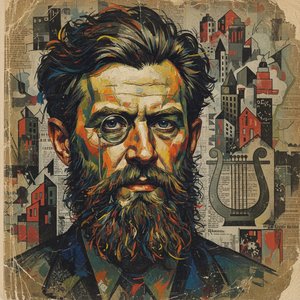
The Fragmented Vision of Wladimir Burliuk
To understand the trajectory of the early twentieth-century avant-garde, one must look directly at the short, sharp impact of Wladimir Burliuk. He was not a figure of long-term institutional stability, but rather a concentrated burst of Neo-Primitivist and Cubo-Futurist energy. His work functioned as a direct assault on academic tradition, favoring the raw and the fractured over the polished. While his brother David often took the spotlight as a central organizer, Wladimir provided the essential, jagged edges that defined the movement's visual language.
His development was marked by a rapid succession of influential environments. From studying under Anton Ažbe in Munich to attending the Kyiv Art School, his technical foundation was constantly being disrupted by new radical ideologies. He did not merely adopt styles; he integrated them into a specific, aggressive aesthetic that sought to dismantle the viewer's expectations of reality.
A Life Defined by Conflict and Movement
Burliuk’s existence was inextricably linked to the geopolitical upheavals of his era. His biography is a sequence of displacements across major urban centers of the Russian empire, including Moscow, Kiev, St. Petersburg, and Odesa. These were not mere residences but tactical bases for artistic rebellion. He participated in the formation of critical groups such as The Link (Zveno) and Jack of Diamonds, where he worked alongside figures like Kazimir Malevich and Aleksandra Ekster.
The physical reality of his life was often dictated by the violence of the age. His early years included service in the Russo-Japanese War, and his career was abruptly terminated by the First World War. He was drafted into the Imperial army in 1916 and died on the Macedonian front in 1917. This sudden end left a gap in the evolution of Cubo-Futurism, cutting off a voice that was still actively refining its approach to book illustration and painting.
The Graphic Impact of the Avant-Garde
Burliuk’s contributions extended significantly into the realm of graphic design and book illustration. He understood that the future of art lay in the marriage of text and image, a concept he applied to several futuristic publications. His work on these projects was characterized by a refusal to let the image remain subordinate to the word.
- The Assistance of the Muses in Spring (1915): A key example of his ability to use illustration to reinforce the radical themes of the era.
- Roar! Gauntlets: A collaborative effort with Kazimir Malevich that pushed the boundaries of typographic and visual experimentation.
- Tango with Cows: A project completed with his brother David, showcasing the familial synergy within the Futurist movement.
His legacy is found in the structural shifts he helped execute. By utilizing thick impasto and a palette that rejected bourgeois subtlety, Burliuk contributed to a visual vocabulary that prioritized the primitive and the mechanical. He remains a vital study for anyone examining how the destruction of old forms was necessary to build the foundations of modernism.
Questions et réponses
Puis-je parcourir les œuvres de Vladimir Bourliouk par technique ?
La page Par technique regroupe les œuvres de Vladimir Bourliouk par technique.
Dans quelle ville et quel pays Vladimir Bourliouk est-il/elle né(e) ?
Vladimir Bourliouk est né à Kotelva, en Ukraine.
Comment puis-je trouver des œuvres de Vladimir Bourliouk par palette de couleurs ?
Retrouvez les œuvres de Vladimir Bourliouk classées par palette de couleurs sur la page Par palette de couleurs de l'artiste.
Où trouver les œuvres de Vladimir Bourliouk regroupées par mots-clés ?
Pour trouver des œuvres de Vladimir Bourliouk sur un thème spécifique, consultez la page Par mots-clés de l'artiste, qui regroupe les œuvres par mot-clé.