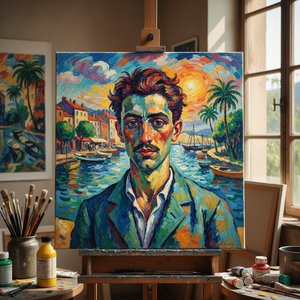
1905. Acrilico su tela. Philadelphia Art Museum.

§ 1Dati del catalogo


§ 2Astratto
Descrizione del reperto
Experience Henri Matisse and André Derain’s revolutionary Fauvist masterpiece, ‘A Dialogue of Color,’ a vibrant exploration of artistic collaboration through bold pigment and dynamic composition – perfect for art lovers seeking a unique statement piece.
 Espandi i dettagli
Biografia dell'artista
Scopri André Derain (1880-1954), fondatore del Fauvismo! Esplora i suoi audaci colori, le vibranti opere e l'eredità artistica che ha lasciato nel mondo dell'arte.
§ 3Commento
Henri Matisse and André Derain: A Dialogue of Color
The painting “Henri Matisse and André Derain,” completed in 1905 by Henri Matisse and André Derain, stands as a cornerstone of Fauvist art—a movement that irrevocably altered the course of European painting. More than just a portrait of two prominent artists, it’s an exploration of artistic collaboration and a testament to the transformative power of color as expressive language.
Matisse, already establishing himself as a visionary innovator, approached Derain with a proposition: to capture their friendship through a bold experiment in pigment. Departing from Impressionistic subtleties, they deliberately rejected blending colors on the palette, opting instead for juxtaposing pure hues—scarlet reds, ochre yellows, and deep browns—directly onto the canvas. This technique, championed by Matisse himself, prioritized visual impact over accurate representation, prioritizing emotion and sensation.
The composition itself is deceptively simple. Two men sit in chairs positioned near a beach, bathed in diffused sunlight. However, it’s the color scheme that dominates the viewer's gaze. The dominant red of Derain’s turban immediately draws attention, creating a visual anchor against which Matisse’s muted tones—primarily greens and browns—provide contrast. This deliberate imbalance isn’t merely stylistic; it symbolizes the dynamic interplay between their personalities – Derain’s assertive presence countered by Matisse’s contemplative gaze.
Historically, “Henri Matisse and André Derain” emerged during a period of fervent artistic debate. Impressionism had begun to wane, paving the way for movements like Neo-Impressionism and Symbolism. Yet, Fauvism pushed boundaries even further, rejecting academic conventions altogether. Matisse and Derain’s decision to prioritize color above form was seen as rebellious—a defiant assertion of artistic freedom against the constraints of tradition.
Beyond its formal innovations, the painting resonates with a profound emotional depth. The serene setting evokes memories of childhood summers, while the figures themselves convey a sense of quiet contemplation and companionship. Matisse’s masterful brushstrokes capture not just physical likeness but also intangible qualities—the warmth of friendship, the beauty of nature, and the enduring spirit of artistic exploration.
The painting's influence extends far beyond its time. It served as an inspiration for subsequent generations of artists who sought to harness color’s expressive potential. Today, reproductions of “Henri Matisse and André Derain” continue to captivate audiences worldwide, demonstrating the timeless appeal of this seminal work.
Domande e risposte
Quale colore risalta di più in "Henri Matisse"?
Il colore dominante di "Henri Matisse" di André Derain è Violetto di cobalto (#647090).
Quali sono i diritti di riproduzione per "Henri Matisse" presso il Philadelphia Art Museum?
"Henri Matisse" di André Derain, conservata presso Philadelphia Art Museum, è di pubblico dominio - il copyright è scaduto. Questo stato determina se sia possibile realizzare riproduzioni dell'immagine.
Dove e per quale uso è consigliata "Henri Matisse"?
"Henri Matisse" di André Derain è consigliato per Accento cromatico, idealmente in un Zona living. L'uso e lo spazio aiutano a individuare l'ambiente ideale per una riproduzione.


 Passa alle stampe


 Per opere d'arte o riproduzioni con un lato superiore a 105 cm (circa 41 pollici), la cornice verrà spedita in forma di kit smontato. Questo metodo garantisce una consegna sicura e previene danni durante il trasporto.