


 Anteprima in scala reale
 Invia
Invia Condividi
 Dettagli opera
 Guida
Guida

 Scarica
 Simili
 Radiografia
 Slideshow
 Q&A
Q&A Statistiche
Landscape

- 50.0 x 37.0 cm


 Espandi i dettagli
Giclée / Stampe d'arte
Stampa giclée o su tela di qualità museale, con produzione rapida e diverse opzioni di finitura. ( Acquista il dipinto realizzato a mano Passa all'immagine digitale)




P118B €10

P118H €10

P118W €10

P438Z €10

P508JH €12

P508YH €12

P805H €10

P805Z €10

P919BZ €10

P919G €10

P919XJ €10

P959ZH €10

P968JZ €12

W106C €8

W218G €10

W218JH €8

W218Y €10

W307PJ €10

W316G €10

W316PJ €8

W316Y €10

W398PJ €8

W4111J €10

W500HY €15

W500JH €15

W692G €12

W849H €8

W940BG €15

W953PJ €8




Scegli tra le nostre dimensioni predefinite, che rispettano le proporzioni originali dell'opera d'arte.

Inserisci la larghezza e l'altezza desiderate, per adattarle alla tua cornice o alla tua parete. Una stampa può essere solo ritagliata, mai resa più grande dell'immagine originale; pertanto, un formato con una forma differente comporterà la perdita di una parte dell'opera. Ti invieremo un mockup digitale da approvare prima di procedere con la stampa. L'immagine mostrata in questa pagina non rappresenta il ritaglio reale — solo il mockup lo mostra.
Consegna in tutto il mondo () in 2 settimane invece delle normali 4/5 settimane. (2 Novembre)

Spedizione espressa gratuita in tutto il mondo

Tela in lino di alta qualità

Assicurazione completa sulla spedizione

Garanzia di rimborso dei dazi doganali

Garanzia di fedeltà cromatica assoluta

Politica di reso entro 100 giorni (solo per difetti di fabbricazione)

Garanzia di rimborso al 100%

Offerta per acquisti multipli
 L'opzione vetro è disponibile solo per dimensioni inferiori a 110 cm

Landscape
Giclée / Stampe d'arte
Dimensioni riproduzione
-


Prezzo finale calcolato
€ 57
A Moment of Serene Reflection: Arnold Schönberg’s “Landscape” (1910)
Arnold Schönberg's "Landscape," painted in 1910, is more than just a depiction of a tranquil scene; it’s a profound meditation on the relationship between nature and artistic expression. Executed in oil on canvas with a characteristic Impressionistic touch, this work embodies Schönberg’s exploration of two distinct modes of creation – those meticulously rendered to mirror reality and those born from intuitive “Visions.” The painting invites us into a world where the boundaries between observation and feeling blur, revealing a deeply personal response to the natural world.
- Style & Technique: The artwork’s style is best described as a synthesis of Impressionism and nascent Expressionism. Schönberg employs loose, gestural brushstrokes – particularly evident in the textured expanse of the grassy foreground – to capture not just the visual appearance but also the atmosphere and emotional resonance of the landscape. This technique creates a palpable sense of movement and depth, drawing the viewer into the scene.
- Color Palette & Composition: The subdued color palette—greens, browns, grays, and muted blues—contributes significantly to the painting’s tranquil mood. Horizontal lines dominate the composition, mirroring the water and horizon, while vertical elements introduced by the trees provide a subtle counterpoint. This balanced arrangement fosters a sense of stability and serenity.
Decoding the Vision: Symbolism and Interpretation
"Landscape" is not simply a picturesque view; it’s a carefully constructed representation reflecting Schönberg's artistic philosophy. The emphasis on natural forms, particularly the water, grassy hills, and trees, aligns with his belief in paintings drawn “perfectly to nature.” However, the loose brushwork and atmospheric effects suggest an underlying current of intuition – the "Visions" that he considered equally valid sources of inspiration. The muted color palette evokes a sense of timelessness and spiritual contemplation, inviting viewers to connect with the inherent beauty and restorative power of the natural world.
- Symbolic Elements: The landscape itself can be interpreted as a symbol of inner peace and tranquility. The flowing water represents fluidity and transformation, while the trees embody strength and resilience. These elements combine to create a harmonious whole that speaks to the soul.
- Historical Context: Created in 1910, this work reflects Schönberg’s engagement with the burgeoning artistic movements of his time – Impressionism's focus on capturing fleeting moments and Expressionism’s exploration of subjective emotion. It represents a pivotal moment in his artistic development, foreshadowing his later innovations in atonality.
Craftsmanship & Reproduction
This meticulously crafted reproduction captures the essence of Schönberg’s original vision with exceptional fidelity. Executed on high-quality canvas using archival pigments, this hand-painted reproduction offers a stunning representation of “Landscape.” The textured brushstrokes and nuanced color palette are faithfully reproduced, ensuring that you experience the artwork's full emotional impact. The dimensions of 50 x 37 cm make it suitable for a wide range of interior spaces, from formal living rooms to contemplative study areas.
- Size: 50 x 37 cm
- Date: 1910
- Artist: arnold schoenberg
A Timeless Masterpiece for Your Collection
"Landscape" by Arnold Schönberg is a testament to the power of art to capture not just what we see, but also what we feel. This exceptional reproduction offers an opportunity to bring this iconic work into your home or office, adding a touch of timeless beauty and intellectual depth to your surroundings. It’s more than just a painting; it's an invitation to contemplate the profound connection between nature, art, and the human spirit.
Domande e risposte
Qual è la collocazione storica di "Landscape"?
Storicamente, "Landscape" è un'opera Expressionist Landscape appartenente alla più ampia epoca 19th Century.
Quale tono emotivo accompagna lo stile Expressionist Landscape di "Landscape"?
All'interno del movimento Expressionist Landscape, "Landscape" si distingue per il suo tono Calm.
A quale periodo storico appartiene "Landscape" di Arnold Schoenberg?
"Landscape" di Arnold Schoenberg risale al periodo 19th Century, epoca che ne definisce il contesto storico.
Opere simili


Biografia dell'artista
Early Life and Musical Beginnings
Arnold Schoenberg, Austrian-American composer who created new methods of musical composition involving atonality, namely serialism and the twelve-tone row. He was also one of the most influential teachers of the 20th century; among his most significant pupils were Alban Berg and Anton Webern. His birth on September 13, 1874, in Vienna, Austria, began a life shaped by humble origins—his father operated a shoe shop—yet Schoenberg’s innate passion for music propelled him to largely self-educate himself in the field. Initially, his musical explorations mirrored the stylistic fusion championed by Johannes Brahms and Richard Wagner, as evidenced in his early masterpiece, “Verklärte Nacht” (1899). However, he swiftly ascended to prominence as a central figure of the Second Viennese School alongside Webern and Berg, marking the dawn of a revolutionary era in musical thought.Notable Works and Musical Innovation
Schoenberg’s compositional breakthroughs fundamentally altered the trajectory of classical music. His seminal works—including “String Quartet No. 2” (1907–1908), “Erwartung” (1909), and “Pierrot Lunaire” (1912)—became emblems of atonality, a radical departure from tonal harmony that challenged established musical conventions. This pioneering approach—later formalized as serialism—involved arranging musical elements in predetermined sequences based on mathematical ratios, fundamentally reshaping the sonic landscape of the time. Furthermore, Schoenberg’s unwavering commitment to artistic integrity led him to resign from the Prussian Academy of Arts in 1933 due to mounting pressure from Nazi ideology, labeling his music as “degenerate.” Despite this perilous period, he persevered in teaching at UCLA (1936–1944), where facilities bear his name—a testament to his enduring legacy.Influence and Legacy
Schoenberg’s influence extended far beyond his immediate contemporaries, shaping the artistic sensibilities of subsequent generations of composers. Theodor W. Adorno and Carl Dahlhaus recognized Schoenberg's profound impact on musicological thought, acknowledging his contribution to redefining musical aesthetics. His aesthetic and music-historical views profoundly impacted the understanding of modern classical music, establishing him as a pivotal figure in shaping its intellectual framework.Later Life and Recognition
As awareness grew of the horrors inflicted during the Holocaust, Schoenberg honored the memory of victims through “A Survivor from Warsaw” (1947), demonstrating his compassion for human suffering. The Israel Conservatory and Academy of Music elected him honorary president in 1951—a poignant acknowledgment of his artistic stature and humanitarian spirit. His final composition, "String Trio" (1946), reflects the somber mood of Vienna during wartime, capturing a moment of vulnerability amidst profound historical upheaval.
Arnold Schoenberg
1874 - 1951 , Austria
Dettagli rapidi
- Artistic Movement Or Style: Twelve-tone technique; Expressionism
- Artists Or Movements Influenced By This Artist:
- Anton Webern
- Alban Berg
- Artists Who Influenced This Artist:
- Johannes Brahms
- Richard Wagner
- Date Of Birth: 1874
- Date Of Death: 1951
- Full Name: Arnold Schoenberg
- Nationality: Austrian-American
- Notable Artworks:
- Suite, op. 29
- Music Typewriter
- Staffliner
- Place Of Birth: Vienna, Austria
Articoli correlati
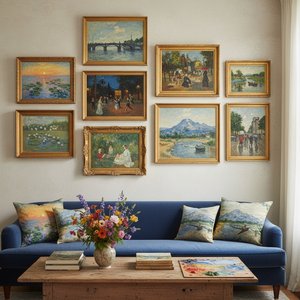
I 10 Capolavori Impressionisti che Hanno Rivoluzionato il Paesaggio Pittorico
Esplora i 10 capolavori impressionisti che hanno rivoluzionato il paesaggio pittorico! Monet, Renoir e altri maestri catturati in stampe su tela di alta qualità. Scopri la storia dell'arte e trova l'opera perfetta per arredare casa tua con AllPaintingsStore.com.

I 10 Capolavori del Paesaggio Romantico: Arte, Storia e Decorazioni di Lusso
Esplora i 10 capolavori del Paesaggio Romantico con AllPaintingsStore.com! Caspar David Friedrich, Turner e altri maestri: storia, tecnica e colori che definiscono un'epoca. Trova riproduzioni d'arte di lusso per la tua casa. Scopri la collezione completa online!

I 25 Capolavori di Hokusai: L'Incanto dell'Onda e del Monte Fuji
Scopri i 25 capolavori di Hokusai e l'anima dell'Ukiyo-e. Esplora la collezione su AllPaintingsStore.com.

Capturing Emotion: A Journey Through the Soul of Expressionist Landscapes
Explore the profound emotional depth of Expressionist landscapes. Discover how Post-Impressionist masters moved beyond light to capture the soul through vibrant color and form. A curated journey for true art lovers seeking the beauty of expressive mastery.

I 10 Capolavori Impressionisti che Hanno Rivoluzionato il Paesaggio Pittorico
Esplora i 10 capolavori impressionisti che hanno rivoluzionato il paesaggio pittorico! Monet, Renoir e altri maestri catturati in stampe su tela di alta qualità. Trova l'arte perfetta per la tua casa su AllPaintingsStore.com.


