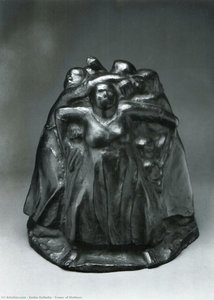
1921. Drawing. Kunsthalle Bremen.

§ 1Catalogue data


§ 2Abstract
Descrizione del reperto
Experience the profound introspection of Käthe Kollwitz's Self-Portrait (1921), capturing deep emotion through masterful drawing; discover this powerful piece today.
 Espandi i dettagli
Biografia dell'artista
Scopri l'arte toccante di Käthe Kollwitz (1867-1945), artista tedesca espressionista celebre per stampe e sculture potenti che ritraggono povertà, guerra e ingiustizia sociale.
§ 3Commentary
The Weight of Contemplation: An Encounter with Käthe Kollwitz's Self-Portrait
To gaze upon this self-portrait by Käthe Kollwitz is not merely to observe a likeness; it is to confront a profound moment of internal reckoning. Rendered in the stark, evocative language of black and white drawing, the piece captures the artist in a posture of deep introspection. The subject’s downward gaze and the placement of the hand upon the face suggest a mind wrestling with weighty thoughts—a universal human experience rendered with unflinching artistic honesty. Kollwitz possessed an unparalleled gift for translating the invisible landscape of the soul onto paper, and here, that mastery is palpable.
Technique and Emotional Resonance
The technical execution speaks volumes about the artist's dedication to capturing nuance. The drawing is remarkably detailed, allowing the viewer to trace the subtle contours of bone structure, the tension around the eyes, and the delicate musculature suggested beneath the hand. This meticulous rendering elevates the portrait beyond a simple study; it becomes an emotional topography. Kollwitz utilized line work not just as description, but as carrier for feeling. The contrast inherent in the medium—the deep blacks against the pale paper—mirrors the chiaroscuro of thought itself: moments of shadow giving way to sudden, piercing clarity.
A Reflection Rooted in Social Conscience
Understanding Kollwitz’s life context enriches our viewing experience. Born into a family steeped in radical social democracy and profound conviction, her art was rarely purely decorative; it was always engaged with the human condition at its most vulnerable. This self-portrait, dating to 1921, emerges from a period where societal upheaval and personal struggle were constant companions. The contemplative mood is thus inseparable from her life's mission: to give voice to the suffering, the marginalized, and the quiet dignity found in moments of profound thought. It is art born not just of observation, but of empathy.
Integrating Art into Modern Living
For the discerning collector or designer seeking a piece that transcends mere ornamentation, this reproduction offers depth. Imagine this drawing gracing a study or a gallery wall—it acts as a silent anchor for contemplation within a modern space. Its timeless quality means it complements both richly furnished historical interiors and minimalist contemporary settings. Owning this work is acquiring a dialogue with one of the 20th century's most empathetic artistic voices, inviting moments of pause and thoughtful reflection into your daily life.
Domande e risposte
Il soggetto di "Self-Portrait" è coerente con i temi abituali di Käthe Kollwitz?
"Self-Portrait" raffigura self-portrait, black and white, thoughtful, human emotion, drawing, figurative art, mentre i temi ricorrenti di Käthe Kollwitz sono social conscience themes depicted, emotional depth human struggle, political commentary social issues, self-reflection artistic introspection. Il confronto tra i due evidenzia come l'opera si relazioni con i soggetti abituali dell'artista.
Con quale tecnica è realizzato "Self-Portrait"?
"Self-Portrait" è realizzata con Drawing.
In quale stanza si consiglia di collocare "Self-Portrait" di Käthe Kollwitz, considerando i suoi colori?
I colori Neutrals di "Self-Portrait" di Käthe Kollwitz si armonizzano con l'ambiente consigliato: un/una Living Room.


 Passa alle stampe


 Per opere d'arte o riproduzioni con un lato superiore a 105 cm (circa 41 pollici), la cornice verrà spedita in forma di kit smontato. Questo metodo garantisce una consegna sicura e previene danni durante il trasporto.